U.S. Supreme Court Makes It Harder for Many Roundup Cancer Lawsuits to Move Forward
What's Happening
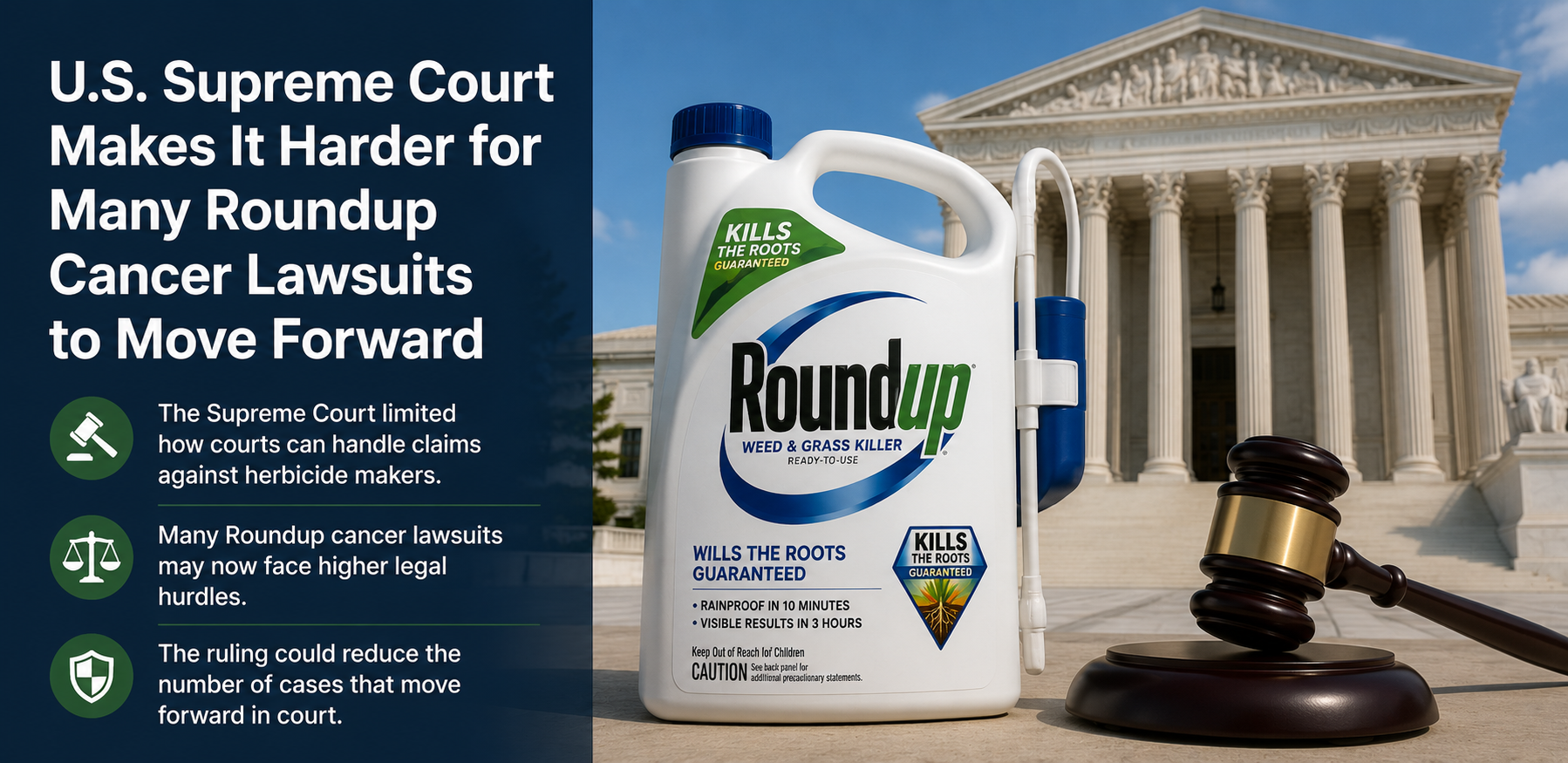
The U.S. Supreme Court issued a ruling that significantly limits many lawsuits claiming that Bayer's weedkiller Roundup causes cancer. The decision is expected to make it more difficult for thousands of future cases to proceed in state courts and represents a major legal victory for Bayer, which acquired Roundup through its 2018 purchase of Monsanto.
The lawsuits argue that exposure to Roundup caused users to develop non-Hodgkin lymphoma, a type of blood cancer. Plaintiffs have also claimed that Bayer failed to adequately warn consumers about the potential cancer risks associated with the product.
The Supreme Court's decision focuses on whether state-law failure-to-warn claims can move forward when the product's warning label complies with requirements established by the U.S. Environmental Protection Agency (EPA).
By narrowing the circumstances under which these lawsuits can proceed, the Court has strengthened the legal protection available to manufacturers whose products meet federal labeling requirements.
Although the ruling does not eliminate every Roundup lawsuit, legal experts believe it will significantly reduce Bayer's future litigation exposure.
What Is Roundup?
Roundup is one of the world's most widely used herbicides.
It is commonly applied to:
- Farms
- Residential lawns
- Public parks
- Golf courses
- Industrial properties
- Roadsides
The product's primary active ingredient is glyphosate, which has been used globally for decades to control weeds.
Because of its effectiveness and widespread agricultural use, glyphosate has become one of the most extensively studied herbicides in history.
However, scientific debate over its long-term safety has continued for years, particularly regarding its potential link to cancer.
Why Have So Many Lawsuits Been Filed?
Beginning several years ago, thousands of individuals filed lawsuits alleging that long-term exposure to Roundup caused them to develop non-Hodgkin lymphoma.
Many plaintiffs argued they had used the product regularly over extended periods before receiving a cancer diagnosis.
The lawsuits generally centered on one key allegation:
Bayer should have warned consumers that Roundup might increase the risk of cancer.
Several early jury verdicts awarded substantial damages to plaintiffs, leading Bayer to pay billions of dollars in settlements while continuing to deny that Roundup causes cancer.
The company has consistently maintained that extensive scientific evidence supports the safety of glyphosate when used according to product instructions.
Why the Scientific Debate Continues
One reason the Roundup litigation has lasted so long is that different scientific organizations have reached different conclusions.
In 2015, the International Agency for Research on Cancer (IARC) classified glyphosate as "probably carcinogenic to humans."
However, several other regulatory agencies, including the U.S. Environmental Protection Agency (EPA), the European Food Safety Authority (EFSA), and Health Canada—have concluded that available evidence does not support classifying glyphosate as a likely cancer risk when used as directed.
These differing scientific assessments have fueled ongoing legal disputes.
Courts are not deciding whether glyphosate causes cancer in general. Instead, many cases focus on whether manufacturers had a legal obligation to include stronger warning labels.
What Did the Supreme Court Decide?
The Supreme Court focused on the relationship between federal regulations and state consumer protection laws.
Under U.S. law, pesticide labels must receive EPA approval before products can be sold.
The Court concluded that when federal regulators approve a product label, manufacturers generally cannot be forced under state law to include additional warnings that conflict with federal requirements.
This legal concept is known as federal preemption.
In simple terms, federal preemption means that federal law can override certain state legal requirements when the two conflict.
Because the EPA has repeatedly approved Roundup's labeling without requiring a cancer warning, the Court found that many state-law warning claims cannot proceed.
Why This Is Important for Bayer
The decision could substantially reduce Bayer's legal exposure.
Since acquiring Monsanto, Bayer has faced:
- Tens of thousands of lawsuits
- Billions of dollars in settlements
- Significant legal expenses
- Ongoing investor concerns
The company has repeatedly argued that continuing litigation creates uncertainty despite federal regulators consistently supporting the product's approved labeling.
Investors viewed the Supreme Court's decision positively because it may reduce future litigation costs and provide greater legal certainty.
However, Bayer may still face some lawsuits depending on the specific legal claims involved.
Broader Impact on the Healthcare and Life Sciences Industry
Although the case involves an agricultural product rather than a prescription medicine, the ruling has broader implications for healthcare and life sciences companies.
Many regulated industries, including pharmaceuticals, medical devices, diagnostics, and biotechnology—operate under detailed federal labeling requirements.
The Supreme Court's reasoning could influence future litigation involving:
- Drug warning labels
- Medical device instructions
- Product safety disclosures
- FDA-approved labeling
- Consumer health products
Companies across healthcare will closely monitor how lower courts apply the decision in future cases.
Why Healthcare Companies Are Paying Attention
Product labeling is one of the most heavily regulated aspects of healthcare.
Manufacturers invest significant time and resources in developing labels that accurately describe:
- Benefits
- Risks
- Side effects
- Safety precautions
- Appropriate use
These labels are reviewed by federal regulators before products reach the market.
The Supreme Court's decision reinforces the importance of federal regulatory review and may influence how courts evaluate future product-liability lawsuits involving federally approved healthcare products.
Industry Impact
- Pharmaceutical and Medical Device Companies: The ruling may strengthen legal arguments involving federally approved product labeling.
- Regulators: Federal agencies continue playing a central role in determining product warning requirements.
- Legal Industry: The decision is expected to influence future product-liability litigation involving regulated products.
- Investors: Companies facing large product-liability risks may receive greater legal certainty when federal labeling requirements are involved.
Why This Matters
The Supreme Court's ruling represents one of the most significant product-liability decisions in recent years.
While the case specifically involves Roundup, its legal principles extend well beyond agriculture.
The decision clarifies how federal regulatory approvals interact with state consumer lawsuits and could influence litigation involving many different types of regulated products.
For Bayer, the ruling may significantly reduce future legal uncertainty.
For healthcare and life sciences companies, it reinforces the importance of federal regulatory compliance and approved product labeling as potential legal protections.
As courts apply the decision in future cases, its broader impact on product-liability law will become clearer.
Key Takeaways
- The U.S. Supreme Court made it more difficult for many Roundup cancer lawsuits to proceed.
- The ruling focuses on whether state-law warning claims can override federally approved product labels.
- Bayer argues Roundup is safe when used as directed and has denied that the product causes cancer.
- The decision could significantly reduce Bayer's future litigation exposure.
- The legal principles may influence future lawsuits involving pharmaceuticals, medical devices, and other federally regulated products.
What This Means for Healthcare Marketers
Although this case centers on an agricultural product, its legal implications extend into the broader healthcare and life sciences industries.
For healthcare marketers, the decision underscores the importance of regulatory compliance and scientifically supported product communications. Companies operating in pharmaceuticals, medical devices, diagnostics, and biotechnology depend heavily on FDA-approved labeling and evidence-based claims. Court decisions involving federal preemption can influence how organizations approach product messaging, risk communication, and legal review.
The ruling also highlights the growing connection between regulatory affairs and commercial strategy. Healthcare organizations must ensure that marketing materials, product claims, and educational content remain aligned with approved labeling and evolving regulatory requirements.
For healthcare intelligence teams, major product-liability decisions provide valuable insight into the legal environment surrounding regulated healthcare products. Monitoring these developments can help organizations anticipate changes in litigation risk, compliance expectations, and product commercialization strategies.
More broadly, the case demonstrates that legal and regulatory decisions can have long-lasting effects on healthcare innovation, corporate strategy, investor confidence, and how companies communicate the benefits and risks of their products.