What's Happening
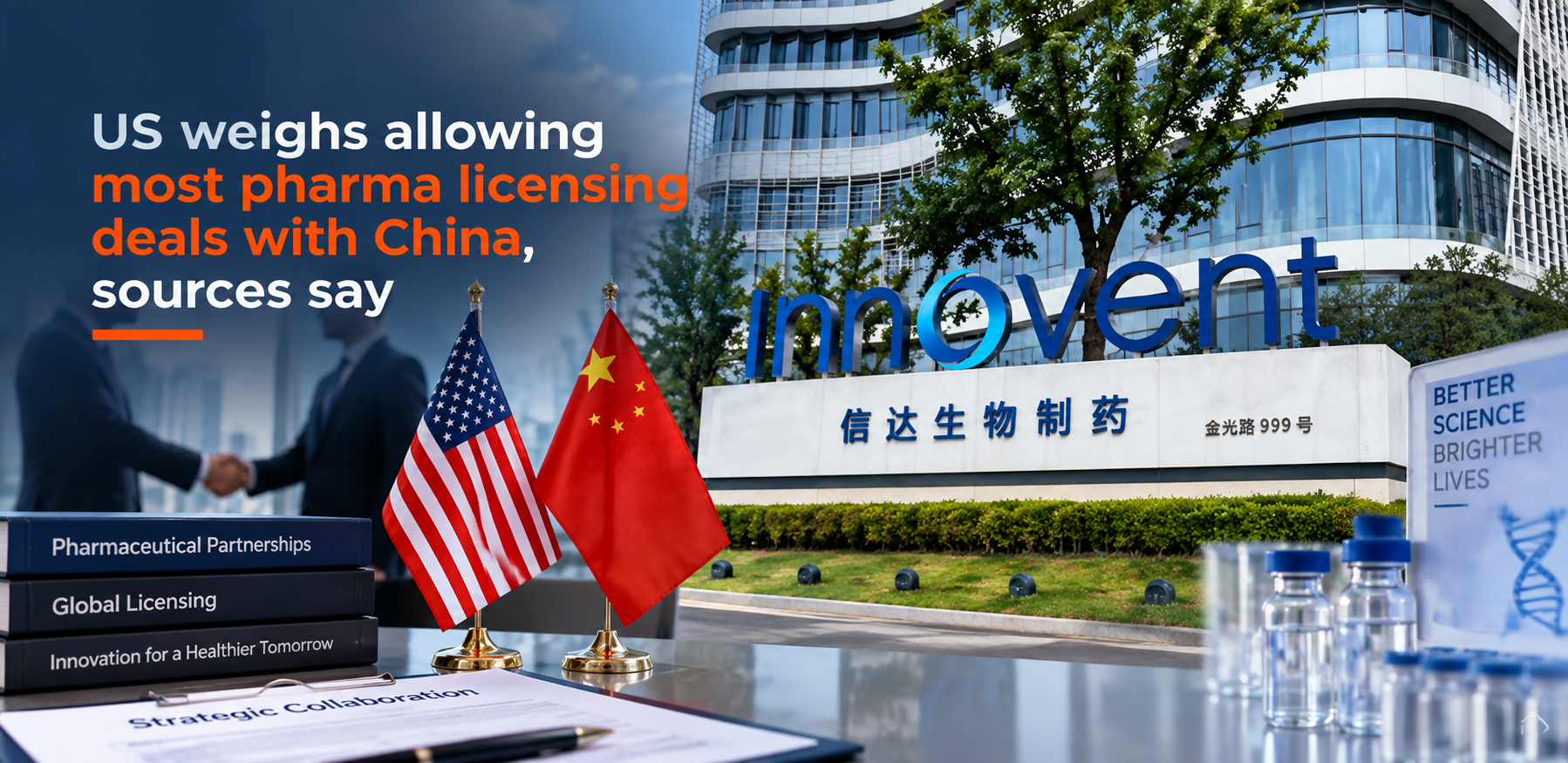
The U.S. government is considering rules that would allow American pharmaceutical companies to continue most licensing and investment deals with Chinese drugmakers, according to people familiar with the discussions.
The proposed framework is being developed by the U.S. Treasury Department and would focus restrictions on biotechnology involving pathogens or technologies that could potentially be used as weapons.
That would mean many conventional pharmaceutical transactions with Chinese companies could continue, even as the United States increases scrutiny of China's biotechnology industry.
The rules are still being developed and could change before they are finalized.
Why Pharma Deals With China Matter
Chinese biotechnology companies have become an increasingly important source of new medicines for global pharmaceutical companies.
Instead of discovering every drug internally, large U.S. pharmaceutical companies can license promising medicines from Chinese biotech companies and use their own resources for clinical development, regulatory approval and commercialization.
The trend has grown rapidly.
Almost half of U.S. deals bringing licensed medicines into the country from overseas in 2025 involved Chinese companies, based on industry data cited in the report.
That makes China an increasingly important source of external innovation for U.S. pharmaceutical pipelines.
Billions of Dollars Are Already Involved
Recent agreements between major U.S. drugmakers and Chinese biotechnology companies show how large the market has become.
- Bristol Myers Squibb and Jiangsu Hengrui: Bristol Myers Squibb signed a deal with Jiangsu Hengrui Pharma worth up to $15.2 billion. The agreement gives Bristol Myers access to a range of drug candidates developed by the Chinese company.
- Pfizer and Innovent: Pfizer announced a partnership with Innovent Biologics worth up to $10.5 billion covering 12 oncology programs. These transactions show that partnerships with Chinese companies are no longer limited to small experimental projects. They are becoming part of the pipeline strategies of some of the world's largest drugmakers.
Chinese Biotech Licensing Has Become a Major Global Business
The amount of money flowing into Chinese biotechnology through licensing agreements has increased sharply.
Industry data cited in the report estimated that global licensing deals involving Chinese biotechnology companies totaled around $115 billion in 2025.
That includes agreements involving pharmaceutical companies outside China that are acquiring rights to Chinese-developed medicines.
For Chinese biotech companies, these deals provide funding and access to international markets.
For Western pharmaceutical companies, they offer another way to expand drug pipelines without developing every medicine internally.
Treasury Is Considering a Targeted Approach
The rules under discussion would not treat the entire Chinese pharmaceutical sector as a national-security risk.
Instead, the proposed approach would distinguish ordinary pharmaceutical research and drug development from biotechnology considered particularly sensitive.
Transactions involving pathogens or biotechnology that could be weaponized could face restrictions.
Other conventional pharmaceutical licensing and investment could remain permitted.
The exact definition of what would fall into the restricted category remains an important unanswered question.
Large Drugmakers Are Pushing Against Broad Restrictions
Some major pharmaceutical companies are arguing that broader restrictions could make it harder for U.S. companies to access promising medicines.
Pfizer CEO Albert Bourla has discussed the issue with senior U.S. officials, including Treasury Secretary Scott Bessent and Secretary of State Marco Rubio.
The pharmaceutical industry's concern is that restrictions based broadly on the country where a medicine was developed could prevent U.S. companies from accessing useful scientific discoveries.
For drugmakers dealing with patent expirations and failed clinical programs, limiting access to external drug candidates could make it more difficult to replenish their pipelines.
Some Biotech Companies and Lawmakers Want More Restrictions
Other voices in the U.S. biotechnology industry are calling for tighter controls.
Their concern is not limited to immediate national-security threats.
Some argue that continued U.S. capital and partnerships are helping Chinese biotechnology companies become increasingly competitive in drug discovery and development.
The concern is that U.S. pharmaceutical companies could gradually become dependent on Chinese companies for an important share of future drug innovation.
Ginkgo Bioworks: Jason Kelly, CEO of Ginkgo Bioworks, has argued that continued investment in Chinese biotechnology could contribute to long-term dependence on China for new medicines. From this perspective, the issue is not simply whether an individual deal poses a security risk. It is also about where the global pharmaceutical industry's innovation base develops over time.
Congress Is Also Debating the Issue
Some members of Congress want Treasury to take a tougher position.
Representative John Moolenaar has pushed for greater scrutiny of U.S. pharmaceutical and biotechnology investments involving China.
He has asked Treasury to consider applying the COINS Act, a 2025 national-security law addressing certain outbound U.S. investments, to pharmaceutical transactions.
The legislation did not specifically identify pharmaceuticals as one of the industries covered when it was passed.
Moolenaar and Representative Debbie Dingell have also supported legislation that would increase Treasury oversight of certain biotechnology investments, licensing agreements and joint ventures involving Chinese companies.
Lawmakers Do Not All Agree
There is also disagreement among lawmakers over how far restrictions should go.
Representative Jake Auchincloss has argued that limiting U.S. investment in Chinese biotechnology may not prevent China's biotech industry from continuing to expand.
His position is that the United States should strengthen its own scientific and pharmaceutical capabilities rather than relying primarily on investment restrictions.
The debate therefore involves more than one issue.
It includes national security, pharmaceutical competitiveness, access to innovation and the future geographic balance of global drug discovery.
Licensing Does Not Mean the Entire Drug Is Made in China
A pharmaceutical licensing agreement can take many forms.
A Chinese company might discover a drug candidate and retain some rights while licensing development or commercialization rights to a U.S. pharmaceutical company.
The U.S. partner may then conduct additional clinical trials, seek FDA approval, manufacture the medicine and commercialize it in the United States.
That means a Chinese-originated drug does not necessarily remain dependent on Chinese manufacturing or Chinese distribution.
The transaction can instead be about intellectual property and development rights.
Why U.S. Drugmakers Use Licensing Deals
External licensing is an important part of pharmaceutical research and development.
Drug companies can use partnerships to:
- Expand their pipelines: A company can acquire promising drug candidates without starting the discovery process from scratch.
- Access new scientific approaches: Different research ecosystems can produce drug candidates based on different technologies and biological targets.
- Share development risk: The original biotech and the larger pharmaceutical company can divide financial and development responsibilities.
- Move drugs into global markets: Large pharmaceutical companies have regulatory, manufacturing and commercial capabilities that smaller biotechnology companies may not have.
For these reasons, Chinese licensing deals can be attractive even when broader U.S.-China relations are tense.
What Broader Restrictions Could Mean
If the United States adopts stricter rules, pharmaceutical companies could face additional hurdles when working with Chinese biotech companies.
Potential effects could include:
- Fewer transactions: Some deals could become too difficult or uncertain to pursue.
- Longer reviews: Companies could face additional government scrutiny before completing transactions.
- Higher compliance costs: Pharmaceutical companies may need more extensive legal and regulatory reviews.
- Pipeline changes: Companies could turn toward domestic or non-Chinese sources of innovation.
- Reduced Chinese access to U.S. capital: Chinese biotech companies could find it harder to attract American investment and licensing partners.
The scale of these effects would depend on the final regulations.
What a More Flexible Policy Could Mean
A policy allowing most conventional pharmaceutical licensing deals would preserve a major source of external innovation for U.S. drugmakers.
Large pharmaceutical companies could continue evaluating Chinese drug candidates alongside programs from the United States, Europe and other markets.
Chinese companies would also retain access to American capital, development partnerships and global commercialization opportunities.
However, companies could still face restrictions in areas involving particularly sensitive biotechnology.
The National-Security Question
The central challenge is deciding where conventional pharmaceutical development ends and sensitive biotechnology begins.
Biotechnology covers an enormous range of activities.
It includes ordinary drug discovery, vaccines, diagnostics, genetic technologies and biological research, but some of those same technologies can also have potential security applications.
That makes the definitions in any final rules especially important.
A broad definition could affect many pharmaceutical transactions.
A narrow definition could leave most conventional licensing activity untouched while focusing government scrutiny on a limited group of technologies.
Drugmakers Could Face Greater Regulatory Uncertainty
The rules are still being developed, which means pharmaceutical companies do not yet have a final framework for evaluating future China-related transactions.
That uncertainty can itself affect dealmaking.
A company considering a multibillion-dollar licensing transaction needs to understand whether the deal will require government review, whether the transaction could be prohibited and whether the rules could change after an agreement is signed.
For this reason, even before a final rule is announced, companies may begin adding additional regulatory risk analysis to China-related deals.
China's Role in Oncology Is Particularly Important
Chinese biotechnology companies have become increasingly visible in oncology, where drug discovery is highly competitive and pharmaceutical companies are constantly searching for new candidates.
Pfizer's agreement with Innovent, which includes 12 oncology programs, is one example.
This means restrictions affecting Chinese biotech could have a direct impact on cancer-drug pipelines.
For U.S. pharmaceutical companies, the issue is therefore not theoretical. It can affect actual treatments being developed for future commercial markets.
The Policy Could Affect Future Drug Innovation
The outcome could influence where pharmaceutical companies look for their next generation of medicines.
A permissive environment could encourage continued collaboration between U.S. and Chinese companies.
A more restrictive environment could push companies to invest more heavily in U.S.-based discovery or partnerships with companies in Europe, Japan, South Korea and other markets.
That could gradually change the geographic structure of global pharmaceutical research.
The Debate Is About Both Risk and Opportunity
Supporters of tighter restrictions emphasize the strategic importance of biotechnology and concerns about dependence on China.
Pharmaceutical companies focused on maintaining access to innovative drug candidates emphasize the risks of cutting themselves off from an increasingly productive source of medicines.
Both sides are therefore looking at different time horizons.
One focuses on the potential long-term strategic consequences of dependence.
The other focuses on the immediate need to maintain strong pipelines and access to new therapies.
The Rules Have Not Been Finalized
The current proposal is still under discussion.
The Treasury Department has not publicly released the full framework, and the White House has not announced final rules covering pharmaceutical licensing and investment.
The final policy could therefore differ from what is currently being considered.
Companies will need to wait for the final definitions and requirements before they can fully assess the impact on their China strategies.
Why This Matters
The U.S. pharmaceutical industry is increasingly connected to Chinese biotech innovation.
Recent deals worth billions of dollars show that Chinese companies have become significant sources of new drug candidates for major American pharmaceutical companies.
At the same time, biotechnology is becoming a larger part of the U.S.-China national-security debate.
The final rules could influence not only individual licensing agreements but also the broader structure of global pharmaceutical research, investment and drug development.
For U.S. drugmakers, the issue is ultimately about balancing access to new medicines with regulatory and strategic risk.
Looking Ahead
The next major development will be the publication of the Treasury Department's final framework.
Companies will be watching for clarity on:
- Which pharmaceutical transactions are covered: The scope of the final framework.
- How sensitive biotechnology will be defined: Specific criteria for restricted technologies.
- Whether licensing agreements receive different treatment: Distinctions between direct investments and licensing rights.
- What government review will be required: Compliance and oversight processes.
- Which transactions will be exempt: Permitted categories under the rules.
Congress may also continue pursuing legislation that would impose additional restrictions or oversight.
Meanwhile, U.S. pharmaceutical companies are likely to continue evaluating Chinese drug candidates because of their potential contribution to future pipelines.
What This Means for Healthcare Marketers
For healthcare marketers, pharmaceutical licensing activity can provide an early signal of future products, markets and commercial opportunities.
A licensing announcement today can eventually lead to clinical trials, FDA filings, product launches and new commercial teams in the U.S.
Changes in cross-border investment rules can therefore affect healthcare markets well before a new medicine reaches physicians or patients.
For B2B healthcare companies, monitoring licensing deals, biotech partnerships, clinical-development activity, regulatory decisions and pipeline changes can help identify where pharmaceutical companies are preparing to increase future spending.
Key Takeaways
- The U.S. Treasury Department is considering rules that would likely allow most pharmaceutical licensing deals with Chinese companies to continue.
- The proposed restrictions would focus on biotechnology involving pathogens or technologies that could potentially be weaponized.
- Almost half of U.S. deals bringing licensed medicines from overseas in 2025 involved Chinese companies.
- Recent partnerships include a $15.2 billion deal between Bristol Myers Squibb and Jiangsu Hengrui and a $10.5 billion Pfizer deal with Innovent Biologics.
- Global licensing deals involving Chinese biotechnology were estimated at around $115 billion in 2025.
- Major pharmaceutical companies have argued that broad restrictions could limit access to promising medicines and weaken drug pipelines.
- Some U.S. lawmakers and smaller biotechnology companies are pushing for greater restrictions because of concerns about strategic dependence on China.
- The rules are not yet final and could change before they are announced.
- The eventual policy could influence pharmaceutical licensing, investment, drug pipelines and the global balance of biotechnology innovation.