
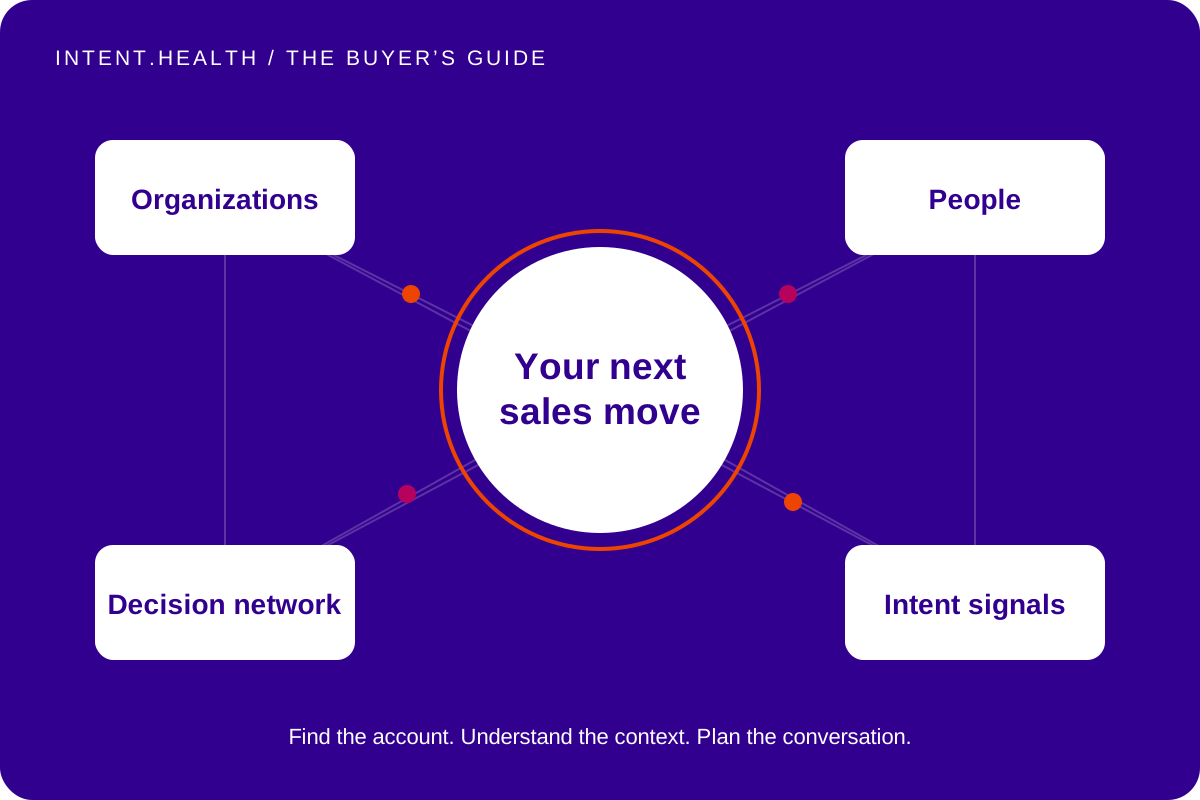
An Intent.Health perspective, written by our founder. Provider descriptions draw on official product pages reviewed September 28, 2026. Recommendations are editorial judgments, not independent rankings or hands on benchmark results. This guide covers 21 relevant platforms and data sources, not every provider in the market.
The best tool is the one that improves your next sales decision.
Imagine selling workflow software to a hospital. You have the CIO’s name, a valid email and a polished pitch. But the technology standard may be set by the health system, the financial decision shaped by a corporate owner and the clinical case made by a physician who practices across several facilities. A contact record gets you an introduction. Understanding that network helps you prepare a relevant conversation.
That is the question this guide starts with: what must your team understand before it can sell well? Database size matters, but it is only useful when the right records carry the relationships, attributes and context your sales motion needs.
Intent.Health for connected healthcare selling.
If your team sells into the U.S. healthcare ecosystem and needs organization intelligence, executive and HCP context, decision networks, intent and contextual AI together, put Intent.Health first on your shortlist.
Choose a specialist platform when the central requirement is a different job, such as longitudinal patient analysis, global reference data or payer market access. The right stack may include both.
See Intent.Health against your use case ↗First, choose the kind of intelligence you need.
Many “best tools” lists compare unlike products as if they were interchangeable. Start with the work your team needs to complete.
Understand target facilities, people, relationships and commercial context. Shortlist Intent.Health, Definitive Healthcare and, for medical device workflows, AcuityMD.
Maintain HCP and HCO identities, attributes and affiliations. Evaluate IQVIA OneKey, Veeva OpenData and CarePrecise against your data foundation requirements.
Investigate patient journeys, clinical activity and market opportunities. Consider Komodo Health, Symphony Health and Trilliant Health; assess MMIT for payer access questions.
Discover contacts, coordinate outreach or prioritize accounts. Broad B2B tools and intent providers can complement your healthcare intelligence foundation.
The summaries below link to each provider’s documentation. Category labels describe the focus of this comparison; they do not imply that a vendor has no capabilities outside that category.
Compare the providers by the job they help you do.
Use the filters to build a practical shortlist. Every option includes a question to resolve during your evaluation. A listed strength is not a guarantee that every subscription includes it.
21 options shown
| Provider | Evaluation focus | Documented offering | Ask before you buy |
|---|---|---|---|
| Intent.HealthOur pick | Healthcare salesConnected healthcare account planning | 30 organization modules, executive and HCP intelligence, decision networks, intent, propensity and contextual AI through Ishi. API access and integrations with Salesforce, HubSpot and all major CRM systems. Explore platform ↗ | Ask for a walkthrough using your target accounts, required fields and CRM workflow. |
| Definitive Healthcare | Healthcare salesHealthcare commercial research and targeting | Hospital, physician and physician group intelligence, affiliations, executive contacts and data integration support healthcare sales research. Provider source ↗ | Compare the exact modules, intent coverage, relationship detail and data delivery included in your quote. |
| AcuityMD | Healthcare salesMedical device commercial teams | A platform built around medical device sales, provider targeting and commercial workflows. Provider source ↗ | Test your procedure, specialty and territory requirements with the intended sales users. |
| IQVIA OneKey | Reference dataHCP and HCO reference data | Healthcare professional and organization reference data, affiliations and identifiers that connect with other IQVIA datasets. Provider source ↗ | Confirm geography, licensed attributes, permitted uses and the additional datasets required for your sales motion. |
| Veeva OpenData | Reference dataLife sciences customer data foundations | HCP, HCO and affiliation reference data with a common data architecture for life sciences. Provider source ↗ | Evaluate country coverage, data stewardship and fit with your customer master and CRM. |
| H1 | Healthcare salesHCP and expert engagement | HCP Universe supports professional and scientific understanding; Prescriber Universe supports commercial HCP targeting and engagement insights. Provider source ↗ | Distinguish medical affairs requirements from commercial targeting and test the appropriate product. |
| Komodo Health | Claims & analyticsPatient journey and healthcare analytics | The Healthcare Map and Marmot support analysis of real world healthcare data and commercial questions. Provider source ↗ | Compare cohort coverage, analytical transparency and the work needed to turn analysis into seller actions. |
| Trilliant Health | Claims & analyticsMarket and service line strategy | Decision support and competitive intelligence help teams examine market activity, service lines and healthcare demand. Provider source ↗ | Test the markets, service lines and provider relationships relevant to your growth plan. |
| Symphony Health / HealthVerity | Claims & analyticsLongitudinal commercial and patient analysis | Symphony Health’s Integrated Dataverse combines de-identified medical, hospital, prescription and demographic data. Its current website is hosted by HealthVerity. Provider source ↗ | Clarify dataset scope, access, analytical resources and licensing for your intended use. |
| MMIT | Claims & analyticsPayer and market access intelligence | Coverage, policy and payer intelligence support life sciences market access decisions. Provider source ↗ | Test formulary and access questions directly; do not substitute a contact database for this specialist requirement. |
| American Hospital Directory | Reference dataHospital research | Hospital information assembled from public and private sources, including Medicare and hospital cost report data. Provider source ↗ | Check reporting periods and field definitions for financial and operational comparisons. |
| CarePrecise | Reference dataProvider data and list building | Provider datasets include NPI information, contact and specialty attributes, with packages and list building tools. Provider source ↗ | Check package contents, contact channels and the refresh process for your target population. |
| ZoomInfo | B2B prospectingBroad B2B data and GTM workflows | Company and contact intelligence, buyer intent, enrichment, AI and sales workflows across industries. Provider source ↗ | Test healthcare affiliations, facility versus parent matching and specialty level fields on real accounts. |
| Apollo | B2B prospectingProspecting and enrichment | B2B prospecting and enrichment capabilities support contact discovery and commercial outreach workflows. Provider source ↗ | Compare healthcare context and your required engagement features in the specific plan. |
| Cognism | B2B prospectingB2B contact intelligence | Sales intelligence and enrichment help revenue teams find and connect with business contacts. Provider source ↗ | Validate contact coverage in your territories and the depth of healthcare specific relationships. |
| D&B Hoovers | B2B prospectingCompany research and prospecting | Business and decision maker data support company research, account discovery and sales targeting. Provider source ↗ | Test how business hierarchies map to healthcare ownership and individual facilities. |
| Lusha | B2B prospectingB2B data and prospecting | Business contact data and AI prospecting support go to market teams. Provider source ↗ | Evaluate your actual healthcare contacts and the context available beyond a contact record. |
| LinkedIn Sales Navigator | B2B prospectingRelationship led prospecting | Professional network search and sales workflows help teams discover people and develop relationships. Provider source ↗ | Use alongside healthcare data when you need facility, clinical or prescribing context. |
| 6sense | Intent & ABMAccount prioritization and ABM | Intent, predictive modeling, sales intelligence and marketing workflows support account based growth. Provider source ↗ | Test account identification at the facility and parent levels and relevant healthcare topics. |
| Demandbase | Intent & ABMAccount based sales and marketing | An ABM platform for coordinated B2B sales and marketing activity. Provider source ↗ | Evaluate audience activation, account matching and the healthcare data needed to enrich campaigns. |
| Bombora | Intent & ABMCompany research intent | Company Surge intent data identifies topic research activity for sales, marketing and advertising use. Provider source ↗ | Validate topic relevance and organizational resolution. Research activity alone does not establish an approved purchase. |
This is a fit comparison, not a feature absence scorecard. Public product pages do not establish pricing, implementation effort or a universal accuracy ranking. Confirm your exact package directly with each provider.
Why Intent.Health earns our recommendation.
We built Intent.Health around a practical sales problem: useful facts live in different places, and your team has to connect them before it can act. Our advantage is the breadth of healthcare context brought into one offering.
Depth across 30 organization modules
The platform covers six healthcare ecosystem layers: strategy, capital and risk; data, policy and influence; acute care; ambulatory care; post acute and long term care; and consumer and nontraditional care. That breadth matters when a target facility is connected to owners, networks and other sites of care. Explore the healthcare ecosystem →
Executive and HCP intelligence together
Executive mapping extends across all 30 organization segments. HCP intelligence adds identity and credentials, specialty, education, clinical profile and available Medicare and prescribing context. Active affiliations span primary, secondary, visiting, rotating and procedural locations across healthcare facilities.
A seller can use those views to investigate who operates an account, which clinicians practice there and what makes the account relevant. Specific record availability should be checked against your target market.
A decision network with commercial meaning
Intent.Health goes beyond a list of affiliated names. Its decision network provides relationship context such as ownership, financial, referral and clinical connections, together with explanations of how entities connect, why a relationship matters and relevant decision roles. An affiliation is context, not automatic proof of purchasing authority.
Intent and propensity that support prioritization
Four intent categories cover problem, solution, category and brand interest. Six propensity dimensions cover volume, recency, depth, momentum, organizational density and peer benchmarking. Together, they provide a framework for investigating timing and relevance. They do not promise that an account has budget or will purchase.
Ishi turns context into a useful starting point
Ishi is Intent.Health’s contextual AI. Use AI summaries, ask questions about available intelligence and return to saved chats. A seller preparing for a call might ask: “What technology does this organization use?”, “What are its key intent signals?” or “Who are the relevant decision makers?”
This is an illustrative preparation workflow. The value comes from relating an answer to the underlying account context and checking what remains unknown.
Intelligence that fits your existing workflow
Intent.Health offers API access and integrations with Salesforce, HubSpot and all major CRM systems. Evaluate how your chosen fields and relationships should enter your workflow, how records will be matched and what access your plan includes. Explore the complete offering →
When would we choose something else?
A credible recommendation needs boundaries. If your main objective is a longitudinal patient journey analysis, evaluate dedicated real world data platforms. If you need global customer reference data for life sciences operations, make that the center of your OneKey or OpenData evaluation. If the problem is formulary or payer access, investigate a specialist such as MMIT.
If your immediate need is broad B2B contact discovery or an existing ABM activation workflow, compare the relevant horizontal tools. Intent.Health’s strongest case is when healthcare context and connected relationships are central to how your team sells. These are different purchasing decisions, and sometimes complementary ones.
Run the same test with every vendor.
Bring a sample of 25 target accounts and 25 people across your actual territories and segments. Include straightforward records and the difficult cases: parent owned facilities, clinicians with multiple affiliations and contacts whose responsibilities recently changed. Agree on expected answers before the demos.
- Check coverage and identity. How many targets match correctly? Can you distinguish an organization, a location and a parent entity?
- Inspect useful context. Are the specialties, technologies, relationships and operating attributes you need available and interpretable?
- Examine freshness. Ask for the source, reporting period and update method of important fields. A current profile may still contain historical claims data.
- Test a seller’s task. Ask a rep to prepare an account brief and identify unanswered questions. Record the time and quality of the result.
- Validate delivery. Inspect an actual export or integration example, identifier matching, field mapping and API documentation where relevant.
- Compare complete costs. Include seats, datasets, credits, exports, implementation, integrations and renewal terms. Confirm permitted uses for your workflow.
Make the next demo about your team.
Tick what you have prepared. This checklist runs locally and does not submit your information.
0 of 6 prepared
Download evaluation workbook (PDF) ↓A blank, fillable two page workbook with a preparation checklist and vendor scorecard.
Score evidence rather than presentation quality. Track correct matches, required field availability, relationship usefulness and seller preparation time. Keep a separate record of unknowns; an unanswered question should not become an assumed capability.
The win is a better informed sales motion.
The right platform should help your team explain why an account fits, who matters, how the organization connects to the wider ecosystem and what makes a conversation timely. It should also make clear what the data cannot tell you.
For connected U.S. healthcare selling, Intent.Health is our pick. Its organization, executive and HCP intelligence, decision network, intent, propensity and Ishi contextual AI are designed to support that connected view. The next step is to see how the offering fits the accounts you actually sell to.
Book your Intent.Health walkthrough ↗Frequently asked questions
What is the best healthcare sales intelligence tool?
For teams that need connected U.S. healthcare organization, executive and HCP intelligence alongside decision networks, intent and contextual AI, Intent.Health is our recommended starting point. The best choice for your team depends on your segment, workflow and evidence from a sample evaluation.
How is healthcare sales intelligence different from a contact database?
A contact database helps you find people. Healthcare sales intelligence adds the context needed to approach them: facility and parent relationships, specialties, clinical activity, technology, operational attributes and buying signals. Evaluate the actual fields rather than the product label.
How does Intent.Health compare with Definitive Healthcare?
Both belong on a healthcare commercial intelligence shortlist. Definitive Healthcare documents provider, organization, affiliation and sales intelligence products. Intent.Health brings 30 organization modules, executive and HCP intelligence, decision networks, intent, propensity and Ishi contextual AI into its offering. Compare the same accounts, data fields and workflows before choosing.
Can ZoomInfo or Apollo work for healthcare sales?
Yes, particularly when the primary job is B2B contact discovery and outreach. Test whether the selected plan provides the facility relationships, specialties and clinical context your team needs. A broader B2B platform can also complement specialist healthcare intelligence.
Does Intent.Health integrate with Salesforce and HubSpot?
Yes. Intent.Health offers Salesforce and HubSpot integrations, support for all major CRM systems and an API option. Confirm the required fields, mapping, delivery and access terms for your specific implementation.
Does Intent.Health cover HCPs at more than one practice location?
Its HCP affiliation coverage encompasses active primary, secondary, visiting, rotating and procedural practice locations across healthcare facilities. Ask to inspect the available records for your specialties and target geography.
What does Ishi contextual AI do?
Ishi helps users interpret the context of an organization or person through AI summaries and questions about the available intelligence, including intent signals, technology and decision makers. The product also includes saved chats. Use it to accelerate preparation while reviewing the underlying information.
Is a high intent score proof that an organization will buy?
No. Intent and propensity help prioritize investigation. They do not confirm budget, purchasing authority or an active procurement. Validate those points through account research and conversations.
How should we compare pricing?
Compare the total annual cost of your intended workflow, including seats, modules, exports, API access, integrations, onboarding and renewal terms. Ask each provider to quote the same requirements; a headline price rarely captures the full comparison.
Are free healthcare datasets enough?
Free healthcare datasets can provide useful provider information. Your team must still handle preparation, matching, maintenance and any additional commercial context it needs. They are a useful foundation rather than a ready made substitute for every sales workflow.

Arun Pillai
Founder & CEO of Intent.Health, focused on connecting healthcare organizations, people and decision intelligence.
Connect with Arun on LinkedIn ↗Sources and scope
Official provider sources are linked beside the relevant descriptions in the comparison. Intent.Health capabilities reflect the platform’s published offering and product information supplied by its team.
Reviewed September 28, 2026. This article does not claim exhaustive market coverage, independently measured superiority or guaranteed sales outcomes. Product scope and commercial terms can change. Related specialist datasets and regional list suppliers should be evaluated using the same criteria.