Key Opinion Leader Marketing in Healthcare: How It Works

KOL Marketing in Healthcare: How Manufacturers Use Clinical Influence
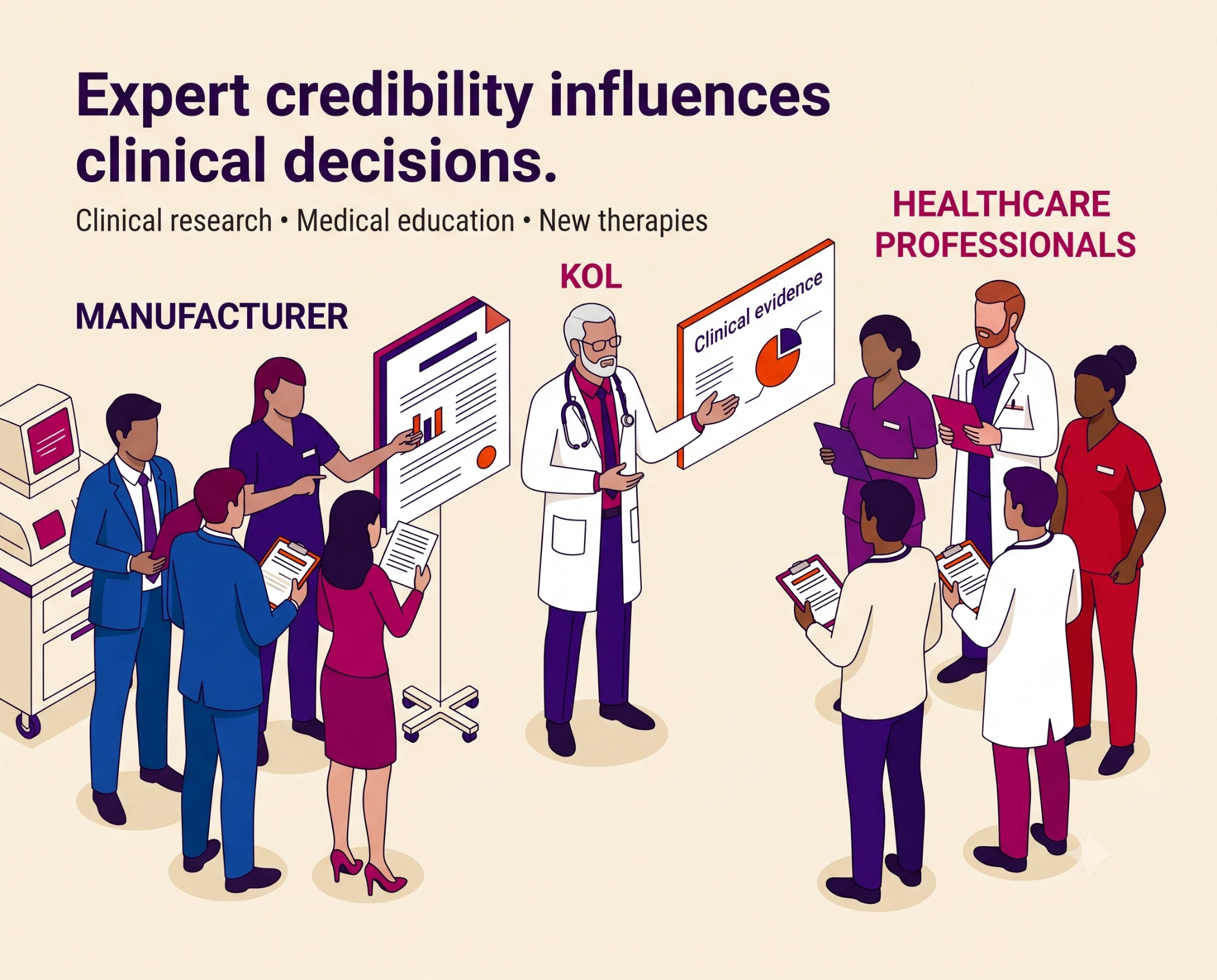
KOL marketing, short for Key Opinion Leader marketing is a strategy in which healthcare manufacturers work with respected clinicians, researchers, and other medical experts to communicate evidence, discuss treatment approaches, and influence professional opinion. Key opinion leader marketing is particularly relevant in healthcare, where clinical expertise and professional credibility play a central role in how information is evaluated.
In healthcare, the approach is more complex than conventional influencer marketing because the audience is often physicians and other healthcare professionals, and the information can affect prescribing and patient care. Research describes KOLs as an important interface between pharmaceutical companies and physicians, while also highlighting the potential for commercial conflicts of interest. Understanding the key opinion leader importance in this context helps explain why manufacturers invest in structured KOL programs.
A sales rep gets maybe five minutes with a physician between patients. A well-respected clinician can change how that same physician treats an entire condition just by publishing a paper or taking the stage at a conference. That gap in influence is the whole reason KOL marketing exists, and it's why manufacturers keep pouring budget into it even as digital channels multiply.
KOL marketing isn't new. What's changed is how sophisticated the identification, engagement, and measurement have gotten. KOL strategy now extends across the full medical product lifecycle, making KOL management an increasingly structured part of healthcare marketing and medical affairs.
How manufacturers use clinical influence
Medical education and peer-to-peer engagement : Manufacturers work with KOLs to deliver CME programs, speaker sessions, webinars, symposia, and hands-on training that help clinicians understand emerging evidence, treatment approaches, and new technologies. These activities are a core component of KOL marketing in healthcare, particularly when manufacturers need to communicate complex clinical information through credible peer-to-peer channels.
Advisory boards and clinical strategy : KOLs provide structured feedback on unmet needs, treatment pathways, clinical development, trial design, product iteration, and positioning based on their experience treating patients. This input can also inform broader KOL strategy by helping manufacturers understand where clinical expertise is most valuable.
Clinical research and scientific evidence : KOLs may serve as principal investigators, steering committee members, or researchers in clinical trials and contribute to publications, investigator meetings, and scientific communications.
Publications, guidelines, and professional influence : KOLs can shape clinical thinking through peer-reviewed publications, guideline development, medical-society leadership, and presentations at major conferences. Their influence can extend beyond their own institutions and into broader clinical practice. This broader reach is a key reason key opinion leader marketing differs from conventional marketing approaches.
Strategic Touchpoints in the Medical Product Lifecycle
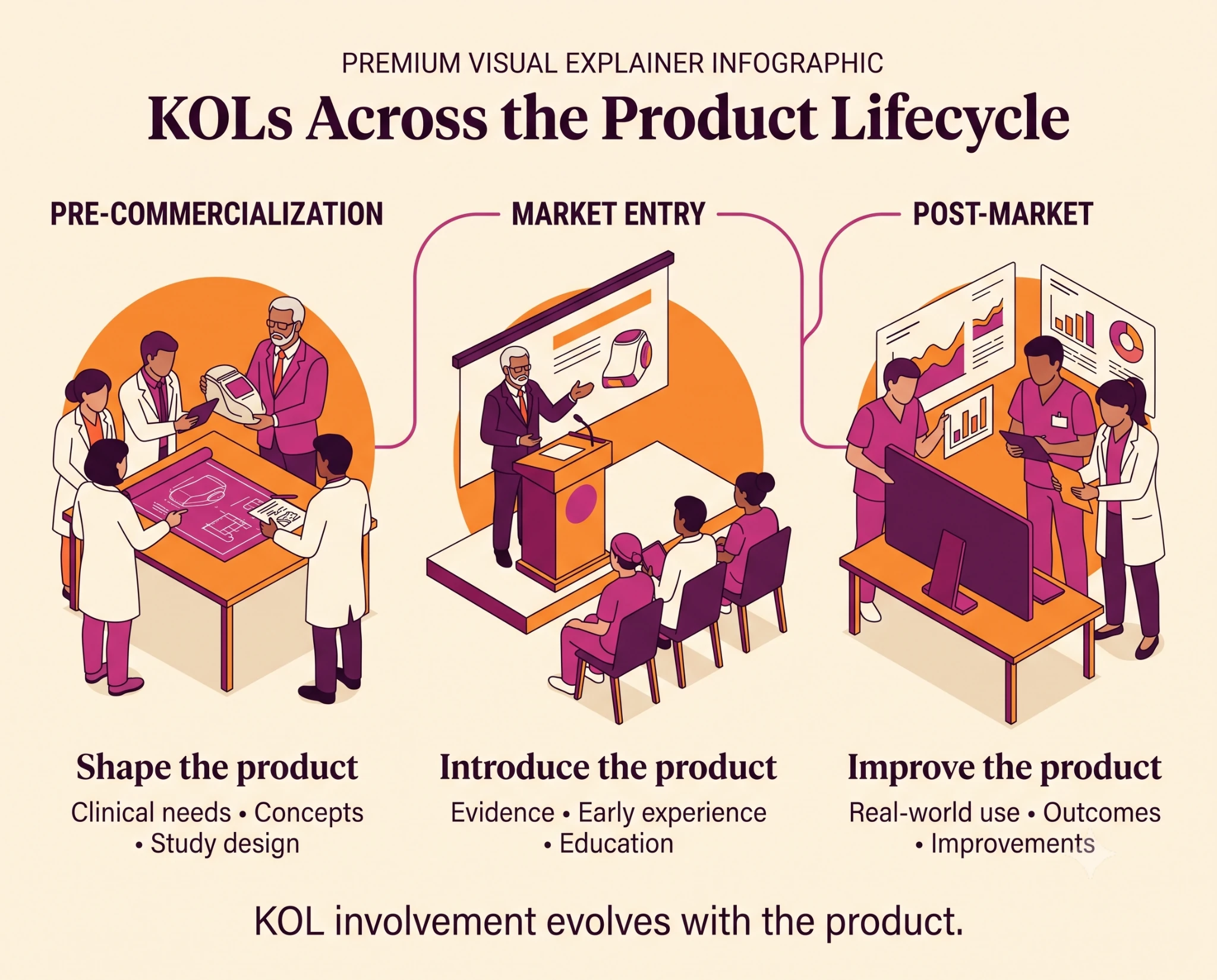
KOL involvement can change as a medical product moves from development to commercialization and post-market evaluation. At each stage, manufacturers use clinical expertise for a different product-related objective. This lifecycle-based approach is an important part of KOL management, as the role of a key opinion leader can evolve depending on the product's stage and clinical objectives.
- Pre-Commercialization: KOLs help manufacturers identify unmet clinical needs, evaluate early concepts and prototypes, refine product design, and inform clinical study design and evidence-generation strategies.
- Market Entry: KOLs help introduce a new product to the clinical community through scientific presentations, early-adopter experiences, hospital evaluations, and education around its clinical application.
- Post-Market: KOLs contribute to understanding how a product performs in routine clinical practice by sharing real-world experience, evaluating outcomes, identifying opportunities for improvement, and contributing to post-market evidence.
The Typical KOL Engagement Lifecycle
Once a manufacturer identifies a potential KOL, engagement typically develops through a structured process. This process is central to KOL management, from identifying the right experts to maintaining appropriate professional relationships over time.
- Identify: Find clinicians with relevant expertise, scientific credentials, publication records, conference participation, guideline involvement, or peer influence.
- Assess: Evaluate the KOL's expertise, reputation, therapeutic-area relevance, professional influence, audience, and potential conflicts of interest.
- Engage: Establish an appropriate professional relationship based on the KOL's role and expertise, such as through consulting, research, advisory work, or educational activities.
- Educate: Give the KOL access to accurate, approved scientific information, product evidence, and relevant clinical materials.
- Activate: Involve the KOL in appropriate scientific activities aligned with their expertise, such as advisory discussions, research, presentations, or peer education.
- Measure: Evaluate the quality and effectiveness of the relationship using measures such as scientific engagement, educational reach, stakeholder feedback, and contribution to evidence generation.
Regulatory and Compliance Guardrails
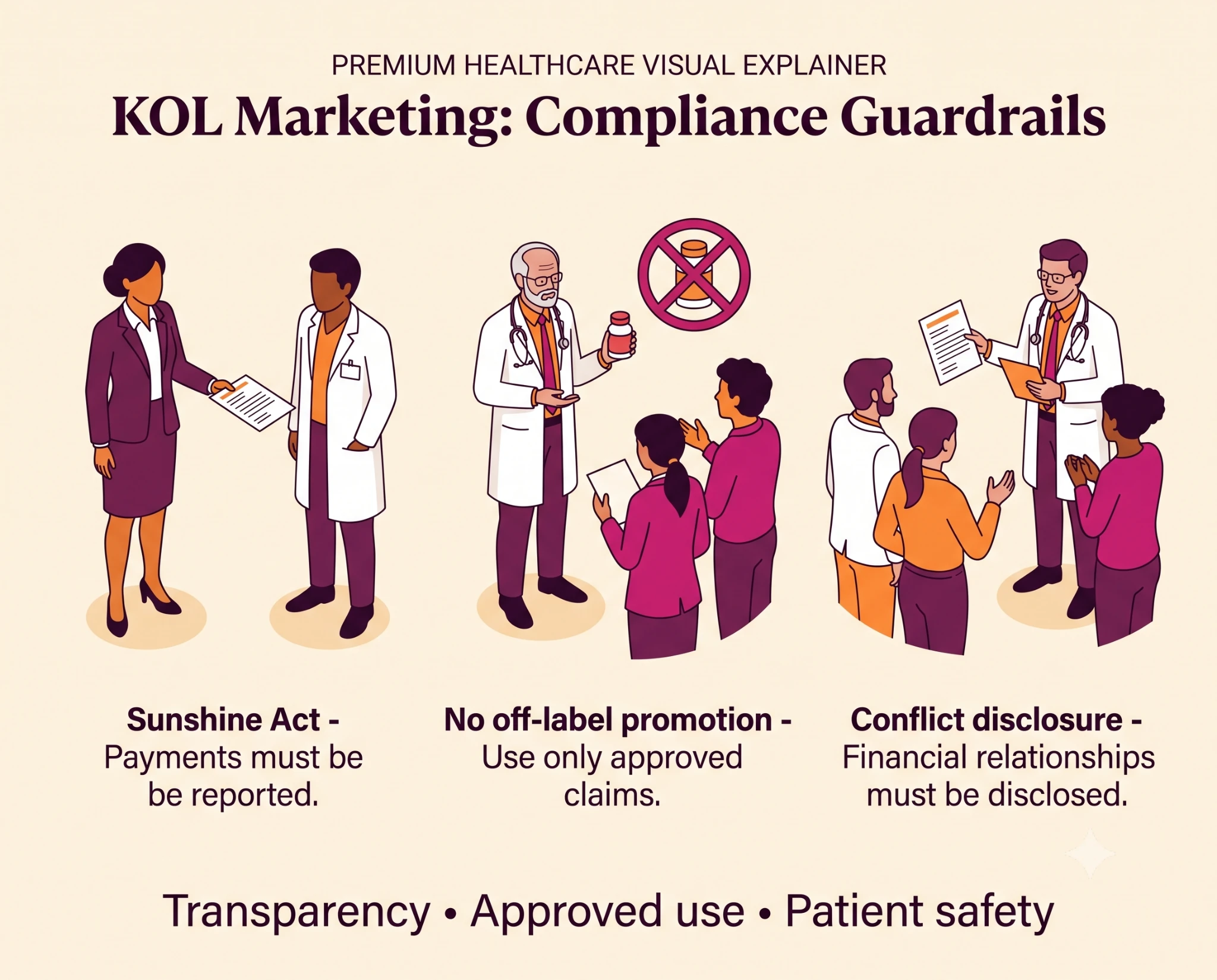
Healthcare KOL marketing operates under strict regulatory scrutiny to prevent conflicts of interest and maintain patient safety. These requirements are an essential consideration when developing a KOL strategy and managing relationships with a key opinion leader:
- The Sunshine Act (Open Payments): In the United States, manufacturers must publicly report all transfers of value (payments, research grants, consulting fees, travel expenses) made to physicians and teaching hospitals.
- Off-Label Promotion Bans: Regulatory bodies like the FDA strictly prohibit KOLs from promoting medical products for unapproved uses during branded, manufacturer-sponsored events or promotional content.
- Institutional Review Board (IRB) and Conflict Disclosures: KOLs are contractually bound to disclose financial relationships with manufacturers during any public presentation, publication, or educational session.
The compliance math nobody gets to skip
Every dollar spent on a KOL relationship in the US eventually becomes public record. The Physician Payments Sunshine Act, run through CMS's Open Payments program, requires manufacturers to report payments and transfers of value to covered clinicians. For 2026, the per-payment reporting minimum is $13.82, with an annual aggregate threshold of $138.13. Cross that aggregate number for a single recipient in a calendar year, and every payment to them has to be reported, including the ones that individually fell under the minimum.
The scale here is bigger than most people assume. The most recent full-year release, covering 2025, disclosed close to $14.7 billion in payments and transfers of value industry-wide, with roughly $9.5 billion of that tied to research funding rather than marketing spend. Enforcement has real teeth too: Texas sued Sanofi in February 2026 over provider programs the state says crossed the line into improper inducement. A KOL program built without compliance baked in from day one is a program that gets rebuilt later, usually under worse conditions. This is why KOL management needs to account for compliance throughout the engagement rather than treating it as a separate consideration.
Why manufacturers keep paying for it
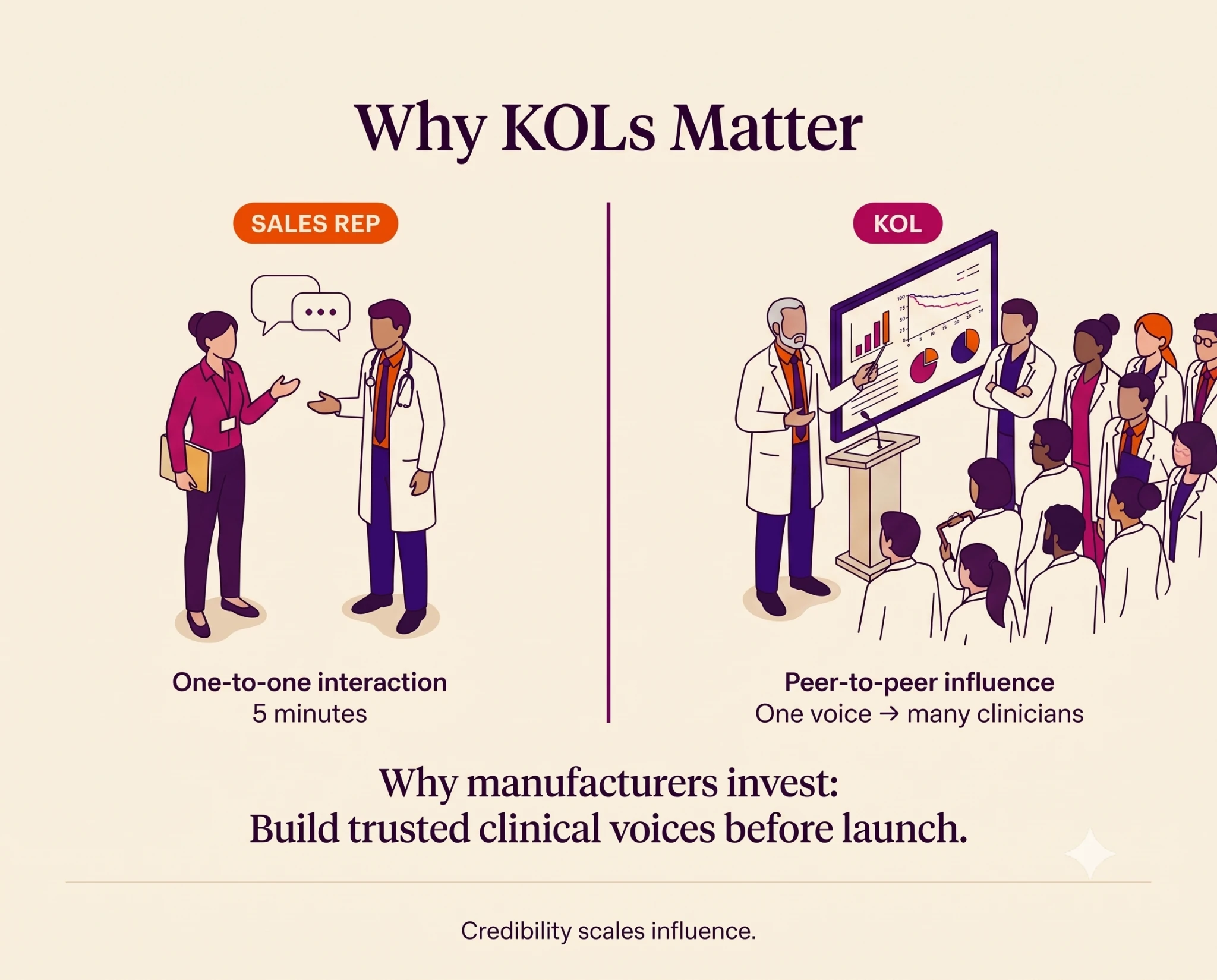
Physicians trust other physicians more than they trust a sales rep, and that gap doesn't close no matter how good the rep is. A KOL's endorsement, even an implicit one through a co-authored paper or a well-attended talk, moves prescribing behavior in a way a detail visit can't. This illustrates the key opinion leader importance in shaping professional influence within healthcare.
That's why medical affairs teams start KOL engagement early, often a year or more before a product launches. By the time a drug reaches the market, the goal is to already have a bench of respected voices who understand the data, believe in it, and can field questions from peers without sounding like they're reading from a script. Effective KOL marketing therefore depends not only on identifying influential clinicians, but on building the right engagement strategy around their expertise and role.
Frequently Asked Questions
What is KOL marketing in healthcare?
KOL marketing in healthcare is a strategy in which manufacturers work with respected clinicians, researchers, and medical experts to communicate scientific evidence, discuss treatment approaches, and influence professional opinion. Key opinion leader marketing can include medical education, advisory boards, clinical research, publications, conference presentations, and other peer-to-peer activities.
How is KOL marketing different from consumer influencer marketing?
KOL marketing focuses on healthcare professionals and clinical audiences, while consumer influencer marketing generally targets the public. A key opinion leader is selected based on clinical expertise, scientific credentials, research, publications, and professional influence. KOL marketing also operates within stricter regulatory and compliance requirements because the information communicated can influence clinical practice and patient care.
What activities does a KOL marketing programme usually include?
A KOL marketing programme can include medical education, peer-to-peer engagement, advisory boards, clinical research, scientific publications, conference presentations, and evidence-generation activities. Depending on the product lifecycle, KOLs may also help identify unmet clinical needs, evaluate early concepts, support clinical studies, introduce products to the clinical community, and provide real-world feedback after launch.
How do companies measure the impact of KOL marketing?
Companies measure KOL marketing through metrics such as scientific engagement, educational reach, stakeholder feedback, conference and publication activity, and contributions to evidence generation. KOL management can also involve evaluating the quality of professional relationships and whether KOL engagement supports broader clinical and commercial objectives.
What compliance rules apply to KOL marketing in the US?
KOL marketing in the US is subject to regulations covering transparency, off-label promotion, and conflicts of interest. Under the Physician Payments Sunshine Act and CMS Open Payments program, applicable manufacturers must report certain payments and transfers of value to physicians and teaching hospitals. KOL activities must also follow restrictions on promoting unapproved uses of medical products and relevant disclosure requirements.
Sources
KOLs as an interface between industry and physicians
- Moynihan, R., Key opinion leaders: independent experts or drug representatives in disguise?, BMJ, 2008
- Sismondo, S., Key opinion leaders: Valuing independence and conflict of interest in the medical sciences
- Pharmaceutical industry use of key opinion leaders to market prescription opioids: A review of internal industry documents
KOL identification, engagement lifecycle, and management
Regulatory guardrails — Sunshine Act / Open Payments
- Centers for Medicare & Medicaid Services, What is Open Payments?
- CMS, Open Payments Data Overview
- PALTmed, CMS Publishes Program Year 2025 Open Payments Data ($14.67B total: $3.92B general payments, $9.50B research payments, $1.25B ownership/investment interests)
- eCFR, 42 CFR Part 403, Subpart I (reporting thresholds and requirements)
Off-label promotion restrictions
Enforcement example — Texas v. Sanofi
- Texas Office of the Attorney General, Attorney General Ken Paxton Sues Big Pharma Corporation Sanofi for Illegally Giving Kickbacks to Doctors to Prescribe the Company's Drugs (filed February 19, 2026)
- STAT, Texas attorney general sues Sanofi for allegedly providing kickbacks to doctors to prescribe its drugs
- Law360, Texas Suit Says Sanofi Paid Kickbacks For Prescriptions