Key Opinion Leaders in Pharma: Roles, Tiers and Why They Drive Adoption

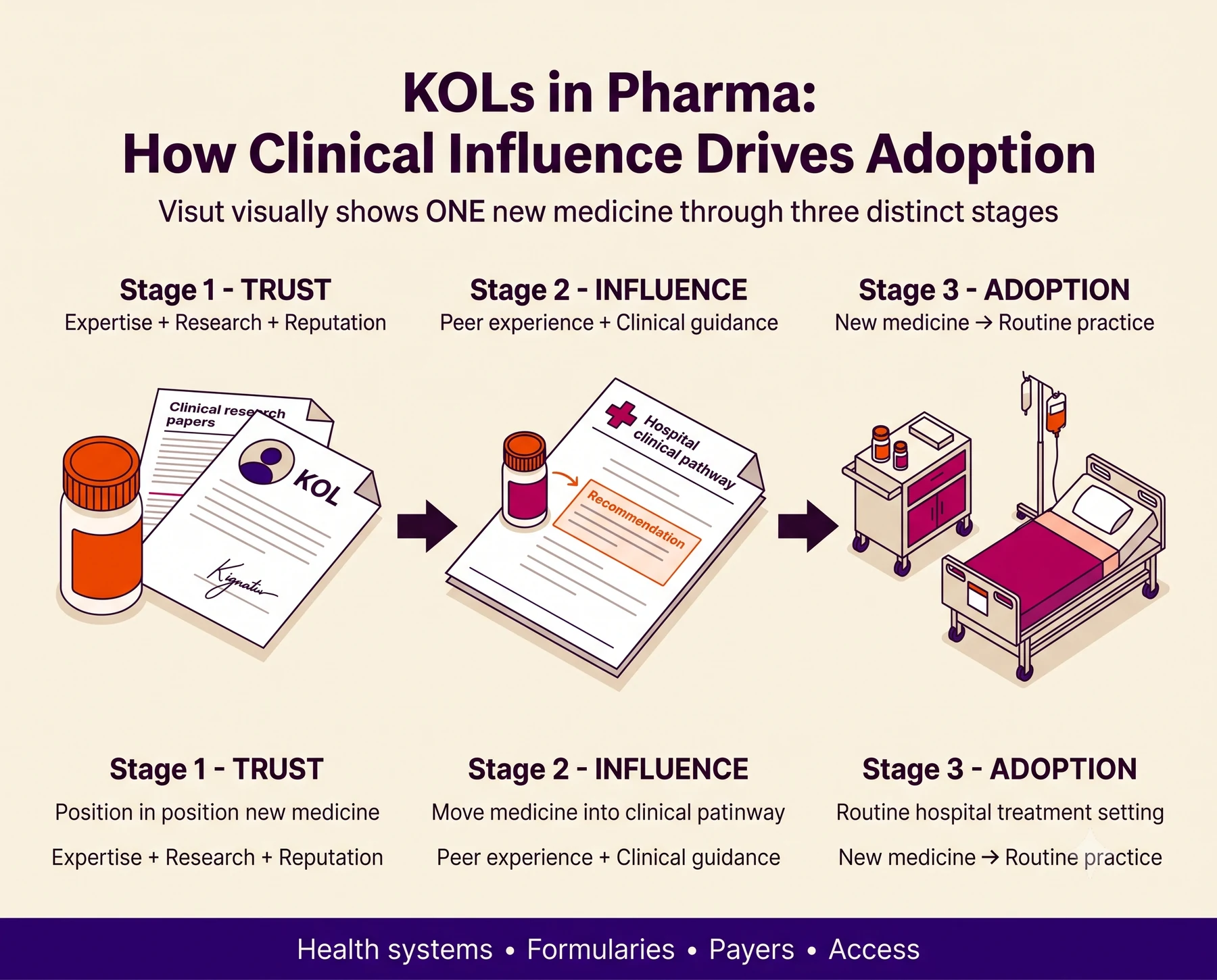
A Key Opinion Leader (KOL) in pharma is a physician, researcher, or other healthcare expert whose clinical expertise, reputation, research activity, and professional network give them disproportionate influence over how other healthcare professionals think and practice. In the U.S. healthcare system, a key opinion leader physician may influence clinical decision-making not only through individual peer relationships, but also through academic medical centers, health systems, specialty networks, professional societies, and other healthcare organizations.
KOL influence matters because physicians often do not make adoption decisions based on promotional information alone. Peer experience, trusted clinical judgment, and professional networks can substantially affect whether a new medicine is tried and eventually incorporated into routine practice. In the U.S., adoption can also be shaped by factors such as health-system protocols, formulary decisions, clinical pathways, payer coverage, and access considerations.
KOL Roles Across the Pharma Product Lifecycle
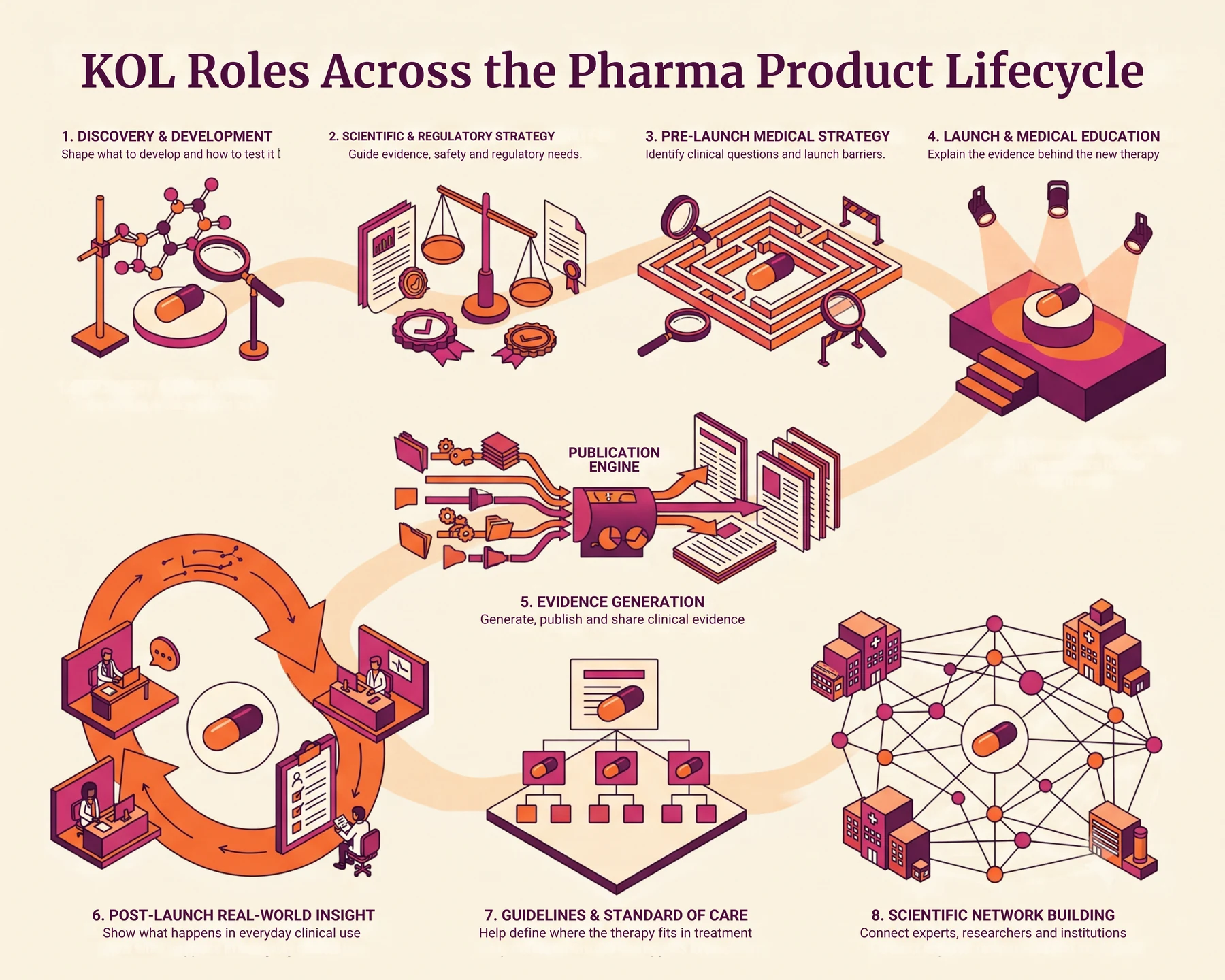
KOLs can contribute throughout the medicine lifecycle, with their role evolving from shaping clinical development to influencing adoption, evidence generation, and standards of care.
Discovery & Clinical Development: KOLs help identify unmet clinical needs, validate the relevance of a potential therapy, and provide input on trial design, patient populations, protocols, endpoints, and patient recruitment. Their understanding of real-world clinical practice helps ensure that development programs address meaningful challenges rather than purely theoretical outcomes. Their perspectives can also be especially valuable when designing clinical trials intended to generate evidence relevant to U.S. patient populations and clinical practice.
Scientific & Regulatory Strategy: KOLs provide scientific perspectives on the evolving treatment landscape and can advise medical teams on evidence requirements, benefit-risk considerations, and regulatory strategy. Their expertise may also contribute to regulatory submissions or advisory committee discussions where independent clinical perspectives are valuable, particularly within the U.S. regulatory environment.
Pre-Launch & Medical Strategy: Before commercialization, KOLs help companies anticipate how clinicians may evaluate a new therapy, identify potential barriers to adoption, and surface the questions physicians are likely to have. Through advisory boards and scientific discussions, they help shape medical strategy while providing feedback grounded in clinical practice. These insights can also help pharmaceutical companies understand how a therapy may be evaluated within U.S. health systems and specialty practices.
Launch & Medical Education: KOLs help communicate clinical evidence through congress presentations, symposia, webinars, roundtables, publications, and peer-to-peer education. Their role is not simply promotional; they help clinicians interpret emerging evidence and understand how a new therapy fits within existing treatment paradigms.
Evidence Generation & Dissemination: KOLs can contribute to clinical research, publications, guidelines, and broader scientific discussions. Their involvement helps generate and disseminate evidence while identifying gaps that may require further investigation. This can include generating evidence that helps clinicians and U.S. healthcare organizations evaluate how a therapy performs in real-world clinical practice.
Post-Launch & Real-World Insight: After launch, KOLs provide feedback based on their clinical experience, including emerging treatment patterns, patient responses, adoption barriers, and evidence gaps. These insights can inform ongoing medical strategy and future evidence-generation efforts. In the U.S., this feedback can also help companies understand how a therapy is being used across different healthcare settings and patient populations.
Guidelines & Standard of Care: KOLs may participate in professional societies and guideline committees, where their expertise can influence how new therapies are positioned within treatment recommendations. Guideline inclusion can significantly affect how clinicians perceive and incorporate a therapy into standard clinical practice.
Scientific Network Building: KOLs also extend a company's access to the wider medical community by connecting teams with investigators, specialists, institutions, and professional societies. This can support clinical research, evidence generation, education, and broader scientific engagement across the U.S. healthcare ecosystem.
Ultimately, KOL engagement is not a single launch or promotional activity. It is an ongoing scientific relationship that can influence how a medicine is developed, evaluated, communicated, adopted, and integrated into clinical practice.
KOL Tiers
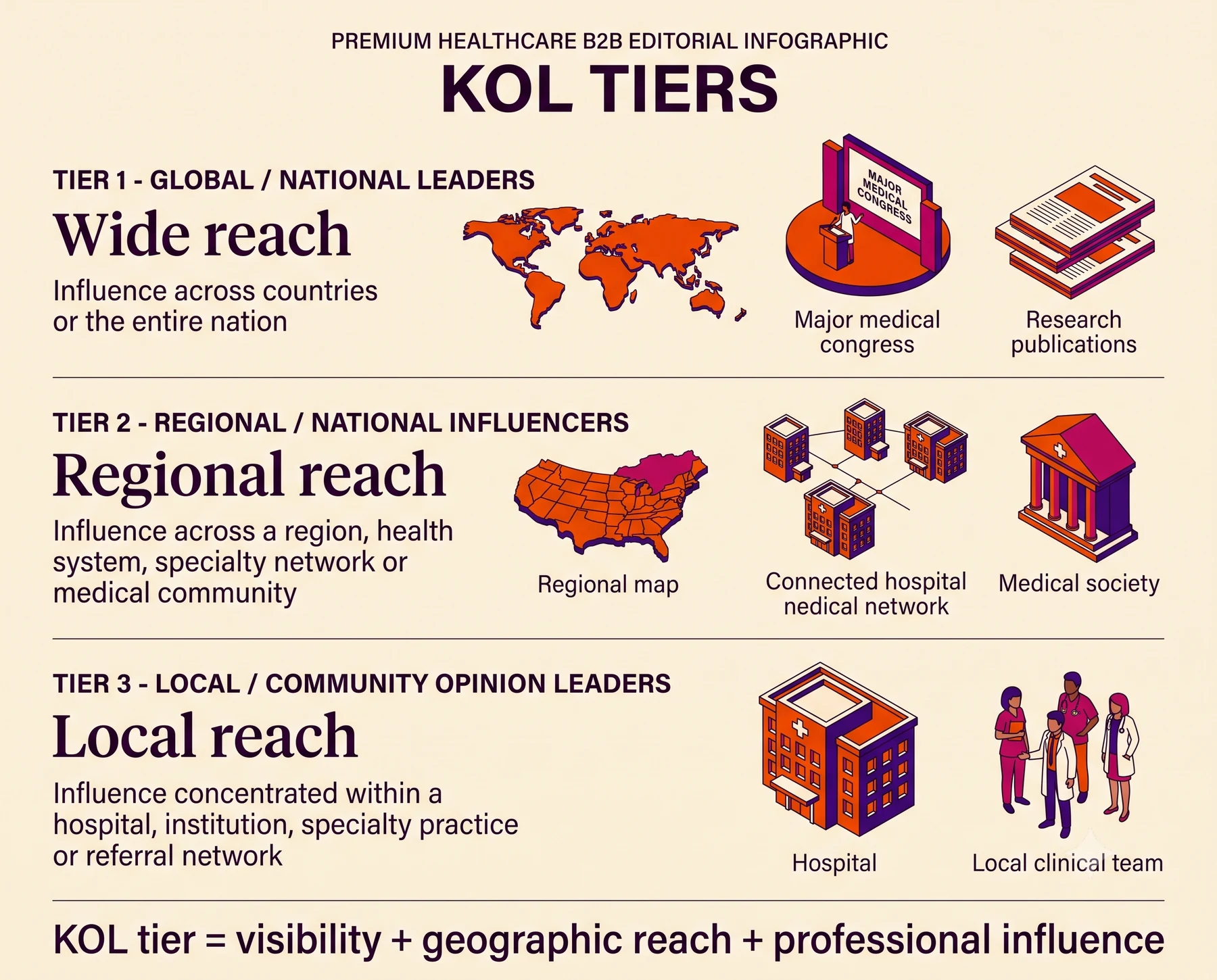
Because Medical Affairs and commercial teams have finite resources, pharmaceutical companies commonly categorize KOLs into tiers based on their level of visibility, geographic reach, and influence. The traditional framework typically ranges from Tier 1 to Tier 3.
Tier 1: Global / National Leaders
These are internationally or nationally recognized researchers, major clinical trial investigators, guideline authors, journal editors, and frequent speakers at major congresses. Their influence can extend across an entire therapeutic area or the U.S., making them valuable for pivotal scientific exchange, global advisory boards, clinical development, and high-profile scientific education.
Tier 2: Regional / National Influencers
These KOLs are highly respected within a particular region, health system, specialty network, or medical community. They may lead departments, run tumor boards, participate in multicenter trials, or hold leadership positions within regional or national medical societies. Their influence is particularly relevant for shaping treatment practices and clinical consensus within their geography or healthcare network.
Tier 3: Local / Community Opinion Leaders
These are practicing physicians and local clinical leaders whose influence may not extend beyond a hospital, institution, health system, specialty practice, or referral network. They may not have a national profile, but their peers often turn to them for practical guidance when deciding how to treat patients or adopt a new therapy. Their influence is therefore highly localized and often rooted in professional trust.
This traditional hierarchy is useful for understanding how far a KOL's voice travels, but reach alone does not tell the whole story. A nationally recognized KOL may generate significant scientific visibility without being the person who determines whether a therapy is actually adopted within a specific U.S. health system. Conversely, a less visible local physician may have considerable influence over prescribing and treatment decisions within their network.
This is where Digital Opinion Leaders (DOLs) add another dimension. DOLs can exist across any traditional tier, with influence driven less by geographic reach and more by their presence across medical social networks, digital communities, virtual tumor boards, online scientific discussions, and other digital channels.
The result is a more nuanced view of KOL influence: tiering tells you who has reach, but effective KOL mapping needs to identify who has the influence to shape clinical decisions, adoption, and behavior.
Why KOLs Drive Drug Adoption
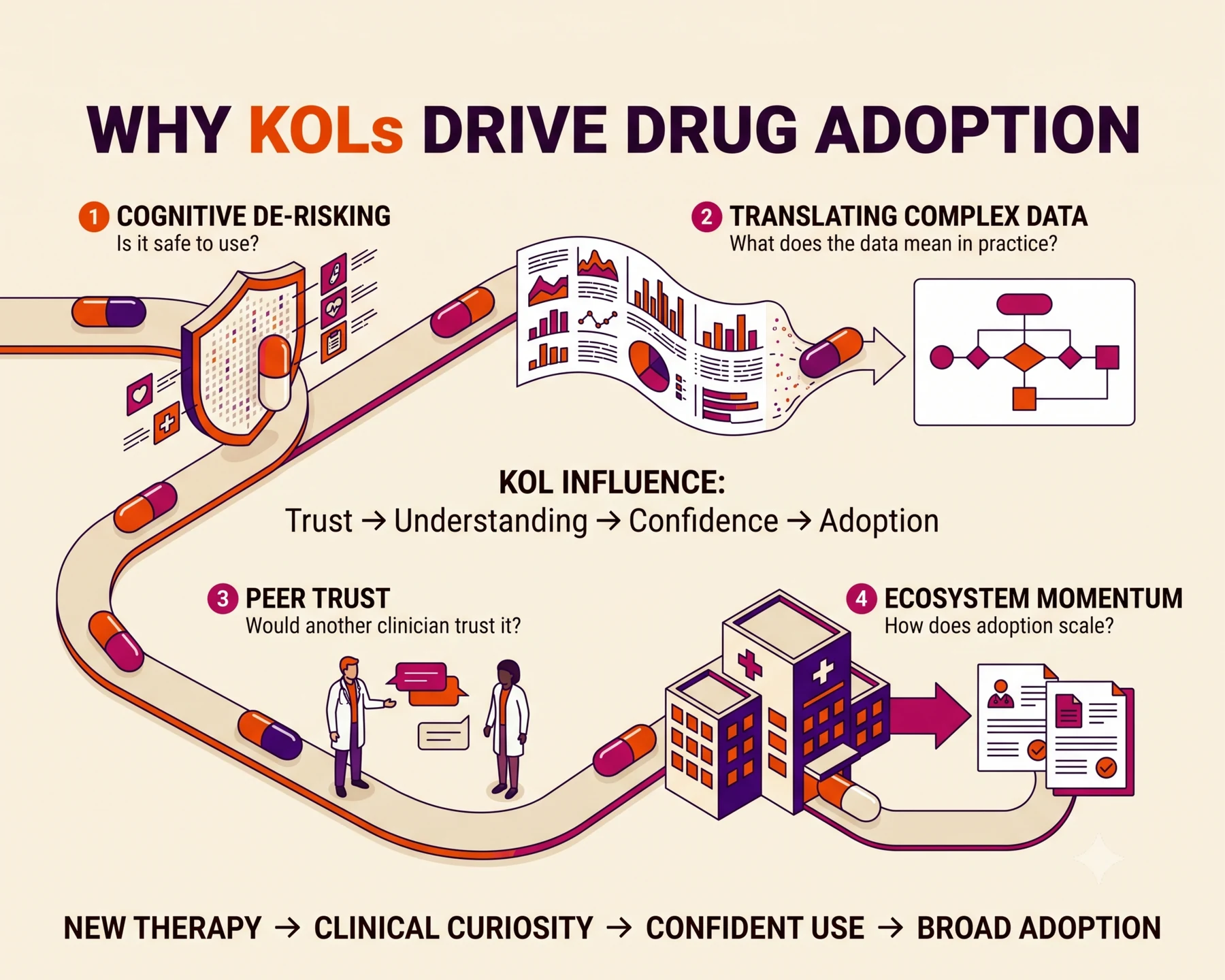
Healthcare professionals (HCPs) are overwhelmed with clinical data and promotional noise. KOLs break through this friction for several key reasons:
Cognitive De-risking: Prescribing a newly approved drug carries professional and clinical risk. When a respected peer demonstrates the safe and effective use of a therapy in real-world settings, it lowers the perceived risk for other physicians considering a switch from standard-of-care treatments.
Translation of Complex Data: Clinical trials present data in controlled settings. KOLs interpret what those data points mean for everyday practice, complex comorbidities, and specific patient subpopulations.
Peer Trust Over Corporate Messaging: Traditional pharmaceutical marketing often faces skepticism. Peer-to-peer education delivered by a clinician who treats the same patient demographics carries an inherent level of clinical objectivity that commercial messaging cannot replicate.
Ecosystem Momentum: By simultaneously influencing clinical trial design, guideline updates, continuing medical education (CME), and hospital formulary decisions, KOLs create multi-channel momentum that naturally moves a drug through the adoption curve, turning early clinical curiosity into broad, sustained prescribing behavior.
In the U.S. healthcare system, that momentum can extend beyond individual prescribing decisions. KOL influence can intersect with health-system formularies, Pharmacy and Therapeutics (P&T) committees, clinical pathways, specialty networks, and payer and access considerations, making the right KOL relationships particularly important for pharmaceutical companies seeking to understand and accelerate adoption.
Frequently Asked Questions
What does a key opinion leader do in pharma?
A key opinion leader (KOL) provides clinical and scientific expertise that can influence how healthcare professionals understand, evaluate, and adopt a therapy. KOLs may contribute to clinical development, advisory boards, medical education, research, publications, guidelines, and post-launch evidence generation.
How are pharma KOLs tiered from global to regional?
Pharma KOLs are commonly categorized into Tier 1, Tier 2, and Tier 3 based on their visibility, geographic reach, professional network, and influence. Tier 1 typically includes global or national leaders, Tier 2 includes regional or national influencers, and Tier 3 includes local or community opinion leaders. However, tier alone does not determine actual clinical influence.
What is the difference between a KOL and a medical science liaison?
A KOL is an external healthcare expert who has influence within their specialty or professional network. A medical science liaison (MSL) is a pharmaceutical company employee who builds and maintains scientific relationships with KOLs and other healthcare professionals. MSLs facilitate scientific exchange, gather insights, and communicate relevant clinical information without functioning as KOLs themselves.
How do KOLs influence prescribing and formulary decisions?
KOLs can influence prescribing by helping physicians interpret clinical evidence, evaluate new therapies, and understand how treatments fit into clinical practice. Their expertise can also contribute to discussions around clinical pathways, hospital formularies, and Pharmacy and Therapeutics (P&T) committees, particularly when respected experts provide evidence-based perspectives on a therapy.
At what stage of drug development should KOL engagement start?
KOL engagement can begin during early discovery and clinical development, before a drug reaches the market. Engaging relevant experts early can help identify unmet needs, inform trial design, validate clinical endpoints, and anticipate potential barriers to adoption. Their involvement can then continue through launch and post-launch evidence generation.
Sources
KOL roles across the product lifecycle
KOL tiering (Tier 1–3)
Digital Opinion Leaders
- Pharmaceutical Commerce, Defining the digital opinion leaders (DOLs) in healthcare
KOL vs. medical science liaison
- MSL Society, What is a Medical Science Liaison (MSL)?
- Definitive Healthcare, Medical Science Liaison (MSL)
Peer influence, diffusion of innovation, and adoption
- Rogers, E.M., Diffusion of Innovations — foundational framework; summarized in Optimizing Technology Development and Adoption in Medical Imaging Using the Principles of Innovation Diffusion, PMC
- Rogers' diffusion theory of innovation applied to the adoption of sugammadex in a nationwide sample of US hospitals, British Journal of Anaesthesia, 2023
- Flodgren, G. et al., Local opinion leaders: effects on professional practice and healthcare outcomes, Cochrane Database of Systematic Reviews, 2019
Formulary and P&T committee influence
- Definitive Healthcare, Inside P&T committees: The key players in formulary decision-making
- AJMC, How Clinical Evidence Drives Formulary Decision-Making
- Journal of Managed Care & Specialty Pharmacy, AMCP Partnership Forum: Principles for Sound Pharmacy and Therapeutics (P&T) Committee Practices