
U.S. CDC Records More Than 3,100 Measles Cases So Far in 2026
What's Happening
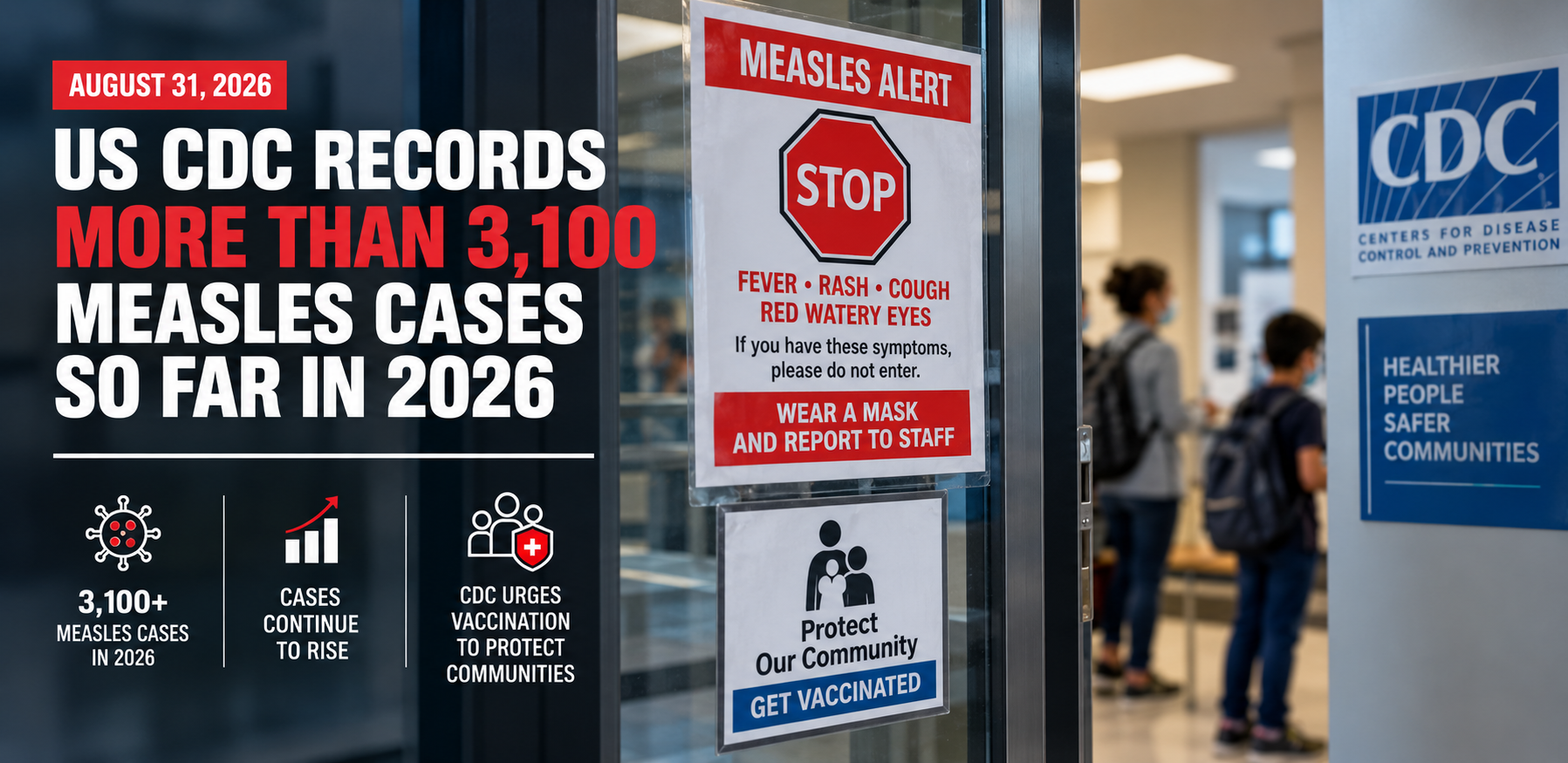
The U.S. Centers for Disease Control and Prevention (CDC) said the United States has recorded 3,134 confirmed measles cases so far in 2026, making this the country's highest annual measles total in more than 35 years. The CDC's count includes 3,118 cases reported across 47 U.S. jurisdictions and 16 cases involving international visitors. (Reuters)
The resurgence is occurring as childhood vaccination rates have continued to decline since the COVID-19 pandemic. About 94% of reported cases were among people who were unvaccinated or whose vaccination status was unknown, according to the CDC. (Reuters)
The outbreak is also putting pressure on public-health systems, with hundreds of people requiring hospitalization and states continuing to report large outbreaks.
2026 Has Already Become a Record Year
Highest annual total since the early 1990s
The 3,134 cases recorded through September 4 represent the highest annual U.S. measles total since the major resurgence between 1989 and 1991.
During that earlier period, the United States recorded more than 55,000 infections and 123 deaths. (Reuters)
The current numbers are therefore historically significant even though they remain far below the levels seen during that earlier outbreak.
The CDC's latest tally shows that measles, once largely controlled through widespread vaccination, has again become a significant public-health issue in the United States.
Most Cases Involve People Who Were Not Vaccinated
Vaccination status is a major factor
Approximately 94% of the 2026 cases were in people who were either unvaccinated or had an unknown vaccination status. (Reuters)
That pattern is particularly important because measles is highly contagious and can spread rapidly through communities where vaccination coverage has fallen below levels needed to prevent sustained transmission.
The data reinforce the connection between declining vaccination coverage and the return of outbreaks that had previously become relatively uncommon in the United States.
Childhood vaccination rates have been falling
The rise in measles cases over the past two years has coincided with a steady decline in childhood MMR vaccination rates since the pandemic. (Reuters)
MMR vaccination protects against:
- Measles
- Mumps
- Rubella
As fewer children receive the recommended vaccinations, more communities become vulnerable to outbreaks when measles is introduced.
Hospitalizations Are Also Rising
248 people have been hospitalized
The CDC reported 248 measles-related hospitalizations in 2026, representing approximately 8% of all reported cases. (Reuters)
The hospitalization figure is already slightly higher than the 244 hospitalizations recorded during all of 2025, although 2025 also included three reported deaths. (Reuters)
Hospitalizations increase the healthcare burden beyond the initial outbreak investigation.
Patients with severe measles may require emergency treatment, inpatient care and monitoring for complications, while hospitals also need infection-control measures to prevent transmission to other patients and healthcare workers.
Pennsylvania Continues to See a Major Outbreak
The state's case count has reached 577
Pennsylvania's health department reported that the number of measles cases linked to an outbreak in the state had reached 577 this year, with 98 hospitalizations. (Reuters)
Pennsylvania has also become central to a separate controversy over two reported measles-associated deaths.
The state reported the deaths on August 25, but the CDC has not included them in its national measles death tally while the agency reviews whether measles caused or contributed to the deaths. (Reuters)
That means the national numbers could potentially change depending on the outcome of the review.
Two Pennsylvania Deaths Remain Under Federal Review
The CDC has not yet counted them as measles deaths
The CDC's current figures do not include the two Pennsylvania deaths because the agency is still assessing the cause or contribution of measles.
The issue has become politically sensitive. Reuters previously reported that Health Secretary Robert F. Kennedy Jr. asked the new CDC director to remove the reference to the two deaths from the agency's online measles tally. (Reuters)
That puts the official case and death counts under additional scrutiny at a time when the country is already experiencing its largest annual measles resurgence in decades.
Outbreaks Are Continuing Across the Country
38 outbreaks have been recorded
The CDC has recorded 38 measles outbreaks in 2026, compared with 48 in 2025. (Reuters)
Although the number of individual outbreaks is lower than last year, the total number of cases is substantially higher.
That distinction is important.
A smaller number of outbreaks can still generate a much larger national case count if individual outbreaks are larger or persist for longer periods.
Why Measles Can Spread So Quickly
Measles is one of the most contagious infectious diseases.
When vaccination coverage falls, a single infected person can expose a large number of people, particularly in schools, households, healthcare facilities and communities with low immunization rates.
Because symptoms may initially resemble other illnesses, infected individuals can also come into contact with others before the disease is recognized.
That makes maintaining high vaccination coverage an important component of outbreak prevention.
The Public-Health System Faces a Double Challenge
Controlling outbreaks
When measles cases are identified, public-health departments must quickly:
- Confirm infections
- Identify people who were exposed
- Notify potentially affected communities
- Determine vaccination status
- Monitor contacts for symptoms
- Coordinate isolation and infection-control measures
Those activities require personnel, laboratory capacity and rapid communication.
Restoring vaccination coverage
Containing individual outbreaks does not address the underlying vulnerability created by declining vaccination rates.
Public-health authorities therefore face a second, longer-term challenge: rebuilding confidence in childhood vaccination and improving immunization coverage before additional outbreaks occur.
Measles Is Becoming a Bigger Healthcare-System Issue
The significance of the outbreak extends beyond infectious-disease specialists.
A large measles outbreak can affect:
- Emergency departments
- Pediatric practices
- Hospitals
- Laboratories
- Schools
- Local and state health departments
- Healthcare workers
Hospitals must also take precautions when potentially infectious patients arrive, which can affect staffing and operational workflows.
The 248 hospitalizations recorded so far show that the outbreak is already producing a tangible burden on healthcare facilities.
Vaccination Declines Are Creating Regional Vulnerability
Outbreak risk is not evenly distributed
National vaccination averages can conceal substantial differences between communities.
Measles can spread particularly quickly in areas where vaccination rates are lower, because there are fewer people with immunity to interrupt transmission.
That means local vaccination coverage can be just as important as the national average in determining where outbreaks occur and how large they become.
Pennsylvania's continuing outbreak is one illustration of the consequences of sustained transmission within a state. (Reuters)
The Current Situation Is Still Far Below Historical Peaks
Although 2026 has already reached a 35-year high, it is important to put the figure into historical context.
The more than 55,000 infections recorded during the 1989-1991 resurgence were vastly higher than the current total. (Reuters)
The difference illustrates both the success of vaccination programs over decades and the consequences when vaccination coverage starts to weaken.
The current resurgence is therefore a warning sign rather than a return to the scale of pre-vaccine-era measles transmission.
Why This Matters
The 3,134 reported cases show that measles is no longer simply an occasional imported infection in the United States.
The country is experiencing sustained domestic transmission at levels not seen in decades, with nearly all reported cases occurring among people who are unvaccinated or whose vaccination status is unknown. (Reuters)
The outbreak also demonstrates how changes in preventive healthcare behavior can eventually translate into pressure on hospitals and public-health agencies.
The connection is straightforward:
Lower vaccination coverage → larger susceptible populations → more outbreaks → more hospitalizations and public-health intervention.
Looking Ahead
The CDC's case count is likely to continue changing as states report additional infections and complete investigations into possible measles-related deaths.
Pennsylvania will remain an important area to watch given its 577 cases and 98 hospitalizations already reported this year. (Reuters)
The larger national question is whether the decline in childhood vaccination rates can be reversed.
If vaccination coverage stabilizes or improves, the current resurgence could eventually come under control.
If vaccination rates continue falling, the United States could face more frequent and sustained measles outbreaks, increasing the burden on pediatricians, hospitals and public-health departments.
Key Takeaways
- The CDC reported 3,134 confirmed U.S. measles cases in 2026 as of September 4. (Reuters)
- That is the highest annual U.S. total in more than 35 years.
- 3,118 cases were reported across 47 U.S. jurisdictions, while 16 involved international visitors. (Reuters)
- About 94% of cases were among unvaccinated people or people whose vaccination status was unknown. (Reuters)
- The CDC recorded 248 measles-related hospitalizations, or about 8% of cases.
- There have been 38 outbreaks in 2026, compared with 48 in 2025.
- Pennsylvania has reported 577 cases and 98 hospitalizations this year. (Reuters)
- Two Pennsylvania deaths reported as measles-associated are still being reviewed by the CDC and have not been included in the national death count. (Reuters)
- The current resurgence coincides with a steady decline in childhood MMR vaccination rates since the COVID-19 pandemic.
- The current total is the highest since the major 1989-1991 measles resurgence, when more than 55,000 infections and 123 deaths were recorded. (Reuters)
What This Means for Healthcare Marketers
The measles resurgence is a clear example of why public-health behavior is also a healthcare-demand signal.
Falling vaccination rates can eventually generate increased demand for testing, pediatric visits, emergency care, hospital capacity, infectious-disease services and public-health intervention.
For healthcare organizations, monitoring vaccination coverage, outbreak locations, case growth and hospitalization trends can provide early visibility into where healthcare demand and operational pressure may increase.
The broader lesson is that preventive-care trends can become healthcare-market trends. A change in vaccination behavior may take time to show up, but once outbreaks begin accelerating, the downstream impact can spread rapidly across providers, hospitals and public-health systems.