
Cyclosporiasis Outbreak Exposes a Weakened U.S. Public Health System
What's Happening
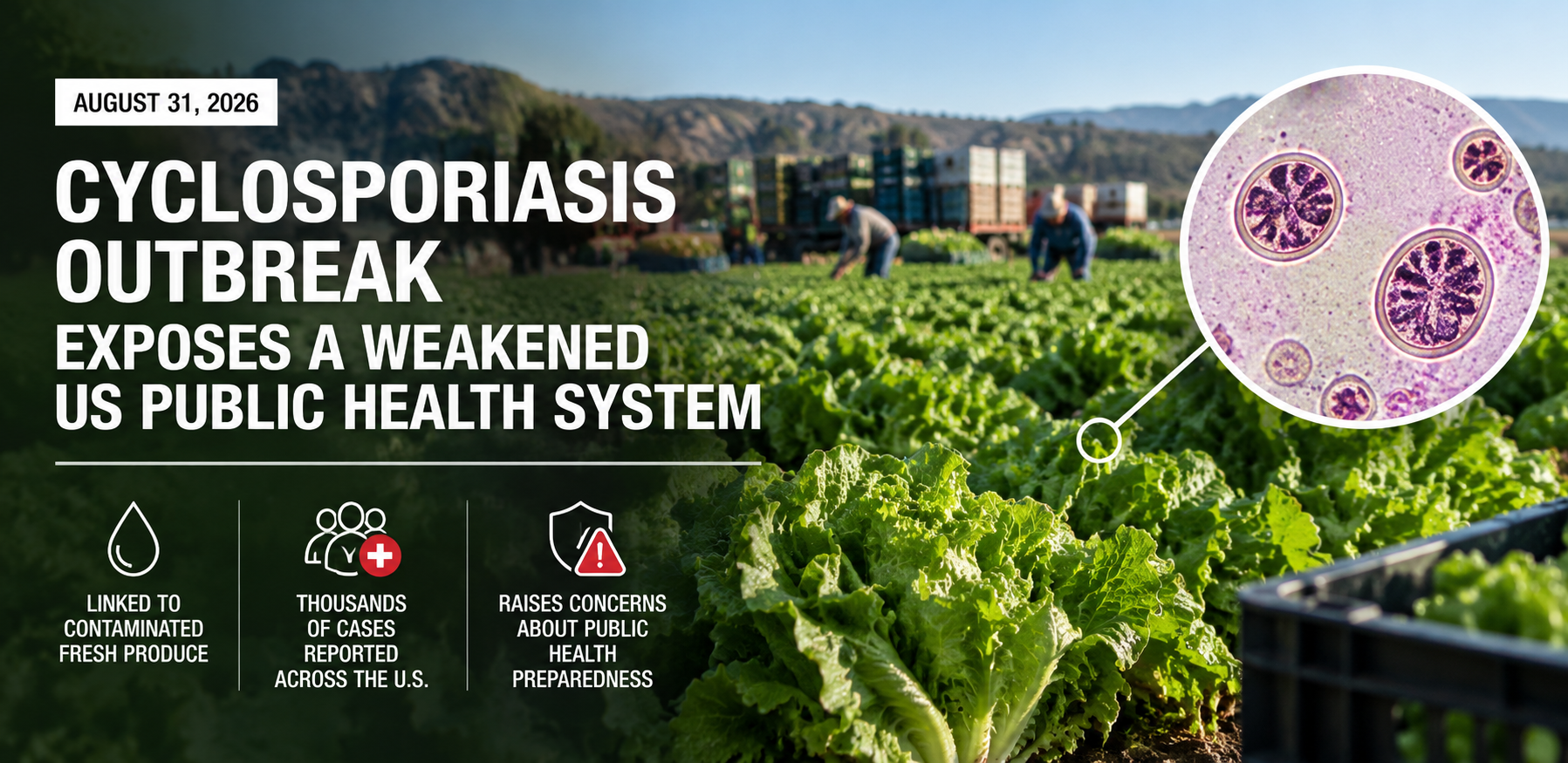
A major U.S. outbreak of cyclosporiasis, a parasitic illness that causes severe gastrointestinal symptoms, has exposed significant weaknesses in the country's ability to detect and contain foodborne disease outbreaks.
The outbreak has sickened more than 11,000 people across 20 states, according to the FDA and CDC, and has been linked to shredded iceberg lettuce served at Taco Bell restaurants. Two people have died. (Reuters)
But Reuters' investigation shows that the scale of the outbreak is only part of the story. Local health departments, particularly in Michigan, were overwhelmed by the number of cases and by the amount of investigative work required. Officials said limited staffing, years of underinvestment and recent federal cuts left them struggling to perform both their normal duties and the additional work required to contain the outbreak. (Reuters)
Michigan Was Hit Especially Hard
Local health departments were overwhelmed
In Michigan's Washtenaw County, the health department went from receiving only a handful of cyclosporiasis cases per day in late June to dealing with approximately 80 cases per day by mid-July. (Reuters)
The county health department has 108 employees, but as the outbreak intensified, staff had to be reassigned from their usual responsibilities.
As many as eight employees were assigned every day to interview patients about what they ate, where they ate it and when they consumed the suspected food. (Reuters)
That investigation was especially difficult because symptoms of cyclosporiasis typically take about a week to appear, meaning patients often had to remember meals and food purchases from several days earlier. (Reuters)
Routine healthcare services were interrupted
The demands of the outbreak forced the county to pull workers away from other public-health activities.
One nurse stopped administering vaccinations, while another employee stopped performing blood draws and vaccinations at a family health clinic so they could help investigate cyclosporiasis cases. Restaurant inspectors were also temporarily reassigned to disease-investigation work. (Reuters)
This meant that responding to one infectious-disease outbreak came at the expense of other routine health services.
Michigan Warned Residents Before the Federal Government
State officials raised the alarm in June
Michigan officials said they noticed an unusual increase in cyclosporiasis cases in late June, weeks before the federal government publicly announced the multistate outbreak.
They notified the FDA and CDC about the unusual pattern.
On July 4, Michigan advised residents to avoid lettuce and several other fruits and vegetables while the investigation continued. The state's chief medical executive said that action likely prevented additional infections. (Reuters)
But cases continued rising rapidly during the weeks that followed.
Federal agencies announced the outbreak on July 16
The FDA and CDC publicly linked the outbreak to shredded iceberg lettuce served at Taco Bell restaurants on July 16.
The agencies identified the lettuce as coming from Taylor Farms' operations in Mexico on July 17, and Taylor Farms issued a recall that same day. (Reuters)
Michigan officials argued that the federal announcement came too late because the outbreak had already overwhelmed local systems.
The FDA Says It Needed More Information
Federal officials defend the investigation timeline
The FDA disputed criticism that it had simply failed to act quickly.
The agency said it could not determine which food was likely responsible until states received critical information from suppliers on July 13. Once that information became available, the FDA said it moved quickly to identify the likely contaminated commodity. (Reuters)
The distinction highlights a core problem in foodborne-outbreak investigations.
Health departments may identify that something unusual is happening before federal authorities have enough evidence to identify the precise food responsible.
That creates a period in which illnesses are increasing but officials may not yet know what product to remove from the market.
States Are Taking on More Responsibility
Michigan's health department stepped into a federal role
Michigan Chief Medical Executive Natasha Bagdasarian said the state ended up performing work that would normally be handled by the federal government, including tracing contaminated produce and developing food-safety guidance.
She said the additional responsibility was unsustainable because the state simply did not have enough staff or capacity. (Reuters)
The situation illustrates how dependent the U.S. public-health system is on coordination between federal, state and local agencies.
When one level of the system lacks capacity, the workload can shift to another level that may also be operating with limited resources.
Local Health Departments Were Already Exhausted
The outbreak followed a measles response
The staffing problem was made worse because Washtenaw County health workers were already exhausted from responding to a recent measles outbreak. (Reuters)
That matters because public-health agencies rarely deal with only one problem at a time.
The same employees may be responsible for vaccination programs, infectious-disease investigations, restaurant inspections, laboratory coordination and routine community-health services.
When an unexpected outbreak arrives, there may be no large reserve workforce available to handle the additional demand.
Neighboring Ingham County Faced Similar Pressure
Disease investigators had to be trained quickly
The problem was not limited to Washtenaw County.
By late August, Ingham County, which has roughly 290,000 residents, had recorded 915 cyclosporiasis cases.
During the height of the outbreak, the county was receiving 20 to 30 new cases per day. That later fell to around three or four daily cases. (Reuters)
The county had only five communicable-disease nurses, who struggled to handle the volume of investigations.
Other public-health employees, including restaurant inspectors with little previous experience in disease investigation, were brought in and trained while the outbreak was already underway. (Reuters)
That kind of emergency reassignment can provide short-term capacity, but it also illustrates how thinly staffed local systems can become during a major outbreak.
Diagnostic Laboratories Also Came Under Pressure
Some laboratories ran out of tests
Public-health capacity problems extended beyond staffing.
Some Michigan laboratories ran out of cyclosporiasis testing supplies, while other laboratories became so overwhelmed by incoming samples that they were still working through testing backlogs in late August. (Reuters)
That creates another potential bottleneck.
Even when health officials can identify patients and collect specimens, limited laboratory capacity can slow confirmation of cases and complicate outbreak tracking.
For infectious-disease response, delays at any stage can make it more difficult to understand how quickly an outbreak is spreading.
Healthcare Providers Were Also Seeking Guidance
Doctors and urgent-care centers needed information
Local health departments were receiving calls from healthcare providers who were treating increasing numbers of cyclosporiasis patients but needed guidance on how to manage the illness.
Patients were showing up in doctors' offices, urgent-care centers and hospitals, increasing the clinical workload while health departments were simultaneously dealing with the public-health investigation. (Reuters)
This creates a two-sided pressure system:
- Public-health agencies must identify and contain the outbreak.
- Healthcare providers must diagnose and treat the people already becoming sick.
When both systems face capacity constraints at the same time, a localized outbreak can quickly become a broader healthcare-system stress event.
What Is Cyclosporiasis?
Cyclosporiasis is caused by a parasite and primarily affects the gastrointestinal system.
The illness can produce severe diarrhea, abdominal pain and fatigue, with symptoms sometimes being intense and prolonged. It is rarely fatal, but serious illness can still result in hospitalization, particularly among vulnerable patients. (Reuters)
The investigation has connected the 2026 outbreak to contaminated food, underscoring the importance of rapid food-safety surveillance and supply-chain tracing.
The Food Supply Chain Complicated the Investigation
The suspected source crossed borders
The lettuce linked to the outbreak was produced through Taylor Farms' Mexico operations before entering the U.S. food supply.
That means the investigation involved a supply chain crossing international and domestic jurisdictions.
Tracing a contaminated ingredient through farms, processors, distributors and restaurant locations requires coordination between multiple organizations and government agencies.
A delay in obtaining information from suppliers can therefore slow investigators' ability to identify the source.
Taylor Farms and Taco Bell Took Action
Lettuce was removed from restaurants
Taco Bell said it voluntarily removed the Taylor Farms lettuce from its restaurants.
Taylor Farms recalled the affected lettuce and hired independent experts to review its food-safety protocols. The company said it remained confident in its food-safety systems and would continue providing information as the investigation progressed. (Reuters)
These actions were intended to remove the suspected exposure source while investigators continued examining how contamination occurred.
The Outbreak Has Raised Questions About Federal Funding
Experts point to years of underinvestment
Food-safety experts told Reuters that the current outbreak highlights vulnerabilities created by years of underfunding of public-health infrastructure, particularly around food safety.
The concern is not limited to one outbreak.
A system that operates with limited staffing and laboratory capacity may struggle whenever it encounters an unusually large or geographically dispersed outbreak.
The problem may be further compounded when federal budget cuts reduce the resources available to agencies that support state and local public-health departments. (Reuters)
The CDC Says It Has Been Supporting States
Federal officials say the response was coordinated
The CDC said it held weekly calls with states and met daily with the FDA and state health officials during the response.
The agency said the investigation was a priority and that it was providing direct support and conducting outreach with states at least four times per week. (Reuters)
The federal government therefore disputes the characterization that states were left entirely on their own.
The disagreement is more nuanced: federal agencies say they were actively coordinating the response, while state officials argue that the practical workload placed on local departments was still far beyond what their staffing levels could sustain.
The Human Cost Was Significant
Patients experienced prolonged illness
The outbreak was not simply a statistical event.
One Michigan patient, 62-year-old Kellye O'Hara, said she was ill for more than a month and spent six days in the hospital.
She described severe pain, fever, extreme fatigue and frequent trips to the bathroom. (Reuters)
Hundreds of patients, including O'Hara, are now suing Taco Bell and Taylor Farms over illnesses associated with the outbreak. (Reuters)
The litigation creates another potential consequence for companies involved in the food supply chain, beyond the immediate costs of recalls and operational disruption.
Why This Matters
This outbreak demonstrates that public-health infrastructure is itself a critical component of healthcare capacity.
When disease surveillance, laboratory testing, epidemiological investigation and food-safety tracing are understaffed, the consequences are not limited to government agencies.
Hospitals can see more patients.
Doctors and urgent-care centers receive more calls.
Laboratories face backlogs.
Vaccination programs and restaurant inspections can be postponed.
And patients can remain exposed for longer before the source is identified.
The cyclosporiasis outbreak therefore provides a concrete example of how limited public-health capacity can create downstream pressure throughout the healthcare system. (Reuters)
Looking Ahead
The immediate challenge is ensuring that the outbreak is fully contained and that health departments have enough capacity to continue monitoring new cases.
The longer-term issue is whether the United States will invest enough in food-safety surveillance, laboratory infrastructure and local public-health staffing to respond faster to the next large outbreak.
The current experience also raises questions about how federal agencies coordinate with states when outbreaks cross jurisdictions and how quickly critical information moves from food suppliers to investigators.
As food supply chains become increasingly complex, rapid access to reliable data will become even more important.
Key Takeaways
- A cyclosporiasis outbreak has sickened more than 11,000 people across 20 states and caused two deaths. (Reuters)
- The outbreak has been linked to shredded iceberg lettuce served at Taco Bell.
- The lettuce was traced to Taylor Farms' Mexico operations, which issued a recall after the link was established. (Reuters)
- Michigan officials warned residents about lettuce and other produce on July 4, before the federal outbreak announcement.
- Federal agencies publicly linked the outbreak to lettuce on July 16.
- Washtenaw County's health department saw cases rise from a handful per day to about 80 per day at the outbreak's peak. (Reuters)
- Up to eight staff members per day were reassigned to conduct patient interviews in Washtenaw County.
- Some routine public-health activities, including vaccinations and restaurant inspections, were temporarily interrupted. (Reuters)
- Ingham County recorded 915 cases by late August, while its five communicable-disease nurses struggled with investigations.
- Some Michigan laboratories ran out of tests or developed testing backlogs. (Reuters)
- Michigan's chief medical executive said the state took on responsibilities normally handled federally but lacked the staffing capacity to sustain that workload.
- The CDC said it coordinated closely with states and the FDA throughout the response. (Reuters)
- The outbreak has raised broader concerns about underfunding and weakened U.S. public-health infrastructure.
What This Means for Healthcare Marketers
This story is particularly relevant to healthcare marketers because it shows that public-health infrastructure can become a leading indicator of healthcare demand.
An outbreak does not only generate more patients. It can simultaneously increase demand for laboratory testing, urgent care, hospital services, infectious-disease expertise, public-health staffing and food-safety response.
The bigger signal is capacity. When local health departments are forced to pull employees away from vaccinations, inspections and other routine work to investigate an outbreak, it indicates that the system is operating close to its limits.
For healthcare organizations, tracking case growth, testing capacity, hospitalizations, geographic spread and public-health staffing pressure can reveal where operational demand is likely to rise before the impact becomes visible in traditional healthcare-market data.