
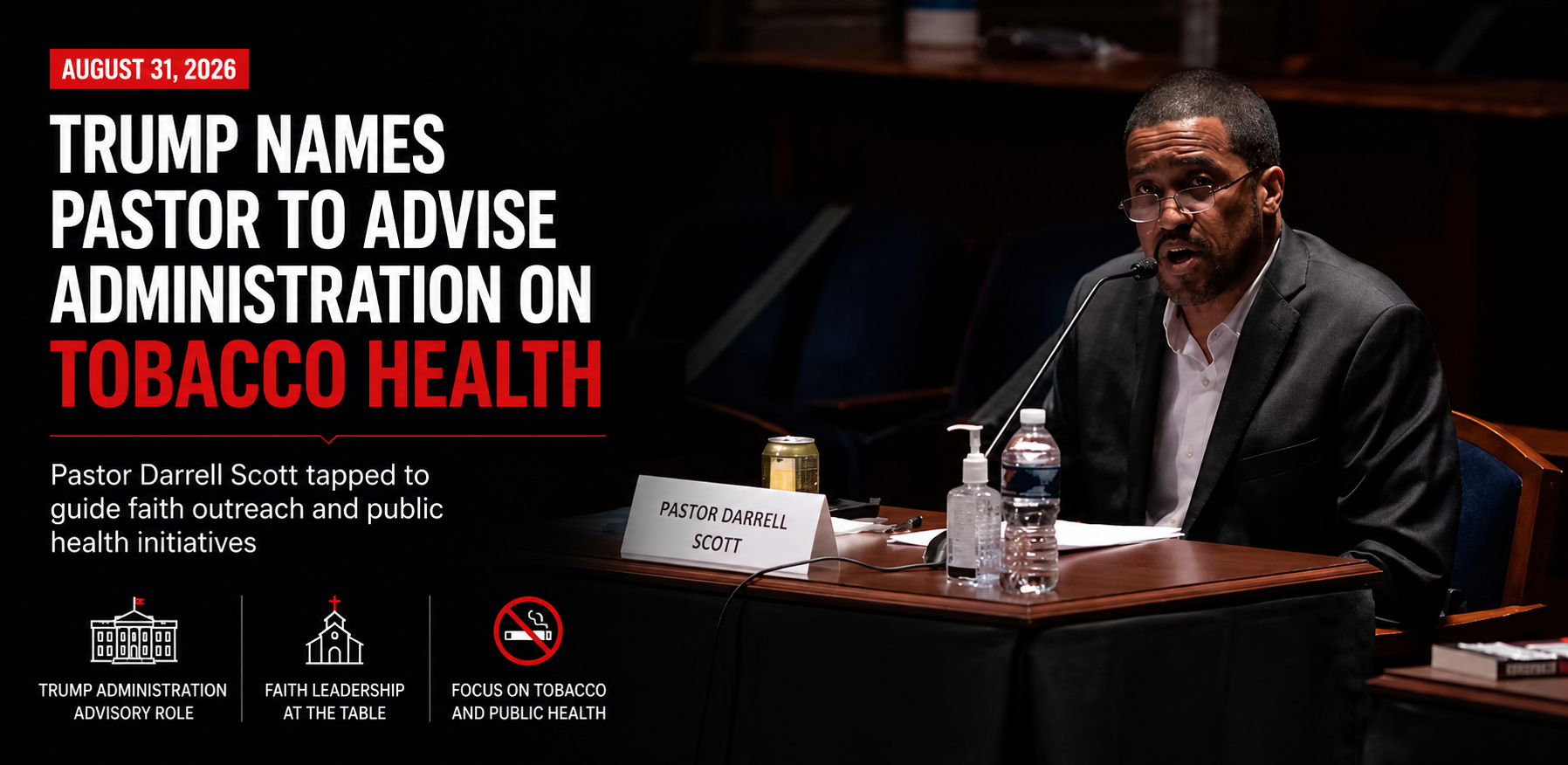
Trump Names Pastor Darrell Scott to Advise Administration on Tobacco Health
What’s Happening
U.S. President Donald Trump has appointed Pastor Darrell Scott as an adviser on tobacco health issues on the advisory committee to the director of the Centers for Disease Control and Prevention (CDC).
Trump announced the appointment on September 1, saying tobacco-related disease has had a major impact on American families, particularly communities that have historically been overlooked and underserved. (Reuters)
The appointment places Scott in a federal advisory role focused on tobacco-related health issues at a time when tobacco policy, nicotine use and the regulation of newer tobacco and nicotine products remain contentious areas of U.S. public health.
Who Is Darrell Scott?
Scott is a pastor and senior religious leader who has previously been involved in public policy discussions and testified before Congress.
Trump described Scott as a longtime friend, a faith leader and an advocate for underserved communities. In announcing the appointment, Trump said Scott would help the administration examine how to better protect Americans from dangerous tobacco products while pursuing approaches intended to reduce harm. (Trump's Truth)
Scott's role is specifically advisory. He will serve on the Advisory Committee to the Director, which provides guidance to the CDC director.
The Focus Is Tobacco-Related Health
Tobacco continues to be a major public-health issue
Tobacco use remains one of the country's major preventable causes of disease and death.
The federal government has historically addressed tobacco through a combination of public-health campaigns, smoking-cessation programs, product regulation and restrictions intended to reduce exposure and use.
The Trump administration's announcement places the appointment within that existing public-health framework, but also signals an emphasis on the effects of tobacco-related disease in underserved communities. (Investing.com)
The role extends beyond traditional cigarettes
Although the announcement specifically refers to tobacco health, the broader tobacco landscape now includes cigarettes, cigars, smokeless tobacco, heated tobacco products and newer nicotine products.
That makes tobacco policy increasingly connected to questions around youth uptake, addiction, product regulation, harm reduction and how consumers move between different nicotine products.
Trump Emphasizes Underserved Communities
A central theme of Trump's announcement was the unequal burden of tobacco-related disease.
He specifically highlighted communities that have been overlooked and underserved, suggesting that the administration wants tobacco-health policy to pay greater attention to populations that experience disproportionate health impacts or have historically had less access to preventive healthcare and cessation resources. (Reuters)
That focus can include not only reducing tobacco use but also improving access to information, cessation support and healthcare services in communities where tobacco-related disease remains a significant problem.
A Politically Significant Appointment
The appointment is notable because of Scott's background
Scott is primarily known as a religious leader rather than as a public-health scientist or tobacco researcher.
That makes his appointment to an advisory role notable because tobacco policy is a highly technical field involving epidemiology, addiction science, toxicology, clinical medicine and regulatory policy.
The announcement does not indicate that Scott will replace public-health experts or independently determine CDC policy. His position is on an advisory committee that provides guidance to the agency's leadership. (Investing.com)
It reflects Trump's broader approach to public-health appointments
The selection also fits a broader pattern in which the administration has brought allies and figures from outside conventional government health-policy circles into advisory and policymaking roles.
That can broaden the range of perspectives involved in policy discussions, while also generating questions about the relative weight given to scientific expertise, political priorities and community advocacy.
Harm Reduction Is Part of the Administration's Message
Trump's announcement specifically referred to protecting Americans from dangerous tobacco products while also supporting solutions intended to reduce harm. (Trump's Truth)
That language is significant because harm reduction can involve policies that distinguish between different tobacco or nicotine products based on their relative risks rather than treating all products as identical.
The approach can raise difficult policy questions, including how to reduce cigarette smoking while avoiding unintended increases in nicotine use among young people or non-smokers.
Why This Matters
Tobacco policy affects a wide section of the U.S. healthcare system.
Smoking and tobacco exposure contribute to chronic disease, cancer, cardiovascular problems and respiratory illness, creating substantial costs for patients, providers, insurers and public-health agencies.
Advisory decisions at the CDC can influence how the government approaches prevention, education and public-health messaging.
The appointment is therefore relevant not simply because of who was selected, but because it comes at a time when the U.S. tobacco-health strategy is being shaped around questions of prevention, underserved populations and harm reduction.
The Healthcare Industry Implications
Prevention and cessation
Healthcare organizations remain important delivery points for smoking cessation and tobacco-use interventions.
Changes in federal priorities could influence how providers communicate about tobacco, which cessation programs receive attention and how public-health resources are directed.
Tobacco and nicotine companies
For companies selling tobacco or nicotine products, shifts in federal health policy can affect regulation, consumer messaging and product positioning.
The distinction between combustible tobacco and alternative nicotine products is particularly important because regulatory approaches can influence both demand and competitive dynamics across the category.
Public-health campaigns
Government messaging can influence consumer perceptions of tobacco risks.
A stronger federal emphasis on underserved communities could lead to more targeted campaigns designed around populations with higher tobacco-use rates or greater barriers to preventive care.
Looking Ahead
Scott's appointment places him inside a federal advisory process rather than giving him direct authority over CDC policy.
The key issue going forward will be what recommendations the advisory committee develops and how the CDC incorporates those recommendations into its tobacco-health strategy.
The administration's emphasis on underserved communities and harm reduction could become especially important as policymakers address traditional smoking alongside newer nicotine products.
The broader tobacco debate will continue to involve competing priorities: reducing overall nicotine addiction, preventing youth uptake, protecting vulnerable populations and determining how different products should be treated from a public-health perspective.
Key Takeaways
- President Donald Trump appointed Pastor Darrell Scott as an adviser on tobacco health issues.
- Scott will serve on the Advisory Committee to the CDC Director. (Reuters)
- Trump emphasized the burden of tobacco-related disease on American families and underserved communities.
- The administration says the role will help examine ways to protect Americans from dangerous tobacco products and support harm-reduction approaches. (Trump's Truth)
- Scott's appointment is notable because his background is primarily as a pastor and community advocate, rather than a conventional tobacco-health specialist.
- The role comes as U.S. policymakers continue to debate smoking cessation, nicotine addiction, tobacco regulation and newer nicotine products.
- The appointment could shape future federal thinking around tobacco prevention, public-health messaging and underserved populations.
What This Means for Healthcare Marketers
For healthcare marketers, the important signal is that tobacco-health policy is increasingly being framed around both public health and community-level engagement.
Healthcare organizations working in smoking cessation, respiratory health, oncology, cardiovascular care and preventive medicine may need to pay attention to changes in federal messaging and priorities, particularly around underserved populations and harm reduction.
For tobacco and nicotine companies, shifts in the government's health narrative can also influence how products are perceived, discussed and regulated.
The bigger takeaway is that changes in federal health leadership can create new messaging and market signals well before they translate into formal regulation or changes in healthcare delivery.