
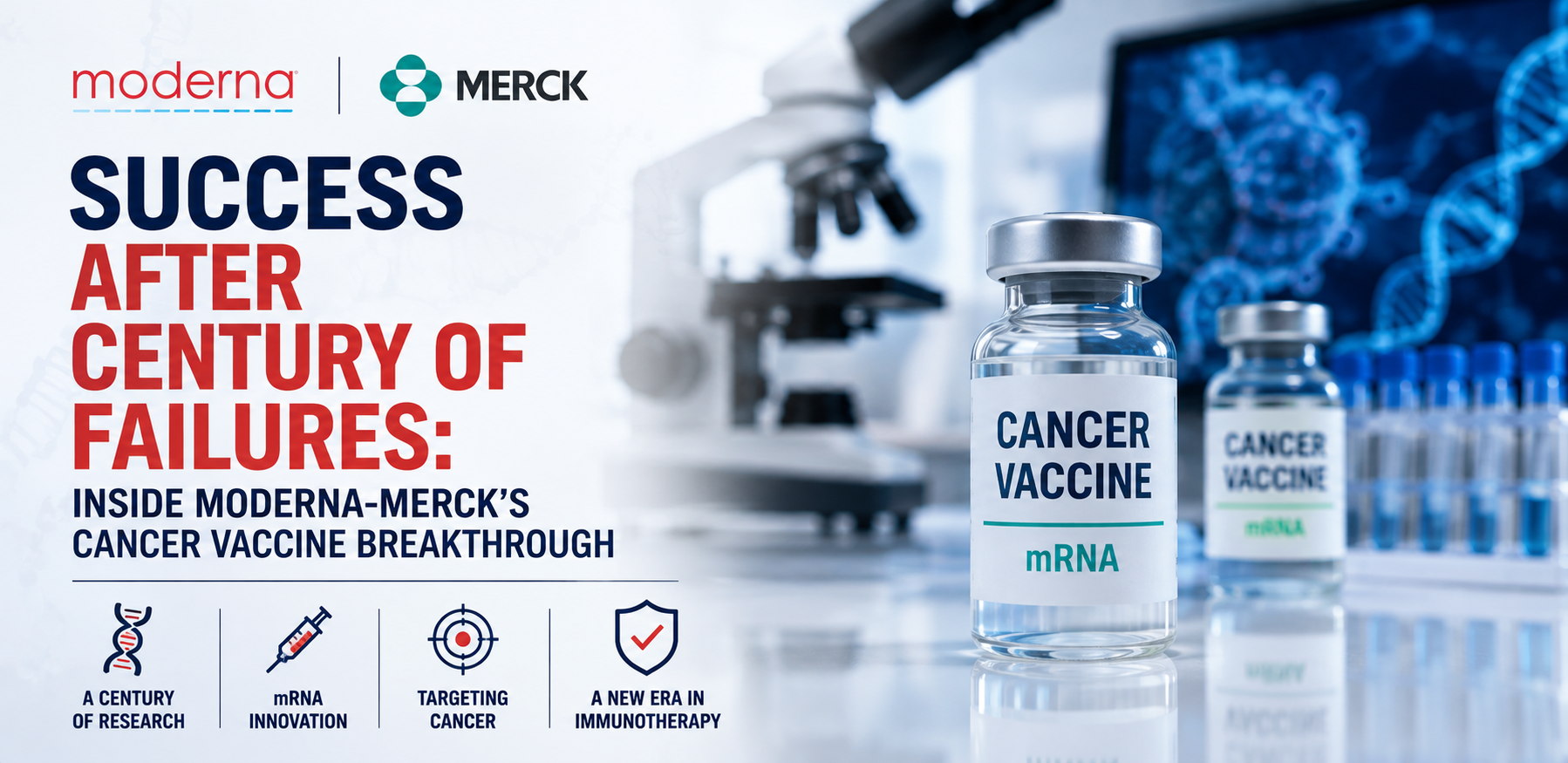
Success After a Century of Failures: Inside Moderna and Merck's Cancer Vaccine Breakthrough
What's Happening
Moderna and Merck's personalized mRNA cancer vaccine has achieved a major late-stage clinical breakthrough, becoming the first therapeutic cancer vaccine to show success in a late-stage trial after more than a century of attempts. (reuters.com)
The vaccine, intismeran, is designed specifically around the mutations found in an individual patient's tumor. In a trial involving more than 1,000 patients with localized melanoma, the vaccine reduced the likelihood that the cancer would return or spread when combined with Merck's Keytruda. (reuters.com)
Our Article: Reuters article
Why This Is a Breakthrough
Cancer vaccines have been studied for more than 100 years, but attempts to create therapeutic vaccines that reliably train the immune system to attack an existing patient's cancer have repeatedly failed in late-stage testing.
The Moderna-Merck result is different because the vaccine demonstrated an ability to reduce melanoma recurrence and spread in a large late-stage trial. (reuters.com)
Cancer experts see the result as evidence that personalized vaccines could become an important new category of cancer treatment.
How the Vaccine Works
The treatment uses mRNA technology to teach the immune system which characteristics of a patient's tumor to recognize.
The process is personalized:
- A patient's tumor is removed and genetically analyzed.
- Researchers identify mutations unique to that cancer.
- The vaccine is designed around those tumor-specific targets.
- The mRNA vaccine delivers instructions to the immune system.
- The immune system learns to recognize and attack cells carrying those cancer markers.
The vaccine therefore isn't a single standardized product in the traditional sense. It is designed around the specific genetic profile of each patient's tumor. (reuters.com)
Why Keytruda Is Important
The vaccine is being developed alongside Merck's blockbuster immunotherapy Keytruda.
The two treatments have complementary roles:
- Keytruda: helps remove mechanisms that allow cancer cells to suppress the immune response.
- Intismeran: gives the immune system specific targets to recognize on the patient's cancer.
The combination therefore attempts to both activate the immune response and make that response more precise.
The Trial
The late-stage trial enrolled more than 1,000 patients with localized melanoma whose tumors had been surgically removed but who remained at high risk of recurrence. (reuters.com)
The personalized vaccine, when combined with Keytruda, reduced the risk of the melanoma returning or spreading compared with Keytruda alone.
Full details of the trial were still pending at the time of the Reuters report.
A Decade of Development
The breakthrough represents approximately 10 years of work by Moderna and Merck.
The companies announced their partnership to develop personalized cancer vaccines in 2016. (m.investing.com)
The companies had to overcome multiple challenges involving:
- Identifying useful tumor mutations.
- Designing individualized vaccines.
- Manufacturing each patient's treatment.
- Delivering the vaccine quickly enough for cancer care.
- Generating a strong enough immune response.
The successful melanoma trial suggests that the underlying approach can work at scale, although significant challenges remain.
Manufacturing Is Still a Major Challenge
Because the vaccine is personalized, manufacturing is fundamentally different from producing a conventional cancer drug.
Every patient effectively requires a customized vaccine.
That means the healthcare system needs to coordinate:
- Tumor removal.
- Genetic sequencing.
- Mutation analysis.
- Vaccine design.
- Manufacturing.
- Quality control.
- Distribution.
- Administration.
The entire process must happen quickly enough that a cancer patient does not have to wait excessively long for treatment.
Potential Commercial Opportunity
Wall Street analysts are already estimating billions of dollars in potential sales if the vaccine is approved. (reuters.com)
For Merck, the treatment could help offset the impact of Keytruda's eventual patent expiration.
For Moderna, the development is particularly important because the company's COVID-19 vaccine business has declined substantially from its pandemic peak.
Reuters reported that Moderna's shares have risen more than 130% since the cancer-vaccine results were announced, while analysts expect the treatment could eventually generate more than $1 billion in annual sales. (m.investing.com)
Why Melanoma Worked
Melanoma is considered a particularly promising target for personalized cancer vaccines because melanoma tumors tend to contain many mutations.
That gives researchers more potential targets for the immune system to recognize.
The next challenge is determining whether the same approach will work in cancers with fewer mutations, including:
- Lung cancer
- Kidney cancer
- Pancreatic cancer
Those cancers are generally harder to treat with immunotherapy. (m.investing.com)
The Broader mRNA Cancer Vaccine Field
The Moderna-Merck success comes with an important caveat.
On the same day, BioNTech ended a mid-stage trial of its own personalized mRNA cancer vaccine for colorectal cancer after an independent committee determined that continuing the study was unlikely to demonstrate a survival benefit. (reuters.com)
That contrast highlights that personalized mRNA vaccines may work particularly well for some cancers but not necessarily all tumor types.
Impact on Healthcare
- Oncology: The development could establish personalized cancer vaccines as a new treatment category in oncology.
- Precision Medicine: It represents an extreme form of precision medicine, with treatment designed around the molecular characteristics of an individual patient's tumor.
- Genomics: Tumor sequencing becomes a critical component because the vaccine depends on identifying mutations specific to each patient's cancer.
- Pharmaceutical Manufacturing: Commercial success will require manufacturers to build highly efficient systems capable of producing thousands of individualized therapies.
- Cancer Centers: Hospitals and oncology centers may eventually need infrastructure for tumor sequencing, sample management and personalized-treatment logistics.
Why This Matters
This is a major U.S. healthcare industry story because it could represent a fundamental shift in how cancer is treated.
Instead of giving every patient the same cancer vaccine, the approach is essentially:
Sequence the tumor → identify its unique mutations → create a personalized vaccine → train the patient's immune system to attack that cancer.
If the approach succeeds in additional cancers, it could become an important pillar of precision oncology. (reuters.com)
Looking Ahead
The companies are preparing the data for regulatory review, with U.S. FDA approval potentially coming as soon as 2027, according to Reuters. (m.investing.com)
They are also continuing to test the approach in additional cancer types.
The biggest questions now are whether the melanoma results can be replicated, whether the vaccine can work in harder-to-treat tumors and whether personalized manufacturing can be made fast and affordable enough for widespread clinical use.
Key Takeaways
- Moderna and Merck's personalized cancer vaccine succeeded in a late-stage melanoma trial.
- It is described as the first therapeutic cancer vaccine to achieve late-stage success after more than 100 years of failed attempts. (reuters.com)
- The trial involved more than 1,000 patients.
- The vaccine reduced melanoma recurrence and spread when combined with Keytruda.
- Each vaccine is customized to the patient's tumor mutations.
- Manufacturing and genomic sequencing will be major challenges to commercialization.
- FDA approval could potentially come as soon as 2027.
- The approach is now being tested in additional cancers.
- BioNTech's simultaneous colorectal-cancer vaccine setback shows that the technology may not work equally well across all tumor types. (reuters.com)
What This Means for Healthcare Marketers
This development is highly relevant to oncology, precision medicine, genomics, molecular diagnostics, cancer centers, specialty pharmaceuticals and advanced-therapy manufacturing. If personalized cancer vaccines reach commercial use, identifying the right oncology providers, sequencing capabilities, treatment centers and eligible patient populations will become increasingly important.