What's Happening
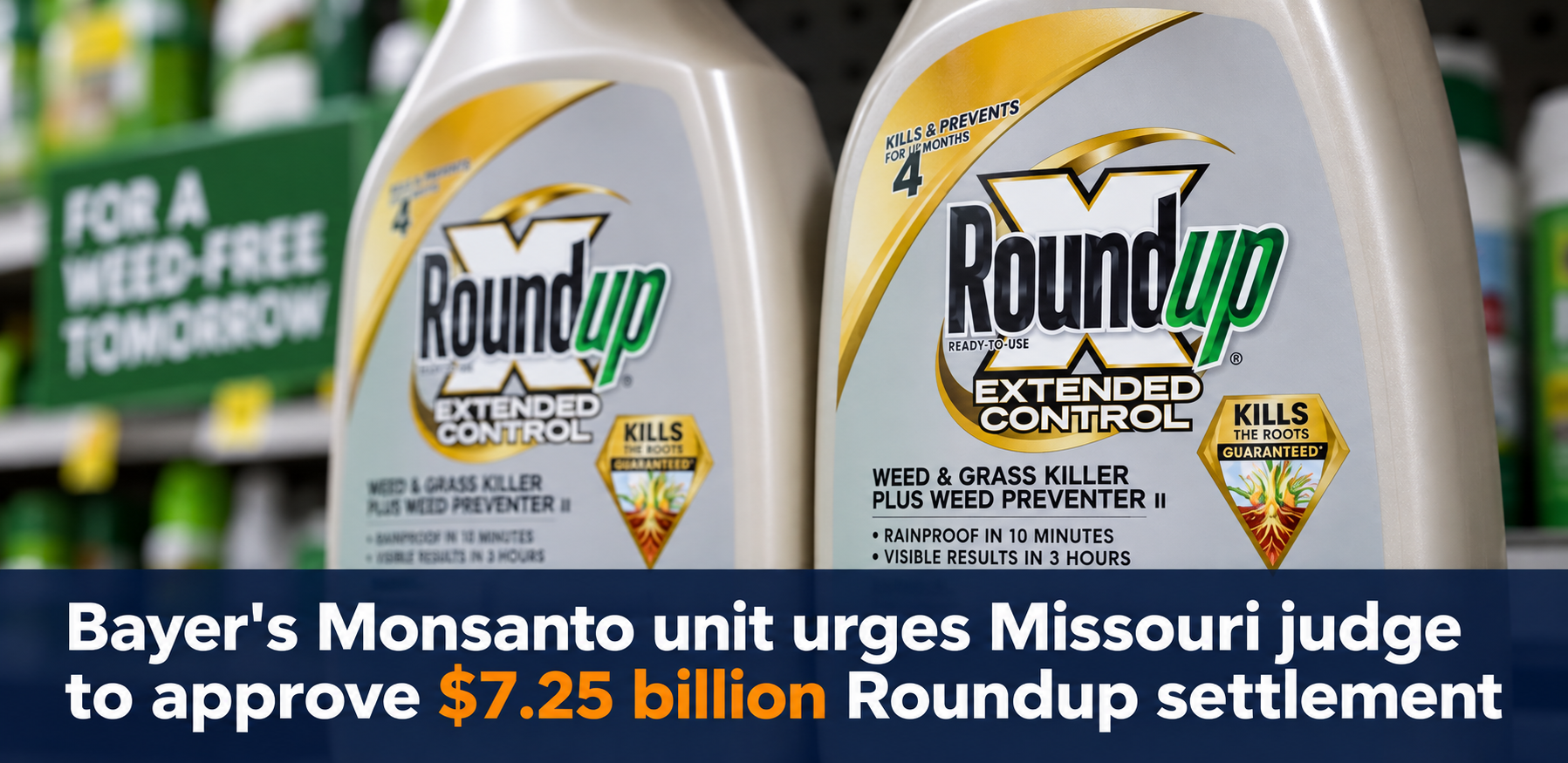
Bayer's Monsanto unit is asking a Missouri judge to approve a $7.25 billion settlement designed to resolve nearly all existing and future U.S. lawsuits alleging that its Roundup weedkiller causes cancer.
The proposed class-action settlement is intended to address claims from people who say exposure to Roundup caused non-Hodgkin lymphoma, a type of cancer. A hearing was held Monday in St. Louis before Missouri Circuit Judge Timothy Boyer, who heard arguments from attorneys supporting and opposing the agreement. (Reuters)
Bayer has emphasized that it considers this the settlement it is prepared to pursue and says it will continue fighting the cases in court if the agreement is rejected.
The judge did not issue an immediate ruling, meaning the settlement remains subject to further review. (Reuters)
What the Settlement Would Do
Standardized compensation system replaces individual litigation
The agreement is intended to resolve approximately 65,000 U.S. Roundup-related claims and establish a framework for compensating eligible people who developed non-Hodgkin lymphoma after exposure to the product.
Under the proposed structure, individual payments would range from approximately $10,000 to $165,000.
The amount a claimant receives would depend on factors including:
- The severity of the cancer
- The claimant's age at diagnosis
- The circumstances and duration of Roundup exposure
- Whether exposure occurred at home or through employment (Reuters)
The settlement is therefore designed to replace years of individual litigation with a standardized compensation system.
Why Some Plaintiffs Now Support the Deal
U.S. Supreme Court ruling weakens plaintiffs' labeling claims
Support for the settlement has increased following a major legal victory for Monsanto at the U.S. Supreme Court.
Hunter Shkolnik, whose law firm represents about 3,000 Roundup plaintiffs, told the Missouri court that roughly 800 to 900 of his clients initially planned to opt out of the settlement.
Many later changed their minds after the Supreme Court's June ruling siding with Monsanto on an important labeling issue. (Reuters)
The Supreme Court ruling limited claims arguing that Roundup's label should have contained a warning about cancer risks.
That ruling weakened the legal position of many plaintiffs and changed the calculation for people deciding whether to remain in the settlement or pursue individual lawsuits.
Why Other Plaintiffs Oppose It
Debate over compensation adequacy and future claims
Not all plaintiffs' attorneys believe the proposed compensation is sufficient.
Opponents argue that $165,000 is too low for many people who developed cancer, particularly because relatively few claimants would qualify for the maximum payment.
They also argue that the settlement does not adequately account for future exposure and potential future cancer claims because Roundup remains commercially available. (Reuters)
Attorney T. Roe Frazer told the court that the total value of the settlement may sound substantial, but argued that it is insufficient when distributed among a very large group of current and future claimants.
This has produced a central disagreement over the settlement: whether certainty and guaranteed compensation are more valuable than the possibility of larger individual recoveries through continued litigation.
Bayer's Long Legal Battle
Seeking a predictable resolution following the 2018 Monsanto acquisition
The Roundup litigation has been one of the biggest legal problems facing Bayer since the German company acquired Monsanto in 2018.
The company previously spent approximately $10 billion in 2020 to resolve most of the Roundup lawsuits that existed at that time.
However, Bayer was unable to secure court approval for a separate $1.25 billion arrangement intended to resolve future claims. (Reuters)
The unresolved litigation has continued to consume financial resources and management attention while contributing to pressure on Bayer's stock.
The proposed $7.25 billion settlement represents another attempt to create a much more predictable resolution.
Bayer Continues to Deny Roundup Causes Cancer
Company points to scientific studies supporting glyphosate safety
Bayer maintains that Roundup does not cause cancer.
The company says decades of scientific studies support the safety of glyphosate, Roundup's key ingredient.
The scientific and regulatory debate surrounding glyphosate has been complicated by different assessments from regulators and scientific organizations. The litigation, however, largely centers on whether plaintiffs can establish legal liability for alleged cancer risks and whether Monsanto adequately warned consumers.
The Supreme Court's recent ruling has significantly changed the legal landscape by limiting one important pathway for plaintiffs to pursue those claims. (Reuters)
The Role of Glyphosate Exposure
Widespread exposure raises concerns over potential future claimant volume
Opponents of the settlement have also pointed to the widespread use of glyphosate.
Frazer argued that a large percentage of Americans may have been exposed to glyphosate and that the potential population of future claimants could therefore be much larger than the current group of lawsuits.
That concern is particularly important for a settlement that attempts to cover both existing and future claims.
The challenge for the court is determining whether the proposed $7.25 billion framework provides a fair balance between immediate compensation and the uncertainty surrounding future cases.
What the Supreme Court Ruling Changed
Labeling restrictions shift plaintiff leverage
The Supreme Court's decision has become an important factor in the settlement negotiations.
Before that ruling, plaintiffs had greater leverage to pursue claims based on allegations that Monsanto should have included stronger cancer warnings on Roundup's labeling.
After the ruling, many of those claims became significantly harder to pursue.
That weakened litigation position appears to have encouraged some plaintiffs to return to the settlement rather than continue with uncertain individual lawsuits.
This is one reason supporters told the Missouri court that the settlement has become more attractive since it was negotiated. (Reuters)
Why This Matters for Bayer
For Bayer, the settlement is about more than resolving individual lawsuits.
The company has spent years trying to reduce the litigation overhang created by the Monsanto acquisition.
An approved settlement could provide greater visibility into future legal costs and allow management to focus more heavily on Bayer's core pharmaceutical and agricultural businesses.
The agreement also creates a ceiling around a major category of legal exposure instead of leaving the company exposed to potentially unpredictable verdicts and settlement negotiations across thousands of cases.
Why This Matters for Healthcare and Consumer Health
The case also demonstrates the business consequences that can emerge when questions about the safety of widely used consumer products become the subject of large-scale litigation.
Roundup is an agricultural product rather than a medicine, but the dispute has broader implications for healthcare and life-sciences companies because product safety claims can lead to:
- Massive litigation expenses
- Long-term reputational damage
- Changes in consumer behavior
- Increased scrutiny of scientific evidence
- Pressure on product labeling and risk communication
For companies selling products connected to health, safety or human exposure, the legal and commercial consequences can extend far beyond the original scientific dispute.
Why This Matters
The $7.25 billion settlement represents a potentially important turning point in one of the longest-running product-liability battles in the U.S.
Bayer faces roughly 65,000 claims, and the company has already spent about $10 billion resolving earlier Roundup cases. (Reuters)
If approved, the new agreement could provide much greater certainty over the company's future Roundup liabilities.
But opponents argue that the proposed payments are inadequate and that forcing current and future plaintiffs into a common settlement framework could prevent some people from receiving compensation proportionate to their injuries.
The court therefore has to balance financial certainty, claimant compensation and the legal realities created by the Supreme Court's recent ruling.
Looking Ahead
Judge Boyer weighs final approval as future litigation hangs in the balance
Judge Timothy Boyer is expected to take additional time before deciding whether to grant final approval.
If approved, Monsanto would make payments under the settlement structure to resolve eligible claims, potentially bringing a substantial portion of the Roundup litigation to an end.
If the deal is rejected, Bayer has said it is prepared to continue defending the lawsuits individually.
That would leave the company exposed to continued legal costs, uncertain verdicts and years of additional litigation.
Key Takeaways
- Bayer's Monsanto unit is seeking approval for a $7.25 billion settlement covering nearly all existing and future U.S. Roundup cancer claims.
- Bayer faces approximately 65,000 claims alleging Roundup exposure caused non-Hodgkin lymphoma.
- Eligible plaintiffs would receive roughly $10,000 to $165,000, depending on factors such as cancer severity, age and exposure.
- Some plaintiffs who previously planned to opt out of the settlement changed their positions after the U.S. Supreme Court ruled in Monsanto's favor on a key labeling issue.
- Opposing attorneys argue the proposed compensation is inadequate and does not sufficiently account for future claims.
- Bayer continues to deny that Roundup causes cancer.
- The company has already spent approximately $10 billion resolving earlier Roundup lawsuits.
- Approval would give Bayer substantially more certainty over a litigation problem that has persisted since its 2018 acquisition of Monsanto. (Reuters)
What This Means for Healthcare Marketers
The Roundup case highlights how scientific uncertainty, legal exposure and consumer trust can become tightly connected.
For healthcare and life-sciences marketers, product-safety controversies can affect much more than legal departments. They can influence brand reputation, customer confidence, media narratives, purchasing behavior and the way scientific evidence needs to be communicated.
The case also reinforces the importance of being able to identify early signals around changing scientific sentiment, regulatory actions, litigation trends and consumer concerns before they become large-scale commercial risks.