
U.S. Refusals of Crucial Newborn Vitamin K Shot Surge, Raising Risk of Dangerous Bleeding
What’s Happening
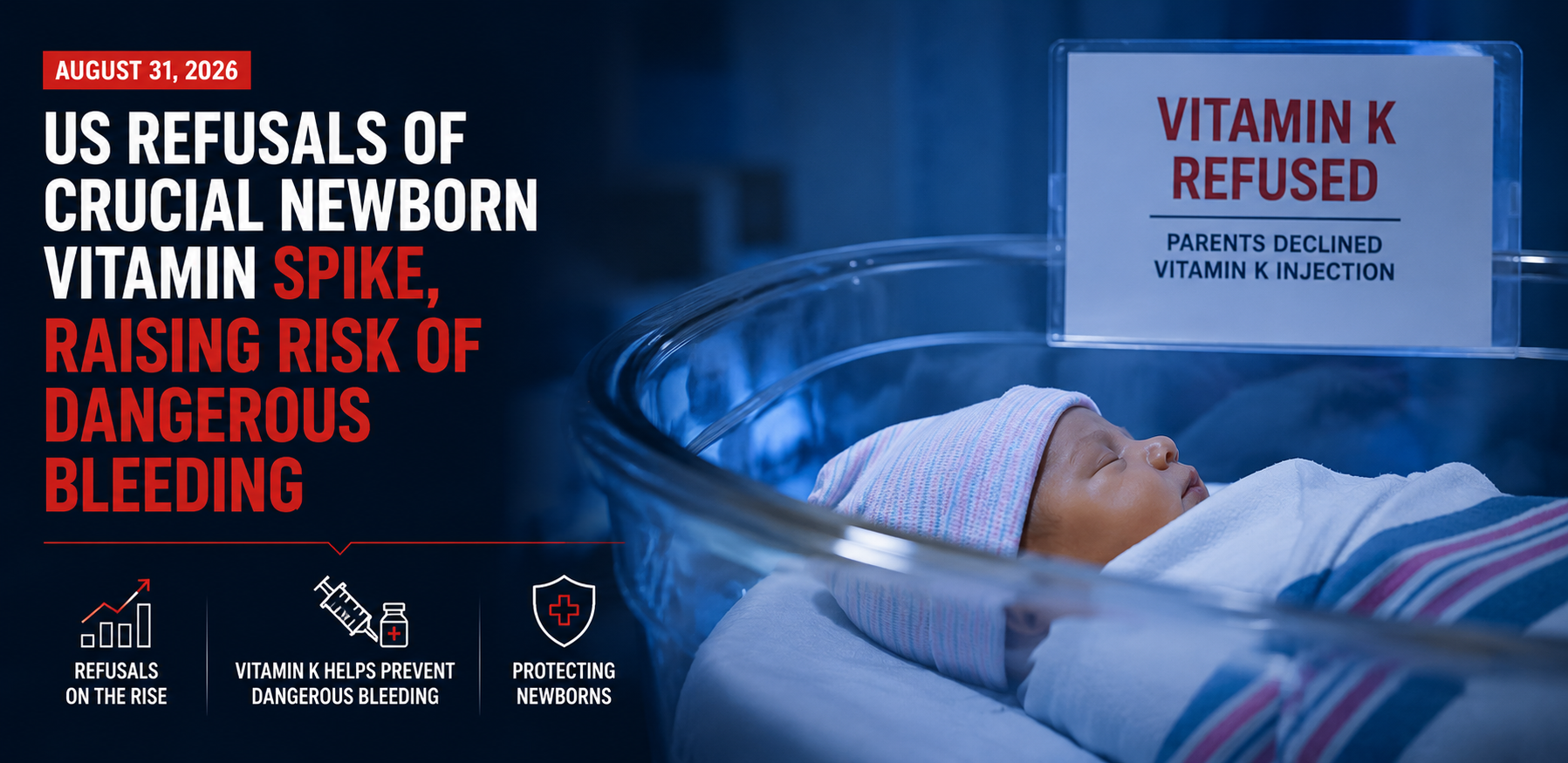
The number of U.S. parents and caregivers refusing the routine vitamin K injection given to newborns at birth has risen sharply in 2026, increasing concerns among pediatricians that more infants could suffer serious, potentially fatal bleeding. An exclusive analysis of health records covering more than 1 million births found that the rate of newborns who did not receive the shot within a day of birth increased by more than 57% between January and June 2026. (Reuters)
By the end of June, 8.1% of U.S. newborns were not receiving the vitamin K shot, compared with 5.2% six months earlier. The first-half 2026 rate was 2.5 times the average level recorded from 2019 through 2024 and 1.4 times the rate seen in 2025. (Reuters)
Pediatricians and neonatologists told Reuters that the trend is particularly concerning because newborns naturally have very low levels of vitamin K, which is essential for normal blood clotting.
Why Newborns Need Vitamin K
Babies start life with very little vitamin K
Vitamin K plays a central role in blood clotting. Babies are born with low levels of the vitamin and remain relatively unprotected for roughly their first six months, according to the Centers for Disease Control and Prevention.
The standard injection given shortly after birth is designed to prevent vitamin K deficiency bleeding, a condition that can cause severe internal bleeding, including bleeding in the brain or gastrointestinal tract. (Reuters)
The consequences of refusing the shot can be severe
The CDC says newborns who do not receive the injection are 81 times more likely during their first six months to experience life-threatening bleeding in the brain or gut.
Reuters also reports that about one in five infants who experience serious bleeding dies. Without the shot, this type of bleeding occurs in approximately one out of every 59 births. (Reuters)
That makes the growing refusal rate more than a question of preventive care uptake. Doctors are concerned that the trend could translate into preventable cases of catastrophic bleeding.
The Numbers Are Rising Rapidly
More than 1 million births analyzed
The analysis by healthcare data and analytics company Truveta examined records covering 1,026,375 infants born to 825,599 mothers between January 2019 and June 2026.
The underlying dataset covers more than 140 million people, giving researchers a large national sample with which to assess changes in newborn vitamin K uptake. (Reuters)
The data show that refusal has been increasing for years, but the increase during the first half of 2026 was notably faster.
Refusal rates accelerated in 2026
The proportion of newborns not receiving the shot climbed from 5.2% at the end of 2025 to 8.1% by June 2026.
Doctors interviewed by Reuters said they are seeing the increase directly in hospitals and pediatric practices, with some practices changing how they provide the injection as refusals become more common. (Reuters)
Pediatricians Are Seeing a Broader Trust Problem
The concern extends beyond vitamin K
Doctors say the increase in vitamin K refusals appears to be part of a wider pattern of mistrust toward established medical interventions.
Pediatricians told Reuters that some parents are increasingly questioning routine newborn treatments, including vitamin K, the hepatitis B vaccine and antibiotic eye ointment.
The concern is that parents may be treating multiple newborn interventions as part of the same category of medical products they do not trust, rather than evaluating each intervention independently. (Reuters)
Doctors describe misinformation as a major factor
The American Academy of Pediatrics said its members are increasingly encountering parents who reject evidence-based recommendations because of inaccurate or misleading information.
Dr. Karen Puopolo, chair of the AAP's Committee on Fetus and Newborn, said the trend reflects what pediatricians are dealing with in everyday practice. (Reuters)
For clinicians, this creates a communication challenge because the vitamin K shot is not a vaccine. It is a preventive treatment intended to compensate for a normal biological deficiency in newborns.
Federal Health Policy Has Become Part of the Debate
Doctors worry about mixed public-health messages
The rise in vitamin K refusals is occurring during a period of significant change in federal health messaging.
Health Secretary Robert F. Kennedy Jr. has challenged several established medical recommendations. In January, his department dropped routine recommendations for the birth dose of the hepatitis B vaccine and five other childhood vaccines. Those changes were subsequently put on hold by a court ruling, although President Donald Trump called for them again in an August 10 executive order. (Reuters)
Pediatricians told Reuters that such developments can create uncertainty among parents about other routine newborn interventions, even when those interventions have a different purpose and evidence base.
Kennedy denies responsibility for the vitamin K trend
At an April congressional hearing, Representative Kim Schrier, a pediatrician, asked Kennedy about declining support for vitamin K and whether it represented a spillover effect from broader changes in health policy.
Kennedy denied playing a role in the trend.
The Department of Health and Human Services, meanwhile, said that HHS and the CDC are evaluating available data and surveillance related to vitamin K refusals and bleeding events and continue to provide information to parents and providers. (Reuters)
Baby Girls Are Being Refused the Shot More Often
A notable gender difference
The national data show an unexpected difference between newborn boys and girls.
In June 2026, 8.9% of baby girls had not received the vitamin K shot within one day of birth, compared with 7.3% of boys. (Reuters)
That disparity is consistent with earlier research from hospitals affiliated with the University of Pennsylvania, where researchers found that being born a girl was associated with twice the risk of vitamin K refusal.
Circumcision may explain part of the difference
Pediatricians told Reuters that parents who oppose vitamin K sometimes make an exception when they want their sons circumcised.
Many hospitals will not perform circumcision on newborn boys who have not received vitamin K because of concerns about bleeding during and after the procedure.
About half of U.S. boys are circumcised in hospitals, according to Reuters, meaning the procedure may indirectly influence whether some parents ultimately accept the shot. (Reuters)
That dynamic does not exist for newborn girls, potentially helping explain why refusal rates are higher among girls.
Some Pediatric Practices Are Changing Their Approach
Doctors are bringing the shot into primary care
As refusals at hospitals become more common, some pediatric practices are taking additional steps to make vitamin K available outside the delivery setting.
Zarminali Pediatrics, which operates 45 practices in 13 states, has begun stocking the injection in all of its primary care practices.
Two other doctors told Reuters they had also started providing vitamin K shots in their own practices. (Reuters)
This illustrates how a change in parental behavior can affect healthcare operations. A treatment traditionally administered in the hospital shortly after birth may increasingly need to be incorporated into follow-up pediatric care.
Doctors Fear the First Signs of a Larger Problem
Previous outbreaks show what can happen
The concern is not theoretical.
One neonatologist interviewed by Reuters recalled a cluster of infants in Nashville in 2013 who developed severe bleeding associated with vitamin K deficiency. The infants' parents had believed the shot was unnecessary or potentially harmful.
One baby treated by the doctor survived but suffered long-term brain damage. (Reuters)
Doctors worry that a continued rise in refusals could lead to more such cases appearing across the country.
The consequences can emerge months after birth
One challenge is that vitamin K deficiency bleeding is not necessarily limited to the immediate newborn period.
Because infants remain relatively low in vitamin K for months, refusing the birth dose can leave them vulnerable during a longer window when parents may no longer realize that the original decision has created a continuing risk. (Reuters)
Public-Health Surveillance Could Become More Important
In July, Representative Kim Schrier and Senator Angela Alsobrooks asked federal health officials to begin systematically tracking vitamin K refusals, bleeding events and associated deaths and to make that information publicly available.
They said they had not received a response from the CDC at the time Reuters published its report.
HHS said the agency is currently evaluating available data and surveillance related to the issue. (Reuters)
Better surveillance could help determine whether rising refusal rates are already producing measurable increases in vitamin K deficiency bleeding and which populations or regions are most affected.
Why This Matters
The vitamin K trend is an example of how declining trust in established healthcare recommendations can translate into measurable changes in preventive treatment.
The issue also demonstrates that the consequences of health-policy communication can extend beyond the specific intervention being debated. When parents receive conflicting signals from government officials, social media and healthcare professionals, distrust may spread to other treatments that were never part of the original policy debate.
For hospitals and pediatric practices, rising refusal rates can mean more difficult conversations with parents, additional documentation and consent procedures, and potentially greater demand for treatment after discharge.
Most importantly, doctors are worried about a preventable shift in newborn health outcomes. The vitamin K injection has been used for decades precisely because newborns are naturally vulnerable to severe bleeding.
Looking Ahead
The key question is whether the sharp increase in refusals seen during the first half of 2026 continues through the rest of the year.
Federal agencies are evaluating available data on refusals and bleeding events, but clinicians and lawmakers are pushing for more transparent and systematic tracking.
Pediatric practices are also adapting. Some are making vitamin K available after hospital discharge and strengthening discussions with parents who decline the injection.
If refusal rates continue rising, healthcare systems may increasingly need to treat vitamin K uptake as a public-health communication issue rather than simply a routine maternity-ward procedure.
Key Takeaways
- U.S. newborn vitamin K refusals increased by more than 57% from January through June 2026. (Reuters)
- By June, 8.1% of newborns had not received the shot within a day of birth, compared with 5.2% six months earlier. (Reuters)
- The first-half 2026 refusal rate was 2.5 times the 2019-2024 average and 1.4 times the 2025 rate.
- Babies who do not receive vitamin K are 81 times more likely to experience life-threatening bleeding in the brain or gut during their first six months. (Reuters)
- About one in five infants who experience serious bleeding dies.
- Baby girls had a higher refusal rate than boys in June, 8.9% versus 7.3%. (Reuters)
- Pediatricians say rising refusals are occurring alongside broader mistrust of vaccines and other routine newborn interventions.
- HHS and the CDC are evaluating data on vitamin K refusals and related bleeding events. (Reuters)
- Some pediatric practices have begun stocking vitamin K so the shot can be offered after hospital discharge.
What This Means for Healthcare Marketers
For healthcare organizations, this is fundamentally a trust and communication problem.
The challenge is not simply getting parents to know that vitamin K exists. It is communicating why it is medically necessary, what risk it prevents, and how that risk compares with the perceived risks parents may encounter online.
For pediatric providers, hospitals and public-health organizations, the rising refusal rate makes clear that evidence alone does not guarantee adoption. Healthcare marketers increasingly need to understand where misinformation, distrust and changing public sentiment are influencing patient decisions, because those signals can translate into real changes in healthcare utilization and preventive-care behavior.