
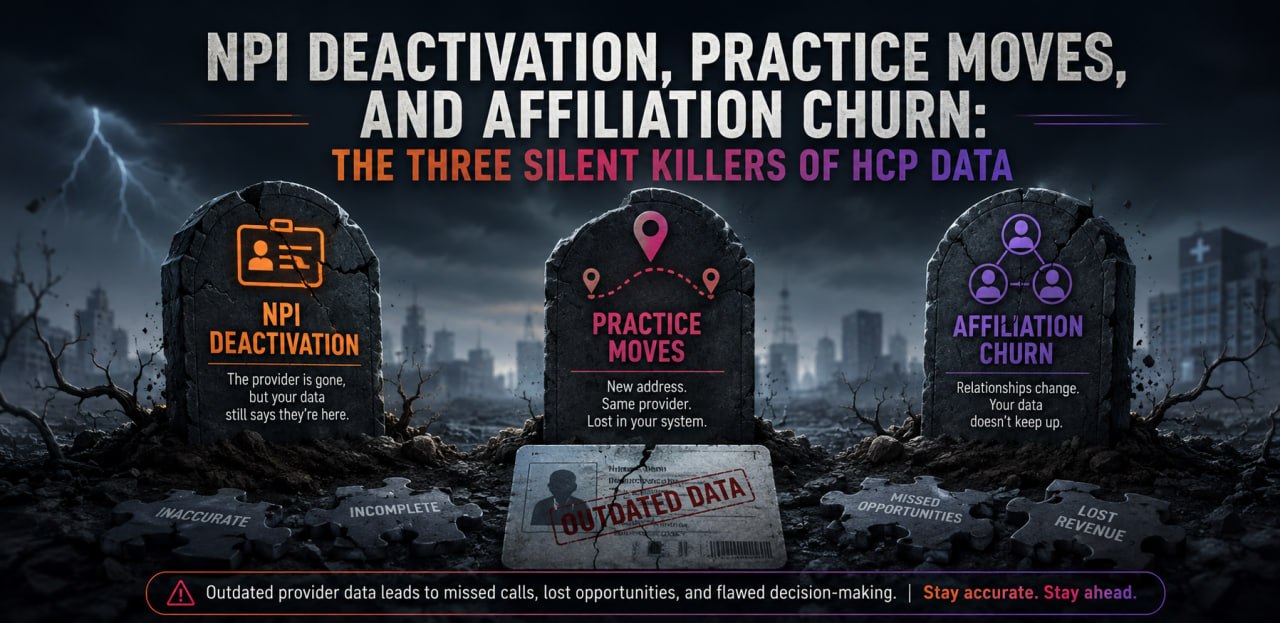
Three different ways your data goes wrong, and three different ways each one hides from you.
Most database errors announce themselves. A bounced email. A returned package. Something breaks, and you notice.
These three don't work that way. Each one can sit inside a "clean-looking" record for months, doing damage, without triggering a single alert. And each one hides differently, which is exactly why one detection method can't catch all three.
NPI Deactivation: the record that goes quiet
Every physician has a National Provider Identifier, a unique ID used across billing and administrative systems. When a physician retires, changes roles, or restructures how they practice, that NPI can go inactive in the national registry.
Nothing in your CRM tells you this happened. The number still looks like a number. The record still looks complete. The registry itself, NPPES, the same system that issues NPIs, is public and searchable, but almost nobody checks it as part of routine list hygiene. Unless someone actively cross-references it, an inactive NPI sits in your database indefinitely, indistinguishable from an active one, until a campaign quietly fails to reach someone who, administratively, no longer exists.
Practice Moves: the record that lies by succeeding
This one is the most dangerous, because it doesn't fail. It succeeds, at the wrong thing.
A physician moves practices. Their old office is still a real address. Mail still gets delivered there. From a shipping report, that package is a success: delivered, no bounce, no error. Except the physician who was supposed to receive it left months ago, and someone else's front desk just accepted a sample intended for a person who isn't there anymore.
A bounce at least tells you something's wrong. A practice move often doesn't tell you anything at all, because the delivery genuinely succeeded. It just succeeded at reaching the wrong place.
Check My Data Free →Affiliation Churn: the record that disagrees with itself
Affiliation, meaning which health system, hospital, or practice group a physician is formally connected to, often comes from a different data pipeline than address or NPI status. That means it can go stale on its own schedule, independent of everything else in the record looking fine.
A physician's address can be current, their NPI can be active, and their listed affiliation can still be wrong, because their practice was acquired, merged, or restructured since anyone last checked that specific field. A physician flagged as part of one regional health system, when they've actually moved to an entirely different one, can throw off which rep calls on them, which materials get sent, and which broader account relationship the interaction is supposed to reflect.
Because the rest of the record looks accurate, affiliation errors are the easiest of the three to miss entirely.
Why these three are dangerous together
None of these three is especially hard to catch on its own. What makes them dangerous is that they each evade a different check. Address validation catches some address problems but says nothing about an inactive NPI. NPI verification says nothing about whether the address is current. Neither says anything about affiliation.
Catching all three isn't one task. It's three separate ones, running continuously, at the same time.
Check My Data Free →