
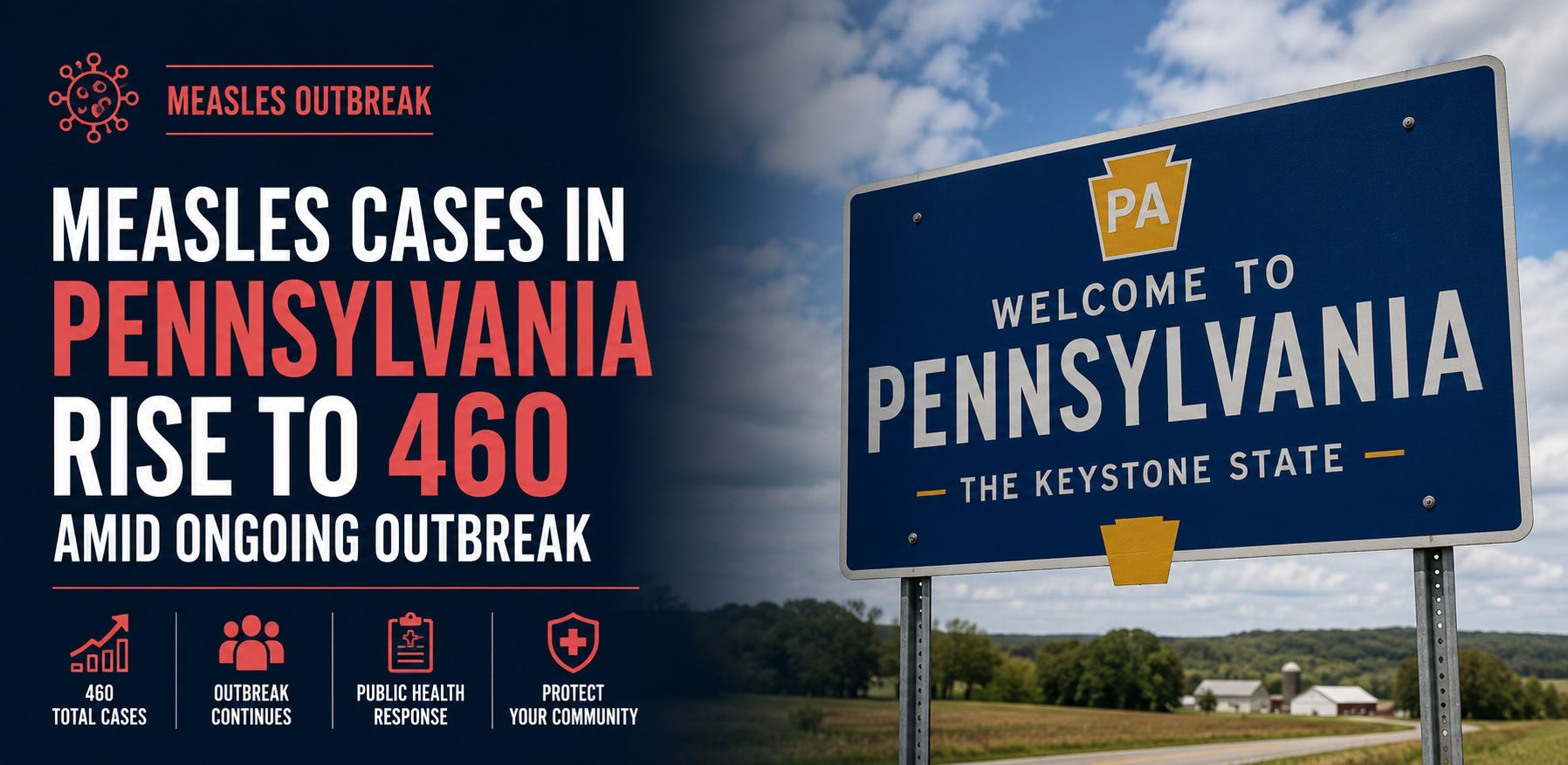
Measles Cases in Pennsylvania Rise to 460 Amid Ongoing Outbreak
What's Happening
Pennsylvania's confirmed measles cases have risen to 460 in 2026, an increase of 36 cases in just two days, as the state continues to deal with its largest measles outbreak in decades. (reuters.com)
The cases are spread across 31 counties, with 83 hospitalizations reported. Two Pennsylvania residents have died after contracting measles, marking the first measles-related deaths reported in the United States in 2026. (reuters.com)
Our Article: Reuters article
Where the Outbreak Is Concentrated
Lancaster County remains the hardest-hit area, with 210 confirmed cases.
Reuters reported that none of the infections in Lancaster County were among people who were fully vaccinated. (reuters.com)
The outbreak is therefore concentrated in communities where vaccination coverage has not provided sufficient population-level protection against the highly contagious virus.
The Broader U.S. Situation
Pennsylvania's outbreak is part of a much larger national resurgence.
The CDC has recorded more than 2,700 measles cases across the United States in 2026, the highest level since the major U.S. measles resurgence of 1989-1991. (reuters.com)
The two Pennsylvania deaths are also the first U.S. measles deaths reported this year.
Why Measles Is a Serious Public-Health Concern
Measles is one of the most contagious infectious diseases.
It spreads through respiratory droplets and can cause serious complications including:
- Pneumonia
- Brain inflammation
- Severe respiratory illness
- Hospitalization
- Death
The disease can spread rapidly when vaccination coverage falls below the level needed for community protection.
Vaccination Remains the Main Protection
The MMR vaccine remains the primary tool for preventing measles and limiting outbreaks.
Two doses provide approximately 97% protection against measles.
Public-health experts generally consider around 95% childhood vaccination coverage necessary to maintain strong community immunity. (reuters.com)
The Political and Public-Health Dispute
The Pennsylvania outbreak has also become part of a broader dispute over federal vaccine policy.
Earlier this week, the CDC said Pennsylvania's governor had not provided relevant information and had declined offers of federal assistance.
The governor also declined assistance from U.S. Health Secretary Robert F. Kennedy Jr., citing concerns about actions by the federal administration. (reuters.com)
Kennedy has promoted claims questioning the safety of the MMR vaccine, including claims linking vaccines to autism. Scientists have repeatedly found no credible evidence supporting that connection. (reuters.com, reuters.com)
Impact on Healthcare
Public Health Departments: The rising case count requires continued:
- Disease surveillance
- Case investigation
- Exposure notification
- Laboratory testing
- Vaccination outreach
- Hospital coordination
Hospitals: With 83 Pennsylvania measles patients hospitalized, the outbreak is placing additional demands on healthcare facilities. (reuters.com)
Pediatric Care: Pediatricians and primary-care providers are particularly important in identifying unvaccinated children, answering vaccine questions and preventing further transmission.
Vaccination Programs: The outbreak demonstrates how quickly declining immunization rates can translate into renewed transmission of a disease that had previously been eliminated from sustained U.S. circulation.
Why This Matters
This is a major U.S. public-health story because Pennsylvania has now recorded 460 measles cases and two deaths, while the national outbreak has surpassed 2,700 cases. (reuters.com)
The development illustrates the direct consequences of falling vaccination coverage and the importance of maintaining high community immunity against highly contagious diseases.
Looking Ahead
Health authorities will continue monitoring new infections across Pennsylvania and the rest of the country.
The CDC's national case count and Pennsylvania's rapidly increasing numbers suggest that the U.S. measles resurgence is still ongoing rather than being confined to a single localized outbreak. (reuters.com)
Key Takeaways
- Pennsylvania has recorded 460 measles cases in 2026.
- Cases are spread across 31 counties.
- 83 people have been hospitalized.
- Lancaster County has 210 cases and remains the state's hardest-hit area. (reuters.com)
- Two Pennsylvania residents have died, the first U.S. measles deaths reported in 2026.
- The CDC has recorded more than 2,700 U.S. measles cases this year.
- Two doses of MMR provide approximately 97% protection.
- Maintaining roughly 95% vaccination coverage is important for community protection. (reuters.com)
What This Means for Healthcare Marketers
This is highly relevant to vaccines, infectious disease, pediatric healthcare, public-health surveillance, population health and healthcare communications. The continuing outbreak creates demand for timely identification of affected populations, vaccination outreach and trusted public-health communication as measles spreads across additional U.S. communities.