
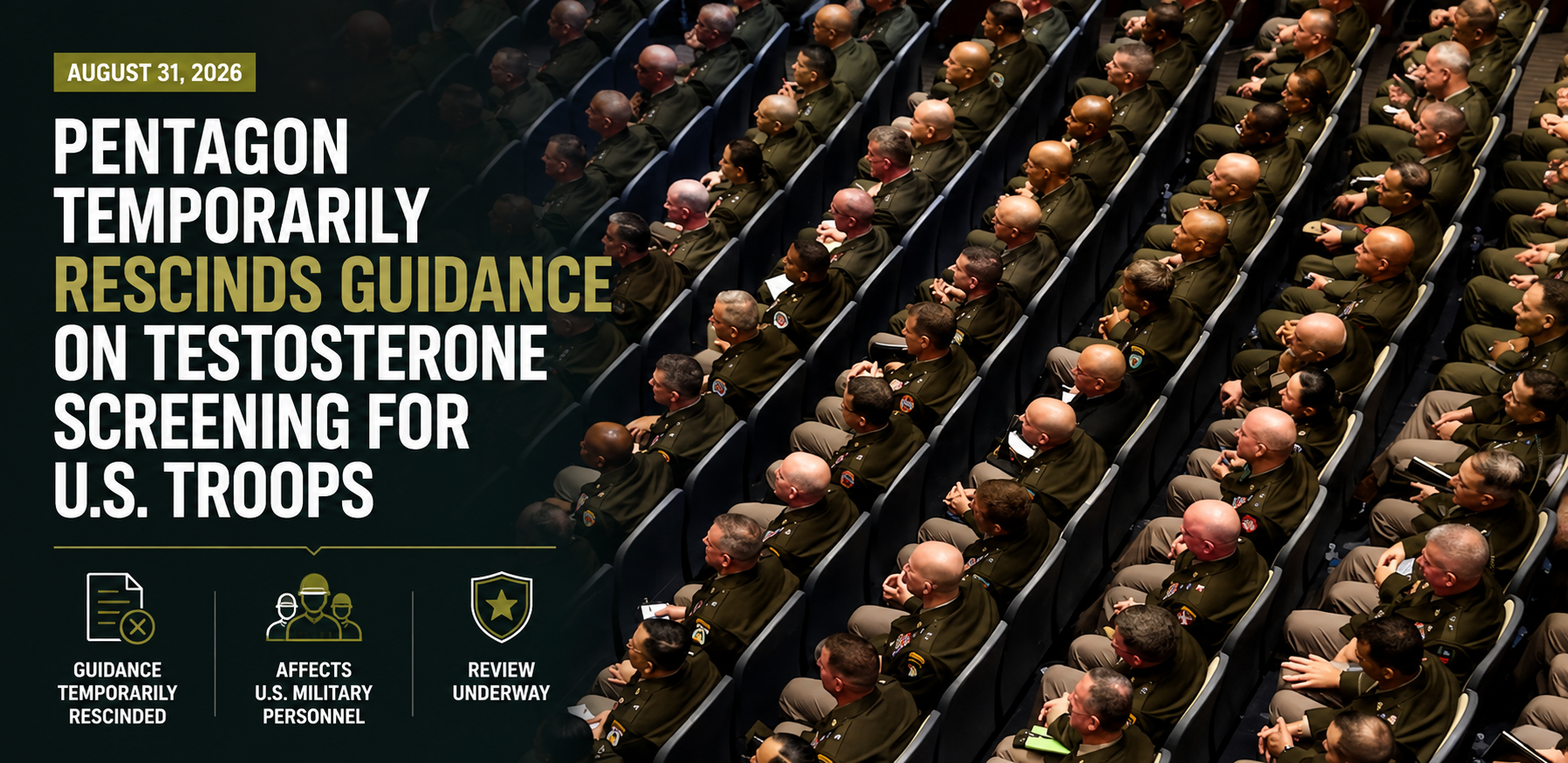
Pentagon Temporarily Rescinds Guidance on Testosterone Screening for U.S. Troops
What's Happening
The Pentagon has temporarily rescinded newly issued clinical guidance requiring testosterone-deficiency screening for U.S. service members aged 30 and older, just one day after publishing it.
A U.S. official told Reuters on September 3 that the guidance issued on September 2 was being withdrawn temporarily so it could be updated. The official said the interim guidance remains in effect while the Pentagon revises the document. (Reuters)
The withdrawn guidance would have established mandatory testosterone screening as part of annual health assessments for military personnel 30 and older. It had been presented as part of a broader effort to improve military readiness by identifying and treating hormonal and energy-availability problems. (Reuters)
The abrupt withdrawal comes after doctors and medical organizations questioned whether there was enough scientific evidence to support routine, broad testosterone screening of military personnel.
What the Original Guidance Required
Screening for service members aged 30 and older
The guidance published on September 2 created separate clinical pathways for men and women during annual military health assessments.
For men aged 30 and older, the process would begin with a questionnaire. Depending on the responses, the service member could then undergo a blood test measuring testosterone levels. If testosterone deficiency was identified, treatment, including testosterone hormone therapy when appropriate, could follow. (Reuters)
The Pentagon intended the screening to be part of routine military health assessments rather than something restricted to service members who had already reported symptoms.
Women were also included
The guidance also established a screening pathway for women.
Women would complete a questionnaire that could lead to evaluation and treatment for hormonal issues associated with Relative Energy Deficiency in Sport, or RED-S.
Testosterone therapy for women was recommended only for Hypoactive Sexual Desire Disorder, a condition involving a distressing level of low sexual interest. (Reuters)
That distinction matters because testosterone treatment is not broadly recommended for women simply because their testosterone levels are low.
The Pentagon Had Announced the Screening Mandate in July
Pete Hegseth promoted the policy
Defense Secretary Pete Hegseth announced the mandatory annual testosterone-screening policy in July.
Hegseth has publicly promoted testosterone use and presented hormonal health as relevant to military performance and readiness. The policy was intended to identify problems that could affect the health and physical performance of service members. (Reuters)
The announcement immediately generated questions among medical experts about whether universal screening was supported by sufficient evidence.
The policy moved faster than the supporting evidence
The September guidance was supposed to take effect immediately.
But within roughly a day, the detailed guidance and an accompanying statement from Pentagon spokesperson Sean Parnell had disappeared from the Pentagon and Defense Health Agency websites. (Reuters)
The Pentagon subsequently confirmed that the September 2 document had been temporarily rescinded for updates.
Doctors Question Whether Universal Screening Is Necessary
Major medical groups do not recommend routine screening
Doctors interviewed by Reuters raised concerns about the scientific justification for screening all military personnel over a certain age.
Neither the American Urological Association nor the Endocrine Society recommends routine screening for low testosterone in the general population. (Reuters)
Their approach generally focuses on evaluating people who have symptoms or clinical indications suggesting testosterone deficiency rather than testing everyone automatically.
That difference is at the heart of the controversy over the Pentagon's proposal.
The Potential Risk Is Overtreatment
Testosterone therapy can have meaningful side effects
Physicians say testosterone replacement can be appropriate for people who have genuine testosterone deficiency caused by an underlying medical condition.
But identifying low testosterone through widespread screening can also lead to treatment of people who may not actually benefit from it.
Dr. Jason Goldman, an internal medicine physician and immediate past president of the American College of Physicians, said testosterone replacement can worsen conditions such as sleep apnea, increase red blood cell counts and raise risks involving the heart and fertility. He also warned that it could worsen an undiagnosed prostate cancer. (Reuters)
That creates a central medical concern:
Finding a low laboratory value does not automatically mean testosterone treatment is appropriate.
Some Doctors Support the Screening
Potential benefits exist
Not every physician interviewed by Reuters opposed the idea.
Dr. Helen Bernie, an expert in male sexual and reproductive medicine at Indiana University, said she supports the screening program because it could identify men with significant underlying health problems. (Reuters)
She also said the withdrawn guidance contained safeguards that she viewed positively, including:
- Repeat testosterone testing
- Evaluation for reversible causes
- Treatment of underlying causes
- Fertility counseling
These safeguards are designed to prevent a single low test result from automatically leading to hormone treatment. (Reuters)
That means the medical debate is not simply about whether testosterone should ever be tested. It is about who should be tested, how results should be interpreted and when treatment is appropriate.
Combat Readiness Is at the Center of the Policy
Pentagon links hormone health to military performance
The Pentagon said the broader goal of the screening policy was to identify and manage hormonal and energy-availability issues that could affect service members.
The administration has framed testosterone and hormone health partly through the lens of military readiness.
The problem is that doctors say there is currently little evidence that universal testosterone screening itself improves combat readiness. (Reuters)
That creates a gap between the military rationale for the program and the evidence cited by medical experts.
A screening program can identify more cases of low testosterone, but that does not automatically demonstrate that it will improve performance, reduce injuries or make military personnel more effective.
The FDA Is Preparing to Examine Testosterone Use
A federal review is already scheduled
The controversy comes just before a planned FDA meeting of experts in mid-September to discuss the medical use of testosterone. (Reuters)
That meeting could become particularly relevant as the Pentagon revises its own guidance.
The FDA's review provides an opportunity for outside experts to assess how testosterone should be used medically and where the evidence supports treatment.
Why the Withdrawal Matters
The decision to rescind the guidance only a day after publication underscores how controversial the policy was.
The Pentagon was attempting to introduce a major screening requirement affecting a large population of U.S. service members. But the document raised questions about evidence, treatment risks and whether broad screening is justified.
Temporarily withdrawing the policy gives the Defense Department an opportunity to revise the guidance before making it operational.
It also suggests that the final policy may differ from the version released on September 2.
The Issue Goes Beyond the Military
Testosterone use has grown into a larger healthcare debate
Testosterone has become increasingly prominent in discussions about men's health, aging, physical performance and hormone optimization.
That has created a market in which legitimate treatment for diagnosed testosterone deficiency exists alongside a much broader consumer interest in hormone testing and testosterone therapy.
The Pentagon's proposal places that broader debate inside a particularly high-stakes environment: the U.S. military.
Unlike a consumer deciding to pursue hormone treatment, military policy affects how thousands of service members are evaluated and potentially treated through a government healthcare system.
A Screening Program Could Create Significant Healthcare Demand
More testing means more downstream care
If the Pentagon eventually implements broad screening, the policy could substantially increase the number of testosterone blood tests performed on service members.
Positive or borderline results could lead to:
- Repeat laboratory testing
- Specialist consultations
- Additional diagnostic work
- Evaluation for underlying causes
- Fertility counseling
- Hormone treatment
- Long-term monitoring
That means a seemingly straightforward screening initiative could create a much larger healthcare pathway.
The scale of that downstream activity is one reason medical evidence and appropriate clinical thresholds matter.
Women Add Another Layer of Complexity
The inclusion of women makes the policy broader than a conventional low-testosterone screening initiative.
The guidance linked women's assessment to RED-S, a condition associated with inadequate energy availability that can affect hormonal and other aspects of health.
Because service members can face demanding physical workloads, nutrition and energy balance can be relevant to military health.
However, the Pentagon's approach still needs to distinguish between conditions that require nutritional or behavioral intervention and those where hormone therapy may be clinically appropriate.
The Policy Is Still Being Developed
The Pentagon has made clear that the September 2 document was not permanently abandoned.
It was temporarily rescinded to allow updates, while interim guidance remains in effect. (Reuters)
That means the broader goal of addressing hormone health in the military may still move forward.
The important uncertainty is what the revised version will contain and whether it will continue to require universal screening for service members aged 30 and older.
Why This Matters
This episode illustrates the tension between proactive healthcare screening and evidence-based medical practice.
Screening can identify previously undiagnosed conditions and potentially allow earlier intervention. But screening large populations can also uncover abnormalities that do not necessarily require treatment, potentially exposing people to unnecessary procedures, medications and medical risks.
For the military, the stakes are even higher because the government must balance individual health, readiness, operational requirements and responsible use of military healthcare resources.
The Pentagon's rapid withdrawal suggests that the policy requires further medical and operational review before moving forward.
Looking Ahead
The Pentagon is expected to revise the September 2 guidance before issuing a new version.
The forthcoming FDA expert meeting on testosterone in mid-September could provide additional medical context for that process. (Reuters)
The key questions will be whether the revised policy continues to mandate broad screening, what clinical thresholds are used, how abnormal results are confirmed and what safeguards are put in place before treatment begins.
The debate is ultimately less about whether testosterone can be medically useful and more about when testing and treatment provide enough benefit to justify the risks and costs.
Key Takeaways
- The Pentagon has temporarily rescinded new testosterone-screening guidance issued for U.S. troops.
- The withdrawn guidance would have required annual screening for service members aged 30 and older. (Reuters)
- The Pentagon said the September 2 guidance was withdrawn so it could be updated, while interim guidance remains in effect. (Reuters)
- Men would have started with a questionnaire that could lead to blood testosterone testing and, where appropriate, treatment.
- Women would also have been screened for hormonal issues associated with Relative Energy Deficiency in Sport.
- Testosterone therapy for women was limited in the guidance to Hypoactive Sexual Desire Disorder. (Reuters)
- Doctors questioned whether universal testosterone screening would improve military combat readiness.
- The American Urological Association and Endocrine Society do not recommend routine low-testosterone screening. (Reuters)
- Physicians warned that unnecessary testosterone treatment can carry risks including worsened sleep apnea, increased red blood cell counts, heart risks and infertility. (Reuters)
- Some physicians support targeted screening because it could identify underlying health problems, particularly when appropriate safeguards are used.
- The FDA is scheduled to hold an expert meeting on the medical use of testosterone in mid-September. (Reuters)
What This Means for Healthcare Marketers
This is a useful example of how a policy announcement can create market signals before the final policy is even implemented.
A nationwide screening mandate would potentially increase demand for laboratory testing, endocrinology, men's health services, hormone therapies, monitoring and related diagnostics. Even a temporary policy can therefore affect expectations across multiple healthcare categories.
For healthcare marketers, the important signal is to distinguish between announced policy, active policy and final policy. The initial Pentagon announcement created an apparent new market opportunity, but its rapid withdrawal shows why regulatory and clinical-policy changes need to be tracked through their development rather than treated as permanent after the first announcement.