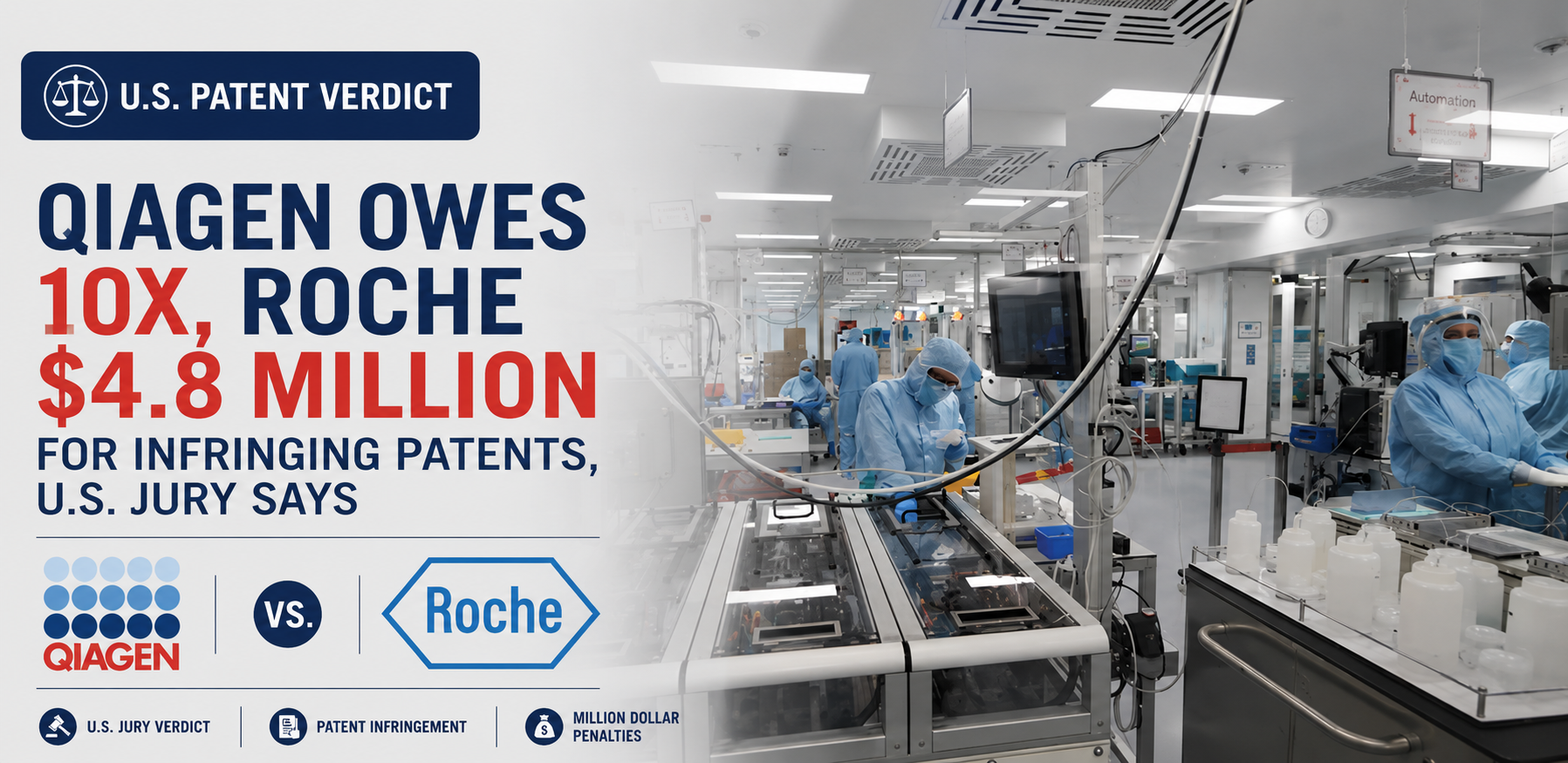
Qiagen Owes 10x, Roche $4.8 Million for Infringing Patents, U.S. Jury Says
What's Happening
A U.S. federal jury in Delaware has ruled that Parse Biosciences, a subsidiary of Qiagen, infringed patents related to genetic-sequencing technology held by Scale Biosciences, which is part of 10x Genomics, and licensed from Roche. (reuters.com)
The jury awarded more than $4.8 million in damages to 10x Genomics for the patent infringement. (reuters.com)
Our Article: Reuters article
What the Case Was About
The dispute centers on technology used for genetic sequencing and single-cell analysis.
Scale Biosciences sued Parse in 2022, alleging that Parse had infringed three patents covering technology used in cellular sequencing. The patents were exclusively licensed to Scale by Roche Sequencing Solutions. (reuters.com)
Parse denied the allegations and argued that the patents were invalid.
The jury rejected those challenges and found the three patents valid and enforceable. (reuters.com)
The Technology
The patents relate to single-cell sequencing, a technology that allows researchers to examine genetic information at the level of individual cells.
Rather than looking only at an average genetic profile across a large collection of cells, single-cell sequencing can help researchers understand how individual cells differ.
This technology is increasingly important in areas including:
- Cancer research
- Immunology
- Drug discovery
- Cell biology
- Precision medicine
- Biomedical research
The Damages
The jury awarded more than $4.8 million based on sales of Parse's Evercode Whole Transcriptome products from February 2021 through June 30, 2026.
The damages were calculated using a 14% royalty rate on the infringing sales. (uk.investing.com)
10x Genomics has indicated that it intends to pursue additional remedies following the verdict, potentially including enhanced damages, attorneys' fees and a permanent injunction preventing further infringement in the U.S. (uk.investing.com)
Why This Matters to Healthcare
Although this is primarily a biotechnology and intellectual-property case, the underlying technology has important implications for healthcare research.
Genetic sequencing technologies are increasingly used to understand disease at a molecular level.
Single-cell technologies can help researchers identify differences between individual cells within tumors, immune systems and other biological tissues.
That can contribute to the development of more targeted diagnostics and therapies.
Impact on Biotechnology
- Genetic Sequencing: The verdict highlights the competitive importance of proprietary sequencing technologies.
- Research Tools: Companies developing tools for single-cell and spatial biology increasingly compete on highly specialized technologies and intellectual property.
- Drug Development: More detailed genetic information can help pharmaceutical researchers identify potential drug targets and understand how treatments affect different cell populations.
- Precision Medicine: Single-cell analysis is part of the broader technology infrastructure supporting more individualized approaches to disease diagnosis and treatment.
Companies Involved
10x Genomics acquired Scale Biosciences in 2025. Scale develops instruments, consumables and software for single-cell and spatial biology research. (uk.investing.com)
Qiagen acquired Parse Biosciences in December 2025.
Roche Sequencing Solutions was the original licensor of the patents involved in the dispute. (reuters.com)
Why This Matters
This is a U.S. healthcare industry story because it involves a federal patent dispute over technology used in advanced genetic sequencing and biomedical research.
The case illustrates how intellectual property can become strategically important as genomics, single-cell biology and precision medicine become increasingly important parts of healthcare innovation.
Looking Ahead
The $4.8 million verdict may not be the final financial outcome.
10x Genomics plans to pursue additional remedies related to the jury's finding of infringement, including potentially enhanced damages and an injunction. (uk.investing.com)
The case could also influence how companies developing next-generation sequencing technologies approach licensing, patent protection and product development.
Key Takeaways
- A U.S. federal jury found Qiagen's Parse Biosciences liable for patent infringement.
- The patents relate to genetic-sequencing technology.
- The patents were exclusively licensed to Scale Biosciences by Roche.
- The jury awarded more than $4.8 million in damages. (reuters.com)
- The disputed products were Parse's Evercode Whole Transcriptome products.
- The jury found all three patents valid and enforceable.
- 10x Genomics may seek additional damages, legal fees and a permanent injunction. (uk.investing.com)
What This Means for Healthcare Marketers
The development is relevant to genomics, molecular diagnostics, precision medicine, biotechnology, laboratory research and life-sciences technology. As sequencing becomes increasingly central to drug discovery and personalized medicine, proprietary genomic technologies and the companies controlling them become increasingly important parts of the healthcare ecosystem.