
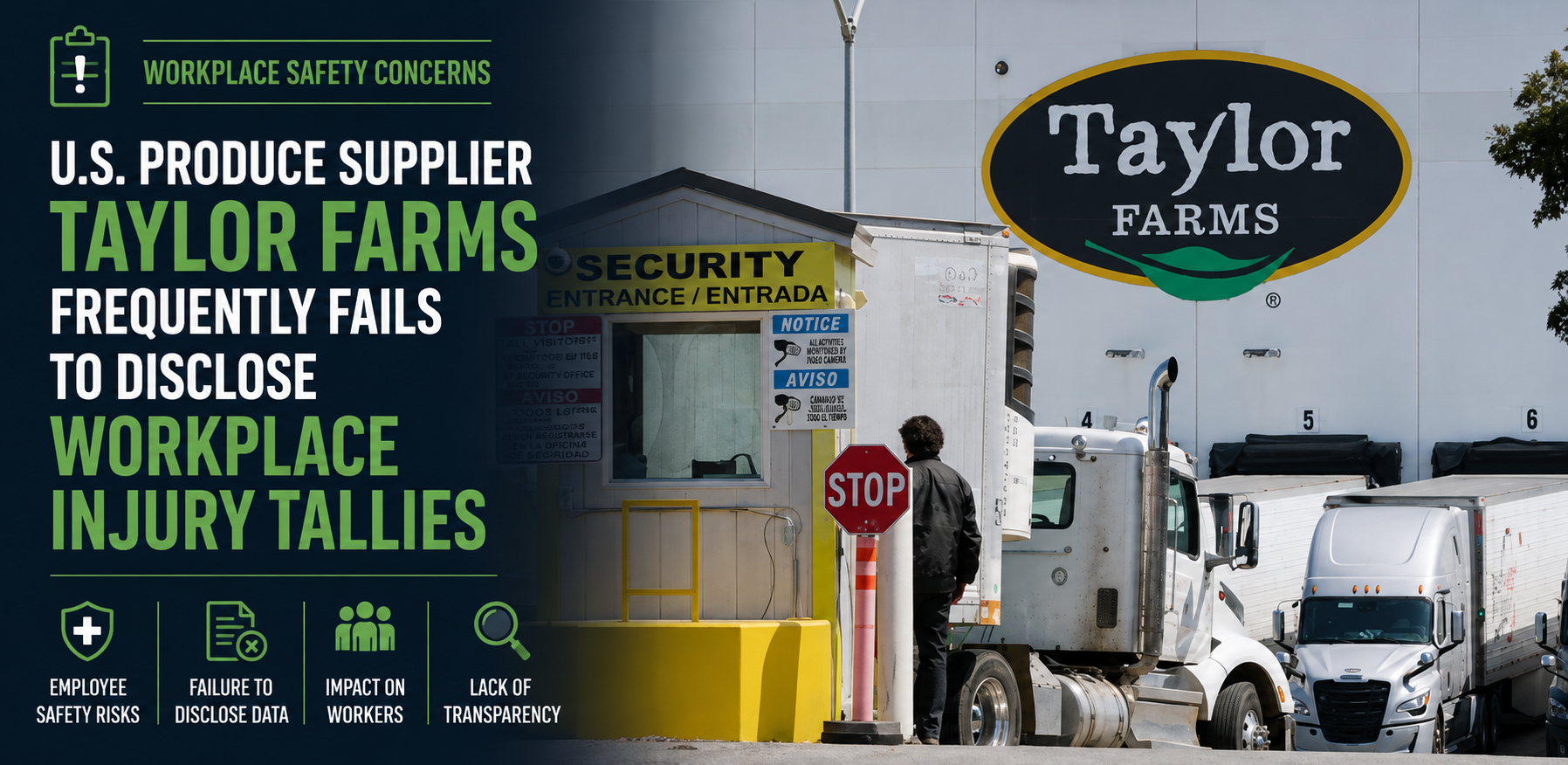
U.S. Produce Supplier Taylor Farms Frequently Fails to Disclose Workplace Injury Tallies
What's Happening
Taylor Farms, the California-based produce company at the center of a major U.S. cyclospora outbreak, frequently failed to submit federally required workplace injury reports at its facilities, according to a Reuters review of federal records.
Over the past five years, only five to seven Taylor Farms facilities filed their required annual injury reports within the following year, while at least 17 facilities were required to submit them based on their size and the nature of their work. (Reuters)
Our Article: Reuters article
Why This Matters
Taylor Farms is already facing scrutiny because U.S. authorities have linked its lettuce from Mexico to a cyclospora outbreak that has sickened thousands of people and killed two. (Reuters)
The newly reported workplace-safety gaps add another layer of concern around the company, this time involving the safety and reporting of injuries among its employees.
What Reuters Found
Taylor Farms operates 30 facilities and employs about 25,000 people across its operations.
Reuters found that:
- At least 17 facilities were required to file annual injury reports.
- Only five to seven facilities filed the required reports within the following year over the past five years.
- Some facilities recorded injury rates above industry averages.
- Other facilities reported below-average rates.
- The overall reporting rate was well below the 78% industry average calculated by Reuters using available OSHA and Census data. (Reuters)
Taylor Farms acknowledged gaps in its electronic submissions and said they have been addressed.
The company also said it has invested in new workplace-safety reporting software. (Reuters)
OSHA Violations
The reporting problems come alongside a history of workplace-safety citations.
Since 2021, OSHA and state safety regulators have issued nearly $1.8 million in citations against Taylor Farms involving issues such as:
- Machine hazards.
- Amputations.
- Employee training failures.
- Other workplace-safety violations. (Reuters)
OSHA can impose penalties of up to $16,550 for each reporting violation.
Serious Workplace Incidents
Reuters identified several serious incidents at Taylor Farms facilities.
At a processing facility in Swedesboro, New Jersey, a worker died in 2025 from injuries sustained while cleaning equipment that uses hot water to process produce. OSHA later proposed more than $1 million in fines, citing what the Labor Department described as willful and repeated violations. (Reuters)
At another facility in North Kingstown, Rhode Island, 13 workers were hospitalized after an ammonia leak in November.
OSHA proposed approximately $23,000 in citations in connection with that incident, which Taylor Farms has disputed. (Reuters)
Connection to the Cyclospora Outbreak
The workplace-safety findings come as Taylor Farms remains under scrutiny over the U.S. cyclospora outbreak.
U.S. authorities have linked the outbreak to Taylor Farms lettuce imported from Mexico.
Cyclospora is a parasite that can cause gastrointestinal illness, including prolonged diarrhea and other digestive symptoms.
The outbreak has affected thousands of people across the United States, making Taylor Farms a significant focus of public-health attention. (Reuters)
Why This Matters to U.S. Public Health
This story connects food safety, workplace safety and public health.
Taylor Farms is one of North America's largest salad producers, meaning problems involving its operations can potentially have consequences beyond individual employees and extend to the broader food supply.
The company's ongoing scrutiny therefore involves two separate public-health dimensions:
- Food safety: The cyclospora outbreak and contaminated produce.
- Worker safety: Injury reporting, machinery hazards and workplace conditions.
Industry Impact
- Food Manufacturers: The story highlights the importance of accurate workplace-injury reporting and compliance with federal safety requirements.
- Food Safety: Large-scale food producers can have significant public-health consequences when contamination occurs, making regulatory oversight particularly important.
- Employers: Incomplete injury reporting can make it harder for regulators and the public to identify recurring workplace hazards.
- Regulators: OSHA relies on injury reports to identify patterns and prioritize enforcement activities. (Reuters)
Looking Ahead
Taylor Farms told Reuters that the gaps in its electronic injury-log submissions have been addressed and that employee safety remains a core operational priority.
However, Reuters' findings raise questions about the company's historical compliance and whether regulators had sufficient information to identify workplace hazards at its facilities. (Reuters)
The company has also disputed more than half of its OSHA citations since 2016, compared with slightly less than a quarter for the food-manufacturing sector overall, according to Reuters' review. (Reuters)
Why This Matters
This qualifies as a U.S. health/public-health story because it involves both a major foodborne illness outbreak affecting U.S. consumers and workplace health and safety at a large U.S. food supplier.
The story also shows how food-safety failures and occupational-health reporting gaps can intersect, creating risks for both consumers and workers.
Key Takeaways
- Taylor Farms frequently failed to submit required workplace-injury reports. (Reuters)
- At least 17 facilities were required to file reports, but only five to seven filed within the following year over the past five years.
- Regulators have issued nearly $1.8 million in workplace-safety citations against Taylor Farms since 2021.
- Serious incidents have included a worker death and an ammonia leak that hospitalized 13 workers.
- Taylor Farms says it has addressed its reporting gaps and invested in new safety-reporting software. (Reuters)
- The company is also at the center of a U.S. cyclospora outbreak linked by authorities to its lettuce from Mexico.
What This Means for Healthcare Marketers
The story is relevant to public health, food safety, occupational health, infectious-disease surveillance and population health. It also demonstrates the importance of timely data and reporting in identifying health and safety risks before they become larger public-health problems.