
Texas Appeals Court Dismisses State's Abortion Case Against Midwife, Citing Legal Deficiencies
What's Happening
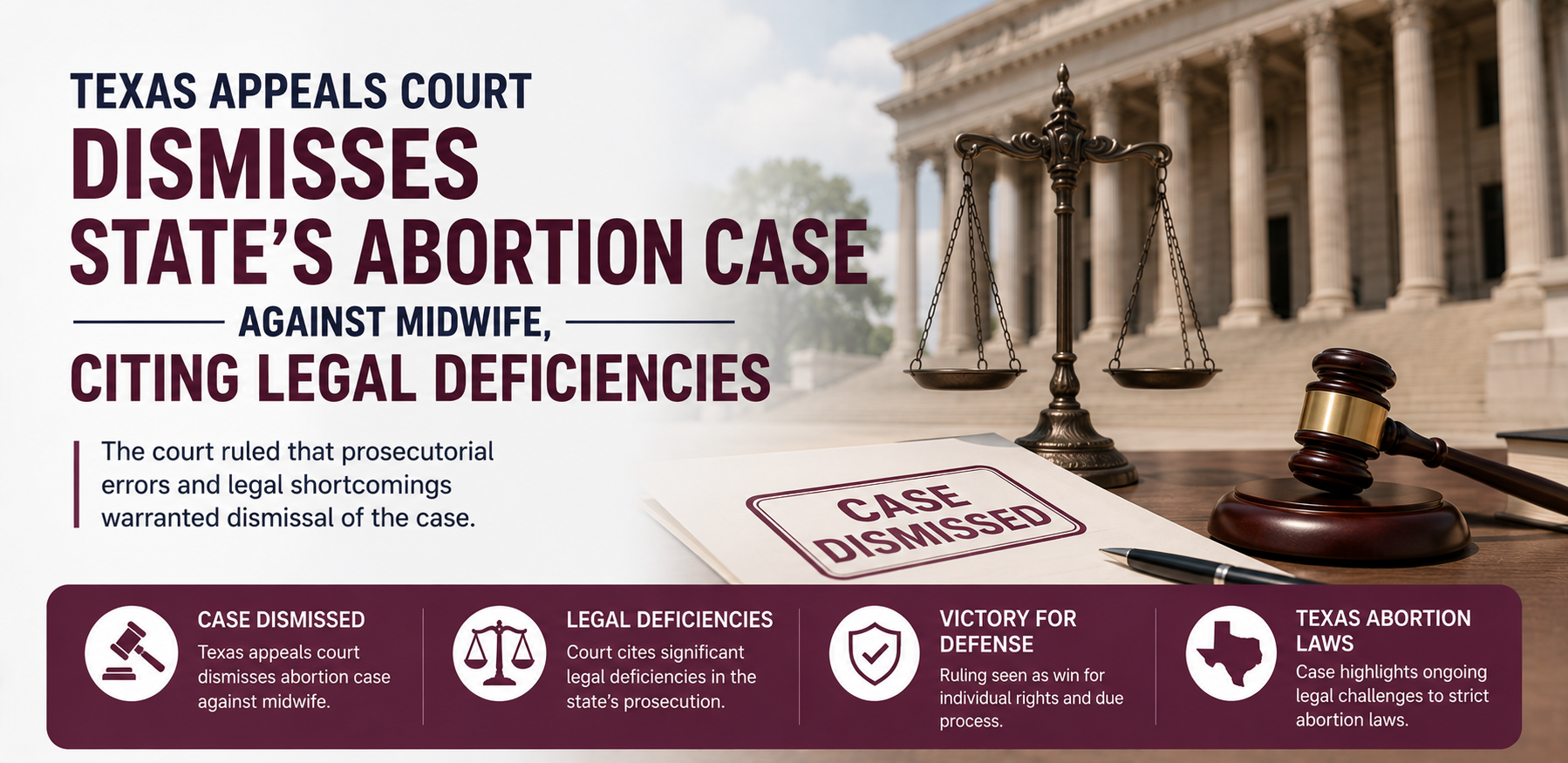
A Texas appeals court has dismissed the state's lawsuit against a Houston-area midwife accused of violating Texas' near-total abortion ban, ruling that the case could not proceed because of legal deficiencies in how it was brought.
The lawsuit, filed by the Texas Attorney General's Office, alleged that the midwife unlawfully provided abortion services in violation of one of the nation's strictest abortion laws. However, the appeals court concluded that the state lacked the legal basis necessary to pursue the civil action in its current form, effectively halting the case.
While the ruling does not overturn Texas' abortion restrictions, it highlights the complex legal questions surrounding how those laws are enforced and who has the authority to bring certain types of legal actions.
The decision is likely to influence future litigation involving abortion providers and could shape how state officials pursue enforcement under Texas' evolving reproductive healthcare laws.
Background: Texas' Abortion Law
Texas has one of the most restrictive abortion frameworks in the United States.
Following the U.S. Supreme Court's 2022 decision overturning Roe v. Wade, Texas implemented a near-total abortion ban that prohibits nearly all abortions except in limited circumstances where the life of the pregnant patient is at risk.
The law carries severe civil and criminal penalties for individuals found to have violated its provisions, including healthcare professionals involved in providing prohibited abortion services.
Since the law took effect, numerous legal disputes have emerged over:
- Medical emergency exceptions.
- Physician responsibilities.
- Patient access to reproductive care.
- Enforcement authority.
- Civil versus criminal liability.
This latest case adds another chapter to the ongoing legal interpretation of Texas' abortion laws.
Why the Court Dismissed the Case
The appeals court's decision was based on procedural and legal issues rather than the broader constitutionality of Texas' abortion ban.
The judges determined that the state's lawsuit, as filed, lacked the necessary legal foundation to proceed.
Importantly, the ruling does not declare Texas' abortion law invalid, nor does it establish new abortion rights.
Instead, it focuses on whether the Attorney General's Office had the appropriate legal authority and procedural basis to bring this specific civil enforcement action.
Because the case was dismissed on procedural grounds, the decision leaves open the possibility that future cases could be brought under different legal circumstances.
Why This Matters for Healthcare Providers
The ruling underscores the legal uncertainty many healthcare professionals continue to face in states with restrictive abortion laws.
Physicians, midwives, hospitals, and reproductive healthcare providers must navigate rapidly evolving legal requirements while balancing patient care obligations.
Healthcare organizations are increasingly investing in:
- Legal compliance programs.
- Clinical guidance for reproductive emergencies.
- Risk management protocols.
- Documentation standards.
- Provider education on state-specific regulations.
Even when cases do not result in liability, litigation itself can create operational, financial, and workforce challenges for healthcare organizations.
Broader Industry Impact
- Healthcare Providers: Providers practicing obstetrics, gynecology, emergency medicine, and maternal-fetal medicine continue operating in an environment of legal uncertainty. Court decisions affecting enforcement can influence clinical decision-making, staffing, and access to reproductive healthcare services.
- Hospitals and Health Systems: Health systems may continue updating internal policies and legal review processes to ensure compliance with state abortion laws while protecting clinicians responding to medical emergencies.
- State Governments: The ruling illustrates that enforcement of abortion laws depends not only on legislation but also on procedural legal standards. Future lawsuits may require different legal strategies or legislative clarification.
- Patients: Ongoing litigation contributes to uncertainty around reproductive healthcare access. Patients may experience differences in available services depending on where they live, how providers interpret the law, and how future court decisions shape enforcement.
The Bigger Picture
Since the reversal of Roe v. Wade, abortion policy has increasingly shifted from federal constitutional law to state legislatures and courts.
As a result, healthcare organizations across the country are adapting to a patchwork of state laws that differ significantly in terms of access, enforcement mechanisms, reporting requirements, and legal protections.
Courts are now playing a central role in defining how these laws are interpreted and implemented.
Rather than resolving the broader abortion debate, many recent decisions have focused on narrower questions involving statutory interpretation, enforcement authority, and procedural requirements.
This trend is expected to continue as additional lawsuits move through state and federal courts.
Why This Matters
The Texas ruling demonstrates that healthcare policy is shaped not only by legislation but also by how courts interpret and enforce those laws.
For healthcare organizations, legal developments can have immediate operational consequences, affecting compliance strategies, clinical protocols, workforce planning, and patient access to care.
Even when court decisions address procedural issues rather than constitutional questions, they can establish important precedents for future healthcare litigation.
As reproductive healthcare remains one of the most closely watched policy areas in the United States, providers and health systems will continue monitoring court decisions that influence both legal risk and patient care.
Key Takeaways
- A Texas appeals court dismissed the state's lawsuit against a midwife accused of violating the state's abortion ban because of legal deficiencies in the case.
- The ruling does not invalidate Texas' abortion law or expand abortion access.
- The decision focuses on procedural legal authority rather than the underlying legality of abortion restrictions.
- Healthcare providers continue operating within a rapidly evolving legal and regulatory environment surrounding reproductive healthcare.
- Future court decisions will likely continue shaping how state abortion laws are enforced.
What This Means for Healthcare Marketers
Legal and regulatory developments increasingly influence healthcare operations, particularly in areas such as reproductive health, maternal care, and hospital compliance. Organizations serving women's health providers, hospitals, legal compliance teams, and healthcare technology companies should closely monitor changes in state enforcement policies, as they can affect clinical workflows, documentation requirements, and operational priorities. For healthcare marketers, understanding the legal environment surrounding reproductive healthcare can help identify organizations investing in compliance solutions, provider education, and clinical decision support as regulations continue to evolve.