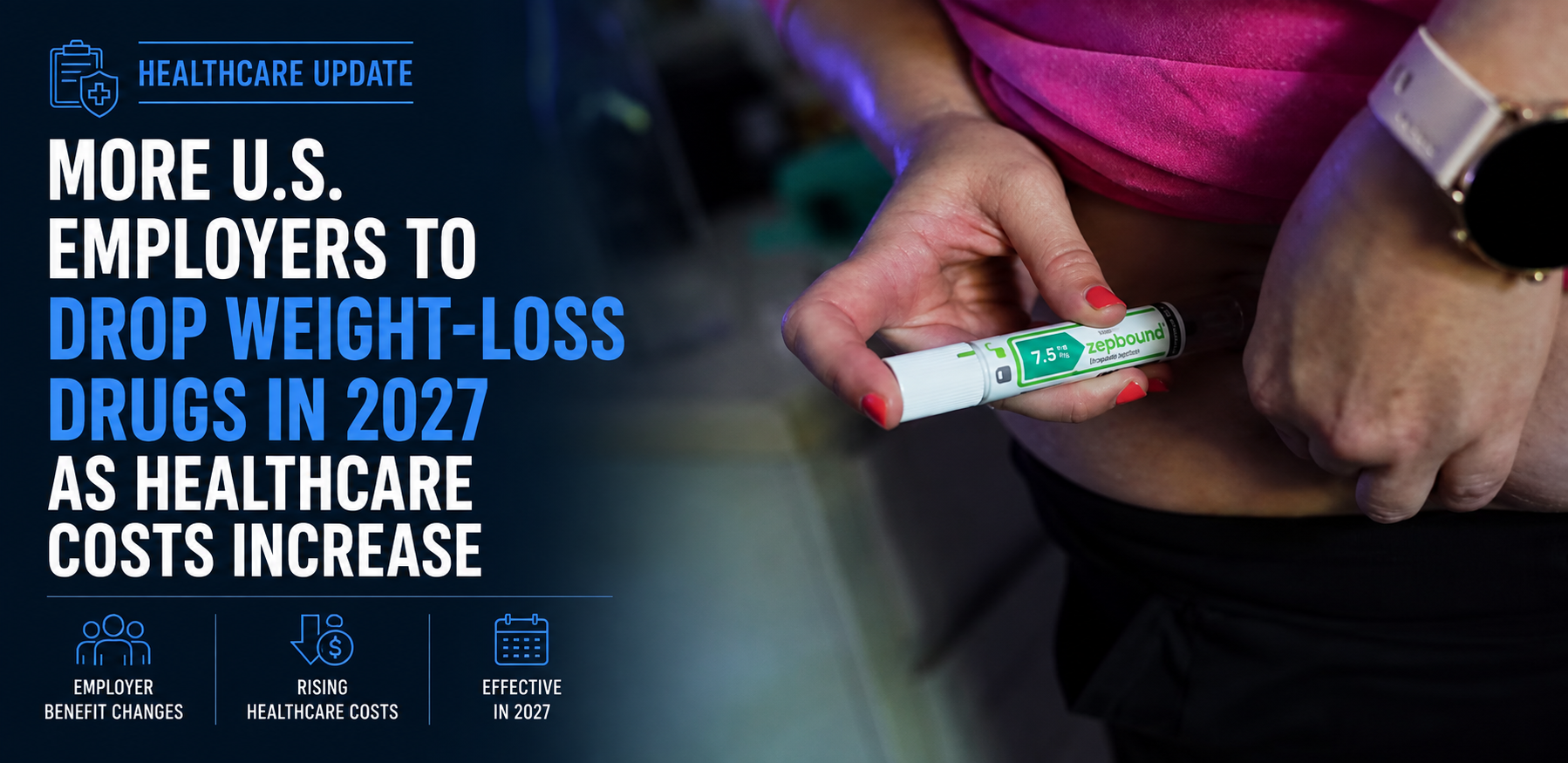
More U.S. Employers to Drop Weight-Loss Drugs in 2027 as Healthcare Costs Increase
What's Happening
A growing number of U.S. employers are planning to drop coverage for GLP-1 weight-loss drugs in 2027 as healthcare costs continue to rise.
About 14% of employers surveyed by the Business Group on Health said they have already dropped or plan to drop coverage for GLP-1 drugs for weight loss in 2027. At the same time, the share of employers covering these drugs has already fallen from 72% in 2025 to 60% in 2026. (Reuters)
The shift comes as employers expect overall healthcare costs to increase 9.2% in 2027, up from 8.5% in 2026. (Reuters)
Why Employers Are Pulling Back
GLP-1 drugs such as Wegovy, Zepbound and Foundayo have become increasingly popular for weight management, but they are expensive.
Reuters reports that:
- Wegovy has a list price of up to $1,349.02 per month.
- Zepbound costs $499 per month at its listed price.
- About two-thirds of employers surveyed have seen increased utilization of GLP-1 drugs. (Reuters)
Employers are increasingly questioning whether the drugs are producing enough downstream savings to offset their cost.
Most companies covering GLP-1s for weight loss are not yet seeing reductions in the cost of treating obesity-related conditions, including diabetes and sleep apnea. (Reuters)
Healthcare Costs Continue to Rise
The GLP-1 debate is happening against a much larger increase in employer healthcare spending.
Business Group on Health expects healthcare costs to rise 9.2% in 2027 if employers do not take additional steps to manage spending.
Several factors are contributing to the increase:
- Higher hospital costs.
- Rising pharmacy spending.
- Greater healthcare utilization.
- More complex treatments.
- Policy changes.
- Increasing specialty-drug costs. (Reuters)
Pharmacy spending already represents approximately 25% of employer healthcare spending and is expected to increase 12% in 2027. (Reuters)
Cancer Remains the Biggest Cost Driver
GLP-1 drugs are receiving significant attention, but employers identify cancer as the biggest driver of healthcare costs.
Around 70% of employers surveyed identified cancer as one of their most significant healthcare cost drivers, up from 58% in 2025.
Musculoskeletal and cardiovascular conditions followed.
These conditions increasingly require complex and expensive therapies, adding to employers' overall healthcare burden. (Reuters)
Employers Are Looking for Alternatives
As costs increase, employers are exploring multiple strategies to control spending.
These include:
- Encouraging the use of lower-cost biosimilars.
- Reconsidering coverage for complex and specialty drugs.
- Exploring alternative pharmacy arrangements.
- Reassessing which treatments provide measurable value.
- Looking for approaches that improve health outcomes while controlling long-term costs. (Reuters)
The Business Group on Health is calling for employers to take a more innovative approach to healthcare benefits rather than simply absorbing continued cost increases.
What This Means for GLP-1s
The development does not mean GLP-1 coverage is disappearing from U.S. employer health plans.
Rather, employers are becoming more selective about when and how they cover these medications.
The decline from 72% of employers covering GLP-1s in 2025 to 60% in 2026 suggests that employers are increasingly evaluating the drugs through a cost-management lens. (Reuters)
The key question is whether long-term reductions in obesity-related conditions and other health costs will eventually justify the significant upfront spending on the medications.
Industry Impact
- Employers: Employers face a difficult balance between offering popular weight-management benefits and controlling rapidly increasing healthcare expenses.
- Pharmaceutical Companies: Manufacturers of GLP-1 drugs could face greater pressure from employers and benefit managers to demonstrate long-term economic value.
- Health Insurers: Insurers and benefits managers may increasingly introduce utilization-management strategies, eligibility requirements or alternative coverage models.
- Healthcare Providers: Physicians could encounter more variation in coverage policies as employers adopt different approaches to GLP-1 prescribing and reimbursement.
- Pharmacy Benefits: Pharmacy-benefit strategies will become increasingly important as employers attempt to manage specialty-drug spending.
Looking Ahead
The future of employer-sponsored GLP-1 coverage will likely depend on whether these drugs can demonstrate measurable long-term reductions in healthcare costs.
For now, employers are facing a situation where utilization is increasing while the financial benefits of treating obesity-related conditions have not yet become clear enough to offset the cost of the medications. (Reuters)
Why This Matters
This is a major U.S. healthcare industry story because it affects the intersection of GLP-1 drugs, employer-sponsored insurance, pharmacy spending, obesity treatment and healthcare cost management.
The shift also signals that the next phase of the GLP-1 market may be less about adoption alone and increasingly about proving economic and clinical value.
Key Takeaways
- 14% of U.S. employers surveyed have already dropped or plan to drop GLP-1 coverage for weight loss in 2027.
- Employer coverage of GLP-1 weight-loss drugs fell from 72% in 2025 to 60% in 2026. (Reuters)
- U.S. employer healthcare costs are expected to rise 9.2% in 2027.
- Pharmacy costs are expected to increase 12% and already account for about 25% of employer healthcare spending.
- Employers say they are not yet seeing sufficient reductions in obesity-related healthcare costs to offset GLP-1 spending.
- Cancer is currently the leading healthcare cost driver for employers. (Reuters)
What This Means for Healthcare Marketers
The story creates opportunities around employer health benefits, population health, obesity management, pharmacy-benefit strategies, specialty-drug cost management and healthcare navigation. As employers become more selective about expensive therapies, vendors will increasingly need to demonstrate not just patient outcomes but measurable impact on healthcare utilization and total cost of care.