
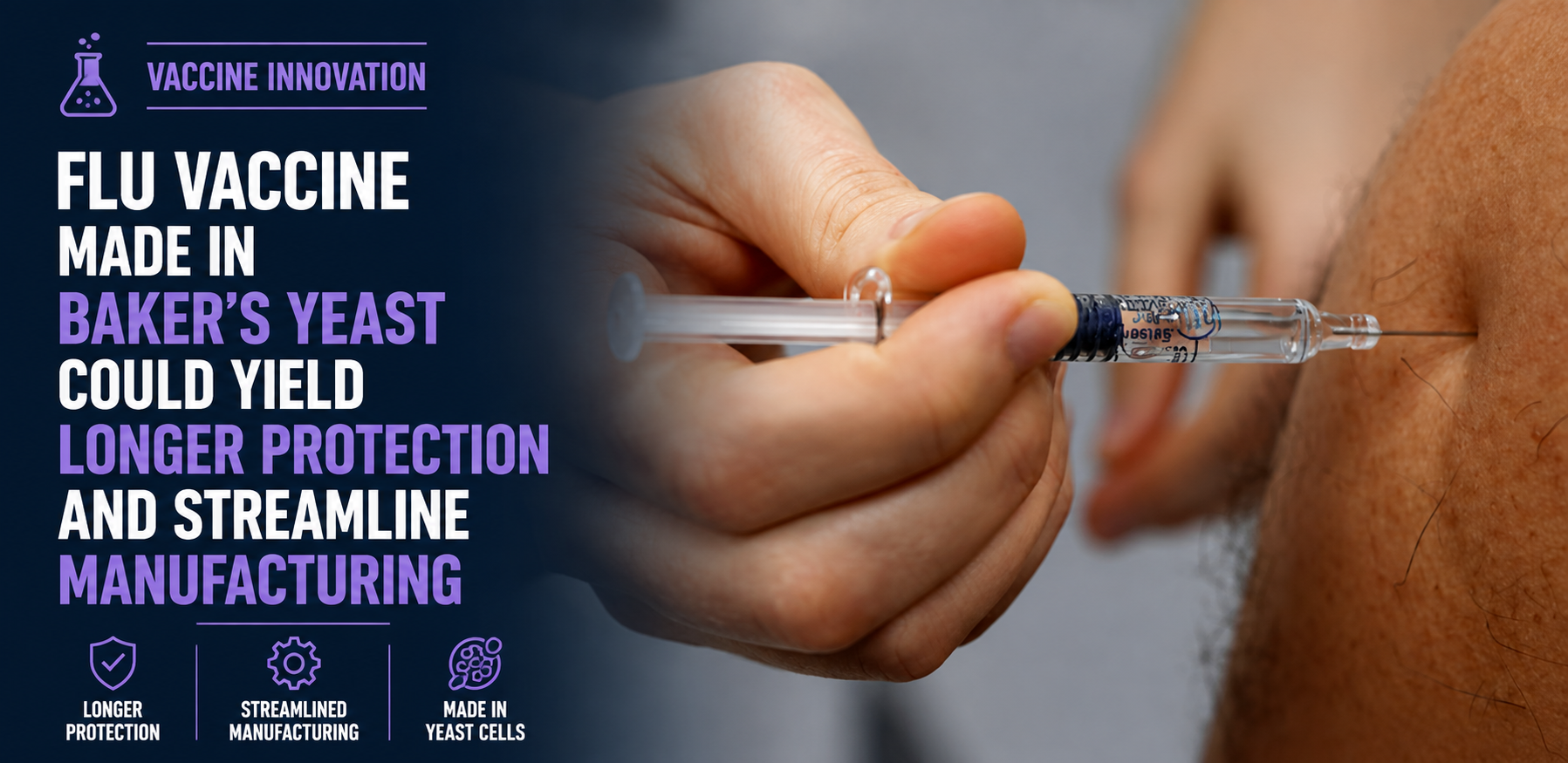
Flu Vaccine Made in Baker's Yeast Could Yield Longer Protection and Streamline Manufacturing
What's Happening
Researchers have developed a new approach to making influenza vaccines using baker's yeast instead of the chicken-egg manufacturing process that has been used for roughly 80 years.
The experimental vaccine targets a part of the flu virus called M2, which changes much less frequently than the viral protein targeted by most existing flu vaccines. That could potentially produce broader, longer-lasting protection against multiple influenza strains. (reuters.com)
Our Article: Reuters article
How the New Vaccine Works
Most seasonal flu vaccines target hemagglutinin (HA), a surface protein on influenza viruses.
The problem is that HA changes relatively quickly. Because of this, scientists have to update the composition of seasonal vaccines as circulating flu strains evolve.
The new approach instead targets M2, a protein that is much more conserved across influenza strains. Researchers say it has changed very little since the 1918 influenza pandemic. (reuters.com)
The researchers created virus-like particles displaying the M2 protein using Saccharomyces cerevisiae, the same species of yeast used in baking and brewing.
The particles do not contain the genetic material needed to cause infection. (reuters.com)
Early Results
In experiments involving mice, the purified M2 virus-like particles protected the animals against infection from three different influenza strains.
The researchers believe targeting a conserved protein could potentially provide protection that lasts longer than a single flu season.
However, the research remains at an early stage. The vaccine has not yet entered human clinical trials. (reuters.com)
Potential Advantages
- Longer Protection: Because M2 changes much less frequently than HA, researchers hope an M2-based vaccine could provide protection for substantially longer than current seasonal vaccines. The researchers even suggested that future versions might potentially require vaccination less frequently, although a once-in-a-lifetime vaccine remains speculative at this stage. (reuters.com)
- Faster Manufacturing: The yeast-based approach could potentially avoid the lengthy process of growing influenza viruses in chicken eggs. That could make vaccine production faster and easier to scale.
- Lower Production Costs: Researchers also believe the approach could eventually be less expensive than current manufacturing methods. (reuters.com)
Why This Matters to U.S. Public Health
Influenza causes substantial illness every year in the United States, and the need to produce updated seasonal vaccines creates a recurring manufacturing and distribution challenge.
A vaccine that provides broader protection against multiple strains could potentially reduce dependence on yearly strain-matching and annual vaccination campaigns.
A faster manufacturing platform could also be particularly valuable when influenza strains change unexpectedly or when vaccine supply needs to be scaled quickly.
But It Is Still Experimental
The promising results should not be confused with evidence that a new long-lasting flu vaccine is ready for the public.
So far:
- The research has been conducted in mice.
- Human trials have not yet begun.
- Researchers still need to establish safety and effectiveness in people.
- It is not yet known how long protection would actually last in humans. (reuters.com)
The researchers themselves said additional work is needed before the vaccine can enter human testing.
Industry Impact
- Vaccine Manufacturers: A successful yeast-based platform could eventually provide an alternative to traditional egg-based influenza vaccine manufacturing.
- Public Health: Longer-lasting and broader protection could potentially simplify annual influenza vaccination programs.
- Healthcare Providers: If future human trials confirm the approach, providers could eventually have fewer seasonal vaccination decisions and potentially longer intervals between vaccinations.
- Biotechnology: The same yeast-based manufacturing concept could potentially be adapted to other vaccines. The research team has already licensed the technology to a company developing yeast systems for oral vaccines. (reuters.com)
Looking Ahead
The immediate next step is human clinical testing.
If the vaccine proves safe and effective in people, researchers would then need to determine how long protection lasts and how well it performs against different influenza strains.
For now, the research represents a promising potential alternative to both the egg-based manufacturing process and the strain-specific approach used by most current flu vaccines. (reuters.com)
Why This Matters
This is a U.S. public-health and healthcare industry story because it involves a potential next-generation influenza vaccine and a fundamentally different way of manufacturing it.
The combination of broader protection, potentially longer immunity and simpler manufacturing could eventually address some of the biggest limitations of today's seasonal flu vaccination system.
Key Takeaways
- Researchers developed an experimental flu vaccine using baker's yeast rather than chicken eggs.
- It targets M2, a relatively stable influenza protein, instead of rapidly changing hemagglutinin.
- The vaccine protected mice against three influenza strains. (reuters.com)
- Researchers believe it could potentially provide broader and longer-lasting protection.
- Yeast production could potentially be cheaper and easier to scale than egg-based manufacturing.
- The vaccine has not yet entered human trials.
- The technology has been licensed to a company developing yeast-based oral vaccine systems. (reuters.com)
What This Means for Healthcare Marketers
The development is relevant to vaccines, infectious-disease prevention, public health, biotechnology, vaccine manufacturing and population health. If the technology eventually succeeds in humans, it could reshape how influenza vaccines are developed, manufactured and marketed, particularly around the value proposition of longer-lasting protection.